Free shipping for order over $50

Free shipping for order over $50
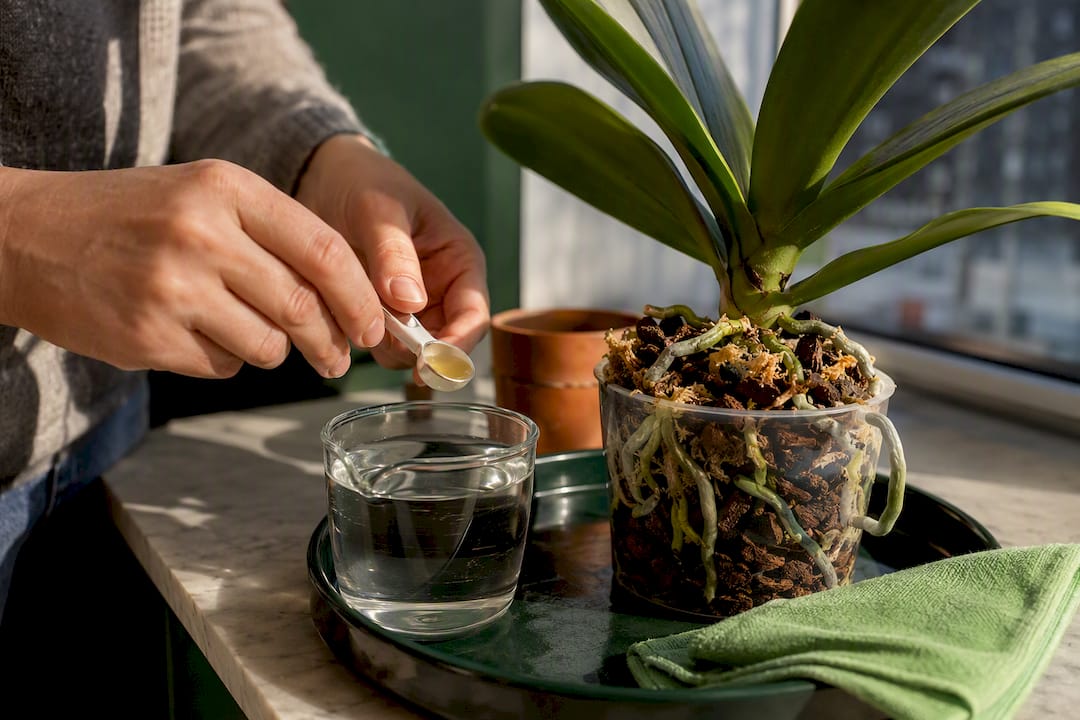
Feed your orchids three times with a quarter-strength liquid fertilizer, then flush with plain water on the fourth watering. That “weekly, weakly” 3+1 rhythm covers most Phalaenopsis, Cattleya, and Dendrobium growing on bark or moss. The one rule that trips people up most: never fertilize dry media, and never skip the monthly flush, or salt buildup will cook the roots before the plant ever shows a flower.
TL;DR:
- Fertilize orchids weekly at quarter strength during active growth, and flush with plain water on the fourth watering to prevent salt buildup.
- Adjust fertilizing frequency based on watering habits, using half strength for biweekly growers and monthly for slow or mounted setups.
- Use higher nitrogen formulas for bark-grown orchids and more balanced formulas for moss or mounted plants, with bloom formulas only temporarily supporting flowering.
- Water orchids thoroughly before applying fertilizer to avoid root burn, and always flush monthly to remove accumulated salts.
- Water quality impacts fertilization; low TDS water requires calcium and magnesium supplements, while hard water may necessitate more frequent flushing.
The 3+1 pattern comes straight from the American Orchid Society, and it’s the closest thing the hobby has to a default setting. Fertilize at watering one, two, and three using a quarter-strength solution (roughly 1/4 teaspoon of a balanced water-soluble fertilizer per gallon), then water four is plain water only, no exceptions. That fourth watering exists purely to rinse mineral salts out of the bark or moss before they accumulate.
Not everyone waters weekly, though, and the schedule has to bend to match your habits, not the other way around.
During slow growth or cooler months, drop back a tier: weekly feeders move to every-other-week, and every-other-week feeders move to monthly. Fertilizer only matters when the plant is actively pulling water and building tissue. Feeding a stalled plant just piles up salt with nowhere to go.
Fertilizer needs to track the plant’s biology, not the calendar taped to your wall. Active growth (new leaves, new roots, spring through summer for most collections) is when a plant can actually use nitrogen and potassium. Dormancy (late fall into winter for most temperate-grown orchids) is when it can’t, and feeding through it does nothing but stress the roots.
Different genera also carry different appetites:
For a mixed windowsill of several genera, the safest default is to fertilize on the lighter, more conservative end and let individual plants signal when they want more; also consider practical advice from urban-gardening tips to adapt small-space fertilizing schedules effectively. Always pause feeding the moment media is bone dry or a plant is holding an open bloom.
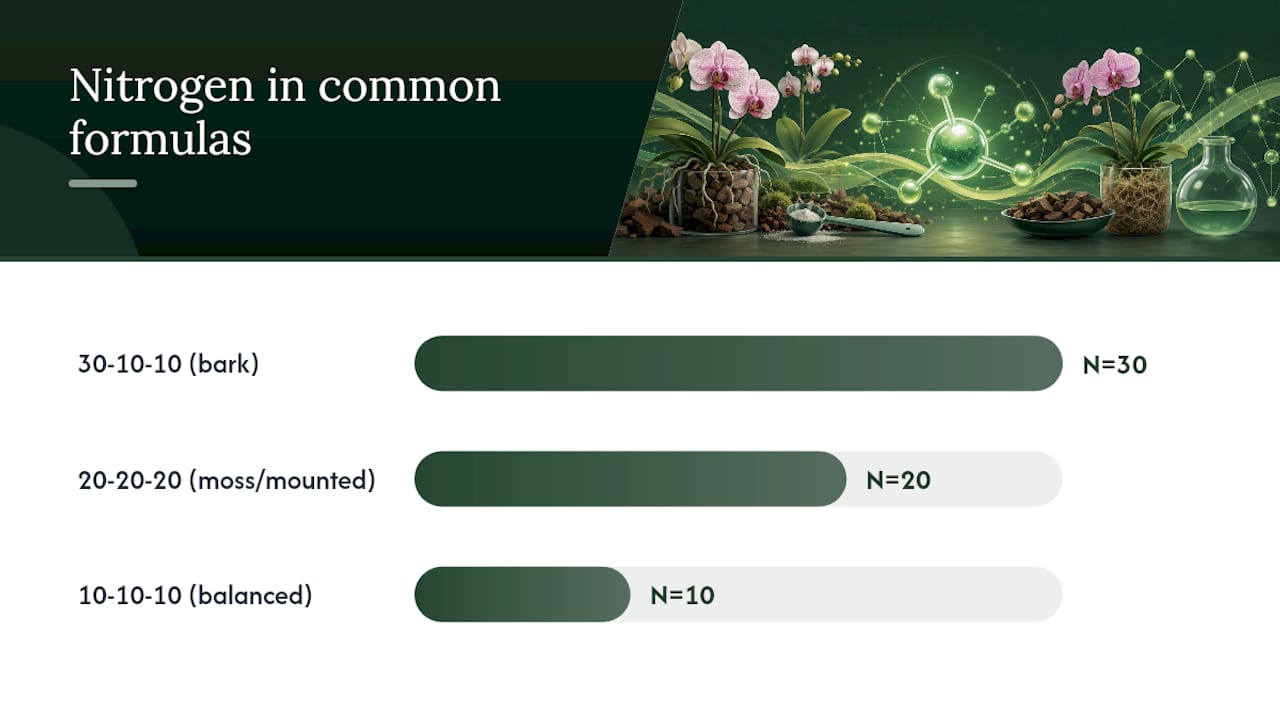
The right formula depends more on your growing medium than on any universal “best” fertilizer. Bark ties up nitrogen as it decomposes, so bark-grown orchids typically need a higher-nitrogen formula, something like 30-10-10, to compensate. Moss and mounted plants don’t fight that same nitrogen drain, so a balanced formula like 20-20-20 or 10-10-10 tends to serve them better, according to AOS guidance on fertilizer selection.
For most home collections, a complete, water-soluble, urea-free fertilizer is the simplest starting point. Urea-free matters because orchid roots and the fungi that help process nutrients in bark break down urea poorly, so a formula using nitrate and ammoniacal nitrogen sources feeds more reliably.
Pro Tip: If you’re using reverse osmosis or distilled water full time, add a supplement with calcium and magnesium, since a standard fertilizer alone often can’t cover what stripped water is missing.
Getting the mechanics right matters as much as picking the right formula. Skipping the prep steps is how otherwise careful growers still end up with burned root tips.
Fertilizer strength under 125 ppm nitrogen is the range most home growers should stay inside; going higher trades a small growth boost for a real risk of root damage.
Yes, and it’s one of the most overlooked variables in orchid care. Reverse osmosis and distilled water are essentially mineral blank slates, which means they carry none of the calcium or magnesium that a standard NPK fertilizer doesn’t fully supply. Growers using RO water full time often need to add a calcium and magnesium supplement, or a formula specifically built to replace what RO strips out.
Hard tap water sits at the opposite end of the problem: it can already be loaded with dissolved minerals, which compounds with fertilizer salts and accelerates the buildup the monthly flush is trying to prevent. A TDS meter is a cheap way to know which situation you’re in. AOS recommends staying under 175 ppm total dissolved solids for ideal conditions, with 525 ppm as the rough upper tolerance for most orchids.
Pro Tip: High-TDS tap water doesn’t just affect the plant, it shortens the interval before your media needs flushing. If your water tests hard, flush every three feedings instead of every four.
Orchids handle being underfed far better than being overfed, and the visible signs usually show up before real damage sets in.
Overfertilizing shows up as crusty white or yellow buildup on the media surface, blackened or mushy root tips, and burned, brown tips on newer leaves. The fix is immediate: flush heavily with plain water for several minutes, cut your dilution in half for the next few cycles, and if the media itself looks salt-crusted throughout, consider repotting into fresh bark or moss rather than trying to rinse it clean.
Underfertilizing looks like slow, weak growth, undersized new leaves, and fewer or smaller flower spikes than the plant produced in prior seasons. The fix here is simpler: resume the 3+1 rhythm consistently rather than reaching for a stronger dose to “catch up.”
Lab testing or professional consultation is rarely necessary for home growers. Nearly every fertilizing problem traces back to dilution, water quality, or an inconsistent schedule, not a mystery deficiency.
Pick the template that matches how often you already water. Trying to force a weekly count onto a monthly watering habit is where most schedules quietly fall apart.
For a mixed collection under one light source, the every-other-week template at half strength is usually the safest shared baseline. It undershoots what a hungry Cattleya could use, but it won’t burn a slower Paphiopedilum sitting next to it.
| Template | Feed strength | Flush timing |
|---|---|---|
| Weekly, weakly (3+1) | Quarter strength | Every 4th watering |
| Every-other-week | Half strength | Every 4th feeding cycle |
| Monthly drench | Half to full strength | Following month |
Fertilizer works like a multivitamin for orchids: useful, but secondary to light, humidity, and water quality doing their job first. Growers who feed lightly and consistently at quarter strength on a 3+1 rhythm see steadier root and flower development than growers who feed heavier but skip weeks. shapes a lot of this perspective, along with watching how forgiving orchids are of a missed feeding compared to how unforgiving they are of one overdose. The single habit worth building: same dilution, same rhythm, every time, rather than chasing a stronger dose when a plant looks tired.
— Luna
Getting the dilution right every week is the part most growers eventually get tired of measuring out. Sprout-lab’s Plant GROW liquid fertilizer is built to mix down to quarter strength for exactly the 3+1 rhythm this guide walks through, so the math stays simple even when your collection grows past a few pots.
Mix roughly 1/4 teaspoon of Plant GROW per gallon for your three feeding waterings, then run a plain-water flush on the fourth to clear residual salts from the media, the same monthly step every orchid authority treats as non-negotiable. If you’re repotting into fresh bark or moss while you’re at it, Sprout-lab’s soil mixes are formulated for the drainage textured media needs to keep fertilizer from pooling around the roots. Grab the full fertilizer lineup and get your next feeding cycle dialed in today.
Skip fertilizer when the media is completely dry, when a plant is in bloom or just setting a flower spike, and during dormancy in late fall and winter when growth has stalled.
A complete, water-soluble, urea-free formula works best for most collections, with the NPK ratio adjusted for your medium (higher nitrogen for bark, balanced for moss); Sprout-lab’s Plant GROW is formulated for exactly this quarter-strength weekly use.
Water from the top, drenching the media fully until water runs freely out the drainage holes, rather than bottom-watering, which lets salts and minerals concentrate in the pot instead of flushing out.
A standard, general-purpose Miracle-Gro can work in a pinch at a lighter dilution than the label recommends, but a dedicated orchid or urea-free formula will feed more reliably over a full growing season.