Free shipping for order over $50

Free shipping for order over $50
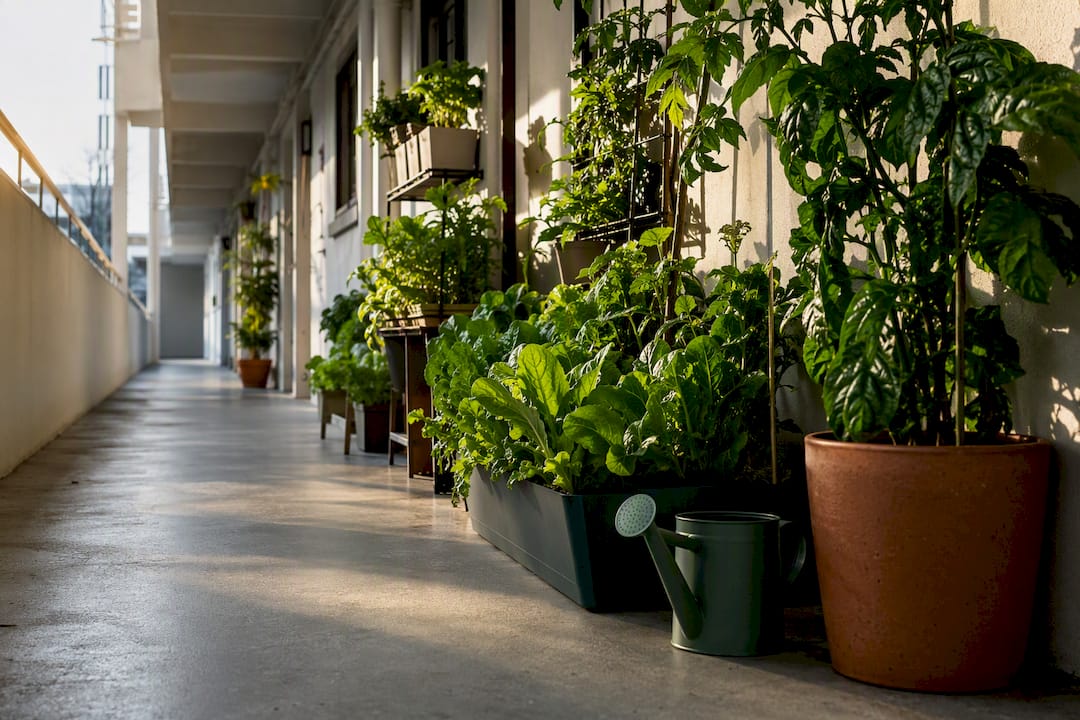
Yes. You can grow plants outside your HDB flat if you keep a continuous 1.2-meter escape path clear along the entire corridor, get your Town Council’s approval before placing anything down and control standing water to stop mosquito breeding. NParks, NEA, and your Town Council set these terms. Start by measuring your stretch of corridor, checking where the drains and hose reels sit, and confirming your council’s specific rules before you buy a single pot.
TL;DR:
- Corridor plants should be kept off the ground with wall-mounted or parapet-mounted setups to ensure a clear 1.2-meter escape path, measured along the entire corridor length.
- Obtain approval from your Town Council before installing any planters, and avoid blocking drains or hoses to prevent mosquito breeding and ensure emergency access.
- Choose plants that stay compact, require minimal pruning, and are safe for shared spaces, with options tailored to direct or shaded light conditions.
- Use contained hydroponic systems or self-wicking containers to eliminate standing water, making maintenance easier and meeting NEA mosquito control guidelines.
- Regularly inspect and maintain your corridor garden by clearing blockages, trimming plants, and repairing mounts to keep it neighbor-friendly and compliant over the long term.
The best HDB corridor plants setups share one habit: they hug the wall and stay off the floor. Wall-flush planters and parapet-mounted racks let residents grow a real garden without eating into the walking path, and they’re the setup most Town Councils approve without a fight.
Some patterns work reliably in practice, based on how residents and local reporting describe successful corridor gardens:
What to avoid is just as important. Skip trailing vines that reach across the walkway, tall top-heavy stands that tip in a gust, and anything placed directly over a scupper drain, since that’s exactly where NEA doesn’t want a plant sitting.
Three separate authorities govern what happens outside your front door, and skipping any one of them is how corridor gardens get dismantled.
One rule, one key principle to remember is that the corridor must maintain a continuous, clear, and unobstructed width suitable for emergency passage, as specified by relevant authorities, measured along its full length, not just at the point where your pots sit.
Add a fourth, less official rule: skip thorny or sharp-edged plants entirely. A corridor is shared space, and a cactus spine at elbow height for a passing neighbor or delivery rider is a problem you don’t need.
Before picking any plant, spend two days watching your corridor at different hours. Direct sun for four or more hours a day opens up edible options; anything under two hours of indirect light pushes you toward shade-tolerant ornamentals.
For sunny corridors, NParks lists solid edible options: kang kong, cai xin, kai lan, xiao bai cai, Chinese mustard, and Thai basil all grow well in direct light with regular watering. These are also fast growers, which matters for a corridor garden. You want something you can harvest and replant before it gets leggy and starts reaching into the walkway.
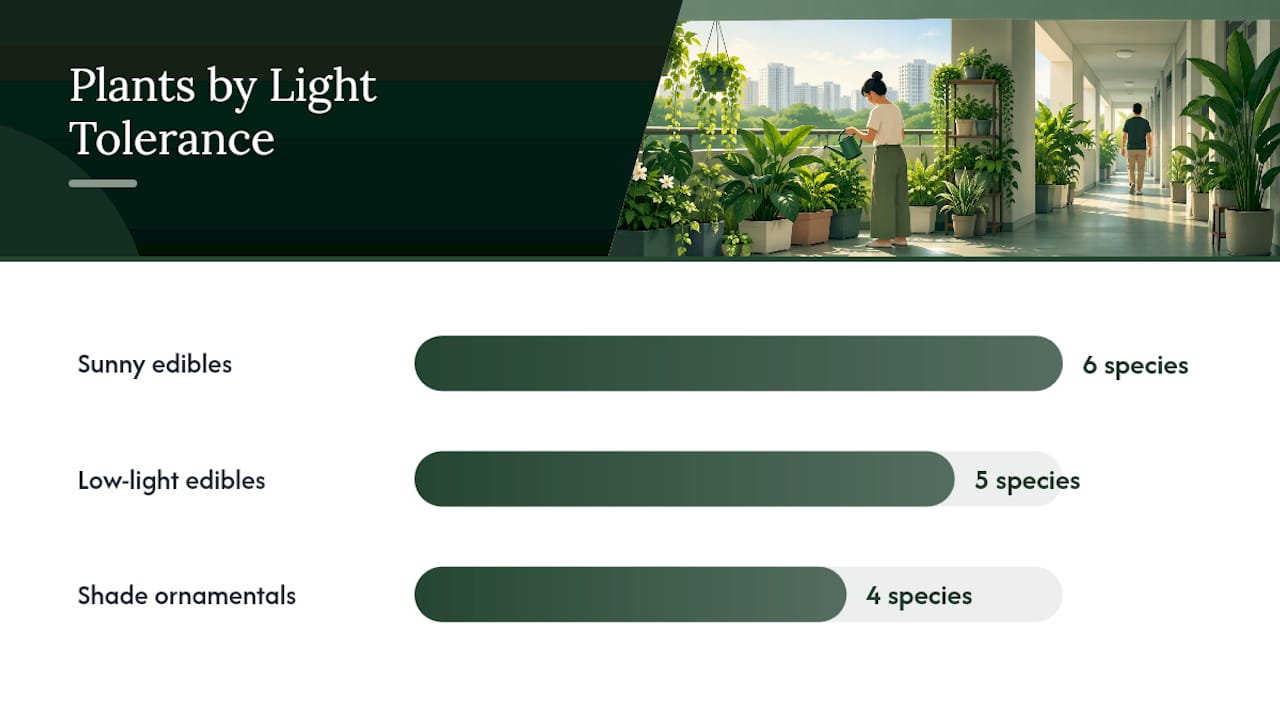
For low-light or shaded stretches, edible choices include Indian borage, sawtooth coriander, sissoo spinach, Okinawan spinach, and longevity spinach. On the ornamental side, snake plant, devil’s ivy (pothos), peace lily, and African violet tolerate indirect light and need far less fuss than flowering plants.
Run every candidate plant through these filters before buying:
Pro Tip: If your corridor gets strong morning sun but goes shady by early afternoon, treat it as a “partial sun” zone and pick plants rated for four to eight hours rather than full-sun edibles that will bolt and wilt by midday.
A corridor garden that survives inspection and lasts years follows a specific sequence. Skipping steps is how residents end up removing setups within weeks of installing them.
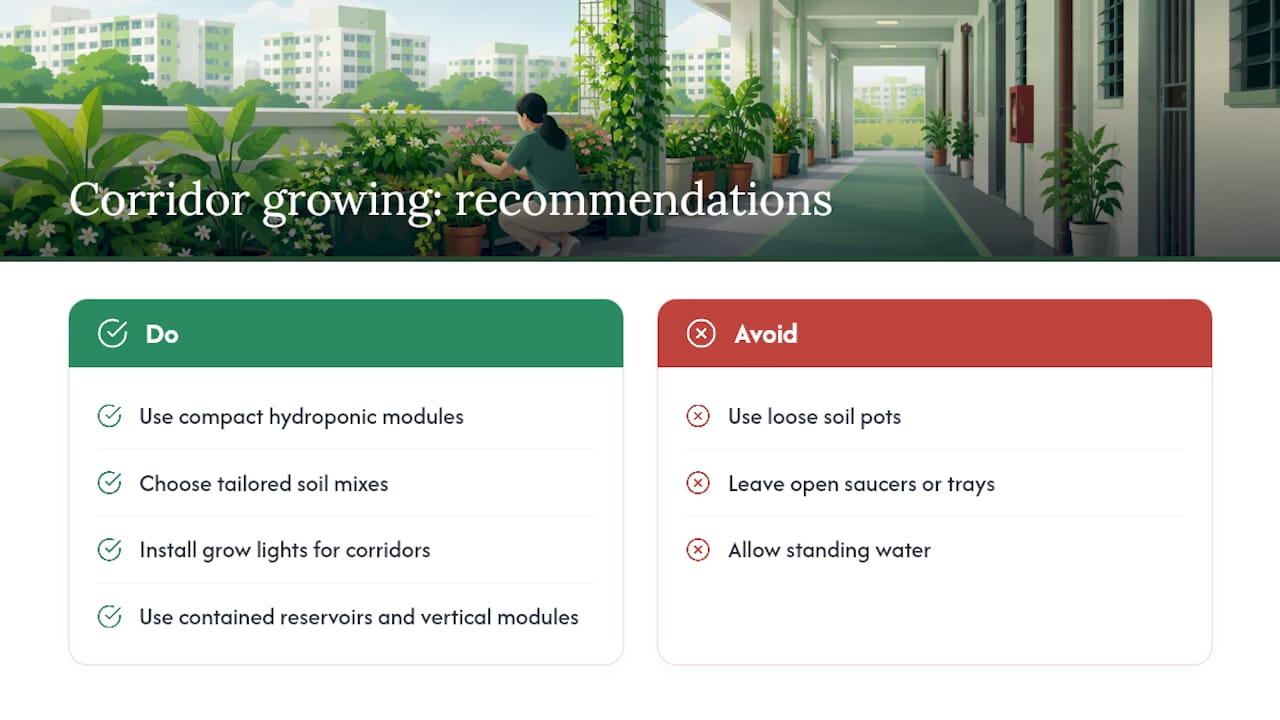
Pro Tip: A contained system, like a compact hydroponic setup, sidesteps the saucer problem entirely since the water stays sealed in a reservoir instead of sitting exposed in a tray.
A corridor garden that thrives for years, rather than getting complaints within a month, runs on a simple weekly rhythm.
Loosening hardened potting soil belongs on this list too. NEA points out that compacted soil and plant axils are common Aedes breeding sites, so a quick loosen with a hand fork every couple of weeks matters as much as watering.
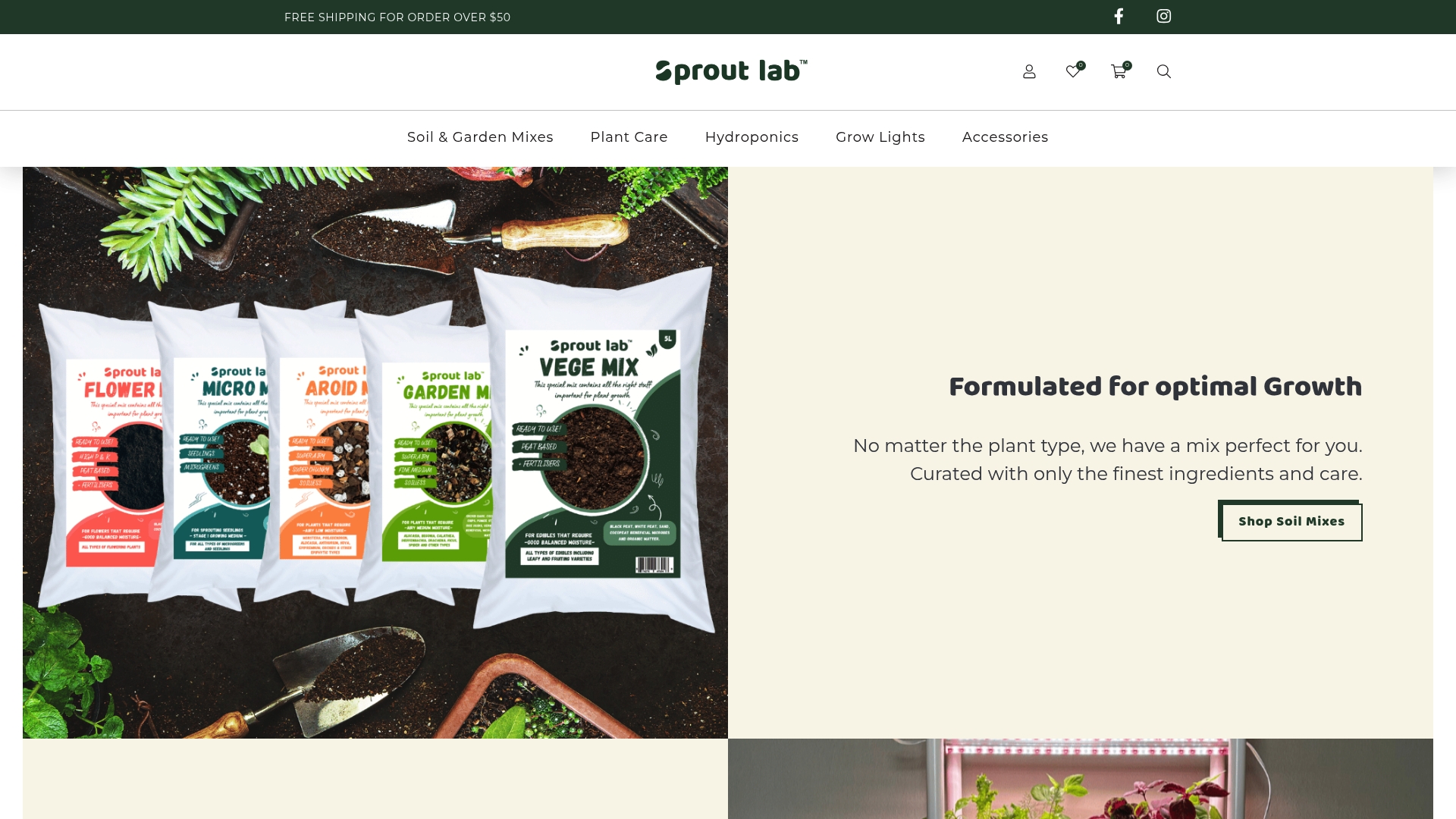
Compact hydroponic modules, tailored soil mixes, and grow lights suit corridor conditions better than loose soil pots. A contained reservoir removes the standing-water risk NEA flags, and vertical modules save the floor width your Town Council is measuring. Irwin Lee’s practical advice: match plant habit to your corridor’s foot traffic, schedule mosquito checks weekly, and favor containment-first systems over open saucers. Explore Sprout Lab’s plant care essentials for low-maintenance options built for exactly this constraint.
Growing plants outside your door works when you treat the corridor like communal ground, not private overflow. A shared watering roster or a quick monthly check with your immediate neighbors catches problems before Town Council does.
— Irwin Lee
If the drainage rules and mounting logistics above sound like more hassle than you want, there’s a simpler route. A contained hydroponic module design can eliminate the common corridor gardening issue of standing water in open trays. The reservoir stays sealed, so there’s no saucer to scrub every other day and far less risk of an NEA violation.
A vertical, modular hydroponic design addresses clearance concerns by sitting flush against the wall and growing upward, fitting many plants in a footprint smaller than a single planter row. That’s a real advantage for anyone whose corridor barely clears the minimum width to begin with.
Once you’ve measured your corridor and confirmed your Town Council’s approval, the next step is simple: browse Sprout Lab’s hydroponic systems or check out the full product range to find a setup that fits your space and skips the saucer altogether.
NParks and various community garden groups occasionally distribute cuttings and seedlings through gardening events and community in bloom initiatives. Checking with your Town Council or a nearby community garden is usually faster than searching online, since many long-term corridor gardeners are happy to share cuttings from fast-spreading plants like pothos or sissoo spinach.
Snake plant and pothos (devil’s ivy) are among the most forgiving choices for HDB corridor plants, tolerating irregular watering and low light without much fuss. For edibles, kang kong grows fast in direct sun and forgives a missed watering better than leafier greens.
Common roadside and verge plants include bougainvillea, hibiscus, and various sedum species, chosen by NParks for their heat and drought tolerance in exposed conditions. These same qualities make sedum varieties like elephant bush a reasonable pick for a sunny, exposed corridor.
Neighborhood nurseries and wet market garden stalls typically price small potted herbs and ornamentals lower than garden centers in malls. For a setup that skips soil and pots entirely, a starter hydroponic kit from Sprout Lab can work out more economical over time since it reduces plant losses from overwatering or root rot.