Free shipping for order over $50

Free shipping for order over $50
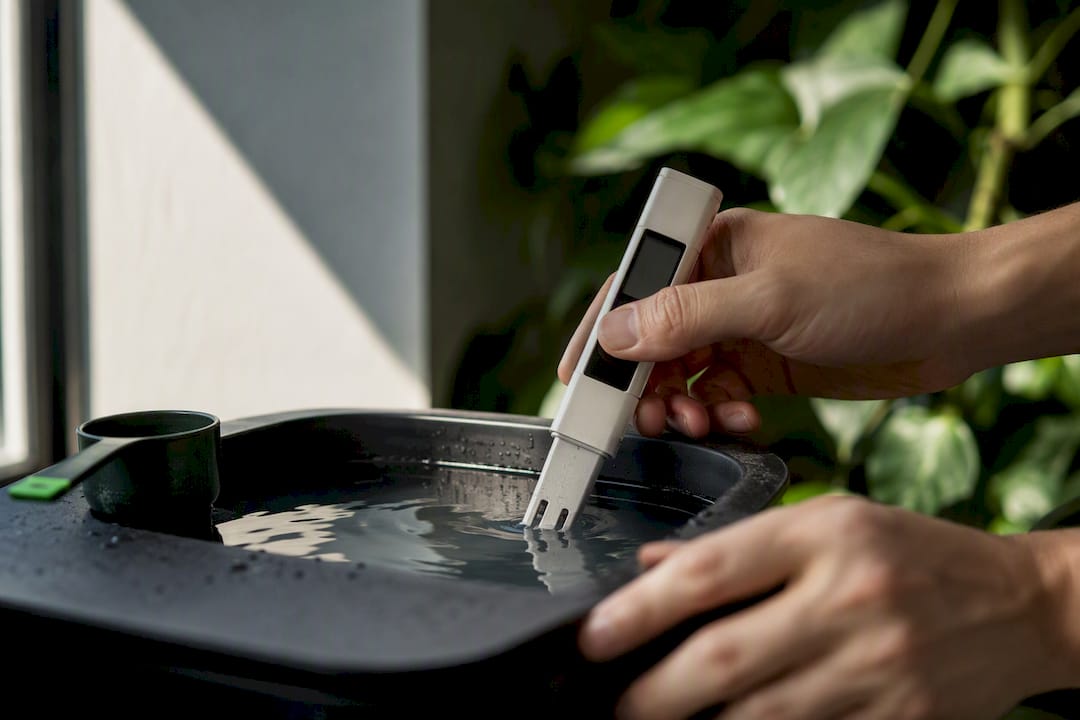
Run a ppm range suitable for seedlings (0.2–0.8 mS/cm) for seedlings, a ppm range suitable for vegetative growth (0.8–1.8 mS/cm) through vegetative growth, and in the higher ppm range once plants hit flowering or heavy fruiting, all at a pH between 5.5 and 6.5, ideally 5.5–5.8 to limit micronutrient lockout. These ranges are a starting point, not gospel. Leafy greens stay near the bottom of each band; tomatoes and peppers push toward the top. Adjust from there based on your crop, your system, and what your meter tells you week to week.
TL;DR:
- Maintaining an EC range of 0.2–0.8 mS/cm for seedlings and increasing to up to 1.8 mS/cm during heavy flowering maximizes nutrient uptake at each stage.
- Use a nutrient mixing sequence that avoids calcium precipitation by adding water, micronutrients, grow, then bloom, with pH adjustment last to ensure solution stability.
- Check and adjust pH and EC daily, and replace nutrient solutions every 7 to 14 days to prevent imbalances, especially during heat waves or intense light.
- For deep water culture, maintain dissolved oxygen above 6 ppm to prevent root rot, whereas NFT systems require more frequent monitoring due to lower buffer capacity.
- Start with 15–20 ml of Plant GROW concentrate for a 20-liter reservoir during vegetative growth, adjusting based on EC readings for optimal crop health.
A hydroponic feeding chart only works if you treat it as a moving target instead of a fixed recipe. Here’s a stage-by-stage breakdown you can copy into a grow log, based on a 20-liter (roughly 5-gallon) reservoir, per the MU Extension stage bands.
Leafy greens (lettuce, basil, most herbs) should stay in the lower third of every band listed above; they bolt or burn easily and rarely need EC above 1.4 mS/cm even at maturity. Fruiting crops like tomatoes, peppers, and cucumbers are the opposite story. They tolerate, and often need, EC readings at the top of the flowering range to size fruit properly. Sprout Lab’s own EC reference for edible crops breaks this down further if you’re growing multiple crop types in one system and need per-plant targets rather than a blanket number.
Order matters more than most beginners realize. Mix calcium and phosphate or sulfate concentrates together at full strength and you get a cloudy precipitate. That’s calcium locked into a compound your roots can’t absorb, and it happens fast enough to ruin a full reservoir if you dump concentrates in the wrong sequence.
Here’s the sequence that avoids it, based on standard mixing guidance:
For a 20-liter reservoir, a starter dose during early vegetative growth often lands around 15–20 ml of a one-part concentrate; by late veg, that climbs to a moderate amount, depending on the product’s labeled strength. Always check the specific product’s dosing chart, since concentrations vary by brand.
EC and ppm aren’t the same unit, and confusing them causes real dosing errors. The two common conversion factors are 500 and 700 (a 1.0 mS/cm reading equals either 500 ppm or 700 ppm depending on which scale your meter uses). Check your meter’s manual before you trust any ppm number. Calibrate your EC and pH meters weekly with calibration solution, more often if you’re dosing daily or the readings start drifting.
Pro Tip: Keep a small notebook or spreadsheet next to your reservoir logging date, EC, pH, and water temperature every time you check. Six weeks of consistent notes will teach you more about your specific setup than any generic chart ever will.
A daily habit and a reservoir calendar do more for plant health than any single mixing formula. Check pH and EC every day, along with water temperature (aim for 65–75°F) and a quick visual scan for wilting, discoloration, or slimy roots.
Humidity and your hydroponic lighting schedule both factor into this rhythm. Longer light periods and drier air mean plants drink more relative to what they eat, so the reservoir concentrates. That’s the single most common reason home growers find EC creeping up between water changes.
Deep water culture (DWC) and nutrient film technique (NFT) don’t behave the same way, and treating them identically is a common mistake.
If your tap water carries high alkalinity or a baseline EC reading above 200 ppm before you add anything, test it first and treat with reverse osmosis or dilution. Otherwise you’re building your feeding schedule on top of an unknown, and every dose calculation downstream is off. Sprout Lab’s modular hydroponic systems are built with this buffering behavior in mind, which is part of why reservoir monitoring stays manageable even as you scale from a few plants to a full setup.
Rising EC over several days almost always means water loss through transpiration, not nutrient depletion. Dilute first. Adding more concentrate to an already-concentrated reservoir compounds the problem and pushes you toward salt stress and nutrient lockout.
Sprout Lab’s nutrient balance guide walks through why certain elements accumulate faster than others in a closed loop, which is useful background before you start ordering lab panels.
Matching symptoms to causes fast saves a crop. Here’s what to check first:
Prevent calcium lockout by keeping calcium in its own stock tank and always following the water-micro-grow-bloom mixing order. If you catch cloudiness during mixing, discard that batch rather than feeding it. When symptoms are mild and EC and pH sit close to target, dilute and rebalance. When the solution is visibly wrong or symptoms are severe, start fresh rather than chasing a bad batch with more additives.
Pro Tip: Photograph affected leaves every few days with a ruler in frame. Comparing images side by side shows you whether a fix is working days before it’s obvious to the naked eye.

Sprout Lab’s Plant GROW concentrate is formulated to slot directly into the vegetative-stage targets above. For leafy greens in a 20-liter reservoir at veg stage, growers typically start around 15–20 ml and adjust based on their EC reading rather than the label alone.
Most people obsessize over hitting the “perfect” EC number and skip the boring work of checking pH consistently. That’s backwards. A stable pH near 5.8 and dissolved oxygen above 6 ppm will save more crops than any fine-tuned nutrient ratio.
Start conservative, log everything, and change one variable at a time. Big recipe swings based on a forum post rarely beat small, tested adjustments logged over a few weeks.
— Irwin Lee
Following a nutrient schedule on paper is one thing. Running it consistently, with a reservoir that doesn’t swing wildly between checks and a concentrate formulated for the stages above, is what actually keeps plants healthy. Some modular hydroponic systems are designed to make nutrient monitoring easier for home growers without a lab background.
If you’re setting up your first reservoir, pair a modular hydroponic system with Plant GROW concentrate so your dosing chart and your hardware are designed for each other from the start. A quality portable pH meter rounds out the basics you’ll want on hand before your first mix. Browse the full Sprout Lab store to build a starter kit sized to your space, whether that’s a single tray or a full 56-plant setup.
A good hydroponic feeding schedule tracks EC and pH by growth stage: roughly a ppm range suitable for seedlings, a ppm range suitable for vegetative growth through vegetative growth, and higher ppm levels suitable for flowering or heavy fruiting during flowering, all near pH 5.5–6.5, according to MU Extension. Adjust within those bands based on whether you’re growing leafy greens or heavy fruiting crops.
Top up daily to hold your target EC as plants drink the reservoir down, and fully replace the solution every 7 to 14 days in closed or recirculating systems, per USU Extension guidance. Replace it immediately, regardless of schedule, if EC or pH drifts outside your safe range and won’t correct with dilution.
DWC is generally more forgiving for beginners because its larger water volume buffers pH and EC swings naturally, while NFT runs faster but tolerates less error, especially during pump failures. Some modular systems use a buffered reservoir design similar to DWC, which can be helpful for growers who are new to hydroponics.
Fill the reservoir with water first, add micronutrients, then the main nutrient parts, keeping calcium separate from phosphate or sulfate concentrates, and adjust pH last, following the standard mixing sequence. This order prevents calcium precipitation, which clouds the solution and locks nutrients out of reach for roots.
For a 20-liter reservoir at vegetative stage, most growers start with 15 to 20 ml of Plant GROW concentrate and adjust based on their EC meter reading. Current pricing and product details are listed on the Sprout Lab site.