Free shipping for order over $50

Free shipping for order over $50
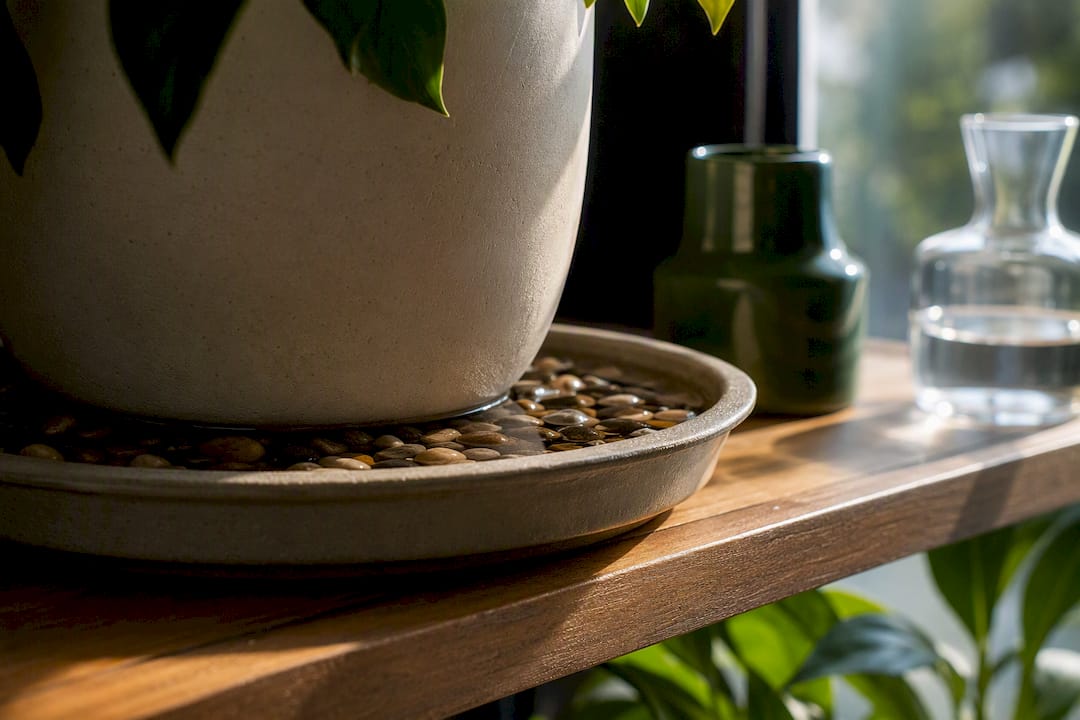
Pebble trays raise the moisture right at leaf level but almost never move the humidity reading for a whole room. They’re worth using for a small cluster of humidity-loving plants, especially paired with grouping and decent airflow. If your hygrometer says the room itself runs dry, a tray won’t fix that. A humidifier will.
TL;DR:
- A humidity tray only affects the air immediately above the pot and does not raise room-wide humidity levels significantly.
- Tropical plants like ferns, orchids, and prayer plants benefit from trays, but succulents, cacti, and low-humidity tolerant species do not.
- Proper setup requires a 1-2 inch deep tray, support stones below the pot, and grouping multiple plants, with regular cleaning to prevent algae and pests.
- If room humidity remains below 50 to 60 percent, a humidifier with a hygrometer is the only reliable solution to increase overall moisture levels.
- Trays are effective only as a local microclimate supplement, not as a replacement for mechanical humidification in dry or large spaces.
A humidity tray works through basic evaporation. Water sits in a shallow layer of pebbles, warms slightly, and turns to vapor that rises into the air right above the pot. That’s the entire mechanism. Nothing mysterious about it.
The problem is what happens next. Once that water vapor leaves the surface of the tray, it doesn’t hover politely around your fiddle leaf fig. It diffuses. It mixes into the general air of the room, gets pulled toward windows, doors, and air vents, and gets replaced by drier air from elsewhere in your home. Penn State Extension puts it plainly: evaporated moisture from a tray diffuses into the surrounding room, so the tray typically makes no measurable difference to whole-room relative humidity.
Plants themselves add moisture too, through transpiration, the process where water moves from roots to leaves and exits through tiny pores called stomata. Research measuring evapotranspiration rates found that raising a room’s humidity meaningfully through plants alone requires a lot of leaf area. One or two houseplants, or one pebble tray, just doesn’t move the needle at room scale. Air exchange with the rest of the house cancels out most of the gain, according to the CentAUR evapotranspiration study.
Statistic Callout: A single humidity tray affects the air in roughly the few inches directly above it. It does not raise the percent relative humidity of a bedroom or living room by any fixed, promisable amount.

Not every plant on your windowsill needs this kind of babying. Tropical species that evolved under rainforest canopies lose water fast through their leaves in dry indoor air, and that’s where a tray earns its keep.
Plants that typically benefit from extra local humidity:
Plants that generally don’t need one:
Oklahoma State University Extension notes that many common houseplants do well around 50 to 60 percent relative humidity, but that target varies by species. The smart move is checking your specific plant’s preferred range and confirming what your home actually delivers with a hygrometer, rather than guessing.
Getting the setup right matters more than most guides admit. A poorly built tray does nothing for humidity and can actively hurt your plant by keeping roots wet.
If your climate is dry enough that hand-filling a tray feels tedious, a raised grid or plastic mesh insert works as well as pebbles and is easier to clean.
Pro Tip: Crouch down to eye level with the tray after filling it and check the pot’s side profile. If you can see water touching the drainage holes, add more pebbles or a plastic spacer underneath before you walk away.
A neglected tray turns into a breeding ground for algae, gnats, and stagnant water faster than most people expect, particularly in warm indoor conditions.
Extension resources consistently flag good airflow as the other half of this equation. A humid pocket with stagnant air invites fungal issues on leaves and stems, so a small fan nearby or simply avoiding tightly packed plant groupings helps prevent problems before they start. If you’re arranging several trays together, spacing plants for better airflow reduces disease risk without sacrificing the humidity benefit.
A hygrometer is the cheapest diagnostic tool you’ll own as a plant owner, and it settles this question fast. Check the reading in the room where your plants live, not just near the tray. If it’s sitting well below what your humidity-sensitive plants want, no amount of pebble trays will close that gap.
The American Orchid Society is blunt about this: trays are a reasonable supplement for a small collection, but a humidifier is the only reliable way to raise indoor humidity across an entire room. Misting falls even shorter. It bumps humidity for a few minutes at best before the water evaporates, according to Penn State Extension, which makes it more of a leaf-cleaning ritual than a humidity strategy.
Statistic Callout: Most houseplants do well in the 50 to 60 percent relative humidity range, per Oklahoma State University Extension, but pushing much higher without airflow raises the risk of mold, fungal spots, and root rot from constantly damp soil. More humidity isn’t automatically better. It has to come with ventilation and a watering schedule adjusted to match.
If you’re tending five or more humidity lovers, or an orchid collection that needs consistent moisture, a small room humidifier with a built-in hygrometer usually costs less in frustration than a windowsill full of trays.

Most tray complaints trace back to one of a few fixable mistakes.
Extension services and orchid specialists have studied this question for decades, and the consensus holds steady: trays help locally, not globally. Penn State Extension frames them as a harmless supplement rather than a room humidifier substitute. Nebraska Extension supplies the depth and clearance specs that most modern guides still repeat. The CentAUR evapotranspiration paper put real numbers behind the leaf-area math, showing why a windowsill of plants can’t replace mechanical humidification. Oklahoma State’s fact sheet rounds it out with the 50 to 60 percent target range most hobby growers should aim for.
For home growers, that translates into a simple takeaway: build the tray correctly, measure instead of guessing, and know when to graduate to a humidifier. Plant care guidance is built around that same evidence, developed with input from horticultural research.
A tray earns its place under a single orchid or a cluster of ferns on one shelf, somewhere a humidifier feels like overkill. I’ve watched a Rex begonia recover its leaf color within a couple of weeks just from grouping and a pebble tray beneath it. But once a whole room of tropicals is struggling, I stop fiddling with trays and just plug in a humidifier. It’s a five-minute swap into my weekly routine: check the hygrometer, top off water, and only escalate to mechanical humidity when the numbers say the room itself is the problem.
— Irwin Lee
A pebble tray solves one problem well. It doesn’t solve propagation, root health, or light, which is where the rest of your plant’s environment comes in. Sprout Lab’s humidity dome and seeding tray set gives cuttings and seedlings the enclosed, high-moisture environment a passive pebble tray can’t replicate, since a sealed dome traps vapor instead of letting it diffuse away. For established humidity-lovers, pairing a tray with the right growing medium matters just as much. Sprout Lab’s soil and garden mixes are built for moisture retention without waterlogging, and its grow lights help regulate the transpiration rate that drives how fast your plant pulls moisture from both the tray and the soil.
If you’re assembling a humidity setup for orchids, aroids, or ferns, browse Sprout Lab’s full plant care range for the pieces that go beyond the pebble tray itself, from grow lights to curated soil blends.
For deeper technical detail beyond this guide, Penn State Extension and Nebraska Extension cover tray mechanics and setup specs. The American Orchid Society offers species-specific guidance for orchid growers, and Oklahoma State University Extension covers general houseplant humidity targets and disease risk.
Yes, but only at a local scale. They add moisture in the air immediately around the pot without meaningfully raising the humidity of the whole room.
Fill a watertight tray 1 to 2 inches deep with pebbles, add water below the top of the stones, and set your pot on top without letting its base touch the water, following the depth and clearance specs from Nebraska Extension. Group a few humidity-loving plants together for a stronger effect.
Most common houseplants prefer a range closer to 50 to 60 percent relative humidity. Pushing conditions much higher without airflow raises the risk of mold, fungal disease, and root rot.
This usually refers to the same thing as a pebble or humidity tray, a shallow water and stone tray placed under a pot to add local moisture. It’s not the same as an actual humidifier, which is a mechanical device recommended by the American Orchid Society for raising humidity across an entire room.