Free shipping for order over $50

Free shipping for order over $50
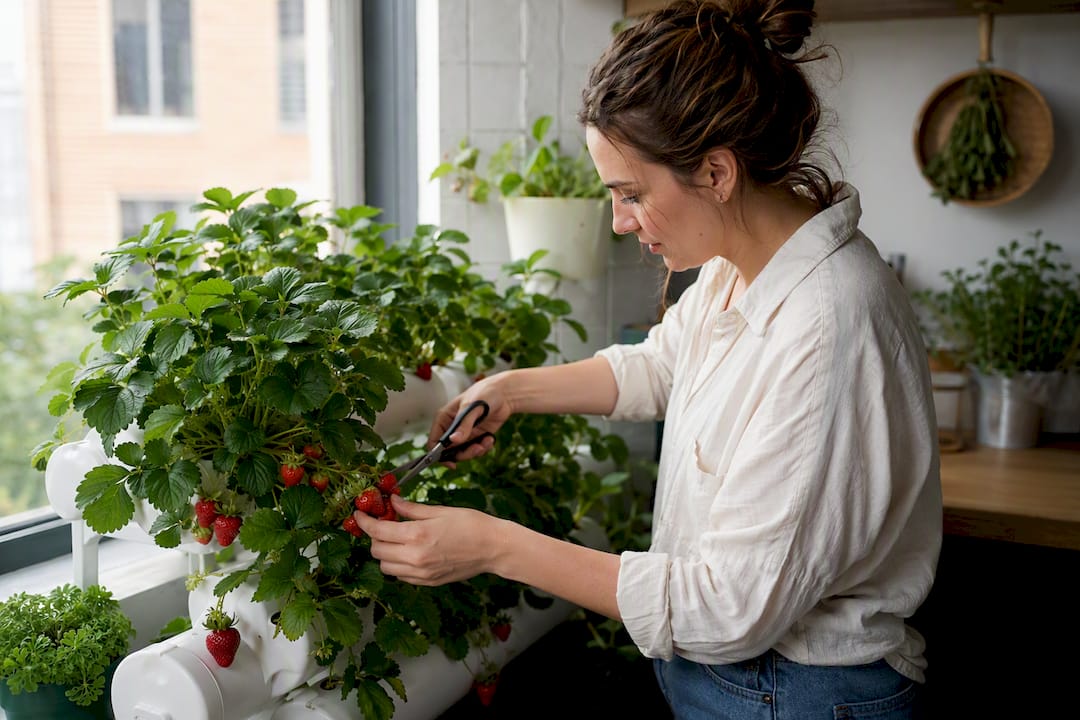
Yes, you can grow sweet, ripe strawberries hydroponically indoors, but only with the right setup. Choose day-neutral varieties, control light and root-zone temperature, hold pH and EC in a narrow band, and hand-pollinate every flower yourself.
Treat this as a project crop, not a set-and-forget herb garden. The numeric targets that separate a bowl of fruit from a leggy plant with no berries:
Miss the root-zone number and you’ll fight rot all season. Skip pollination and you’ll get leaves, flowers, and nothing else.
TL;DR:
- Day-neutral strawberry varieties like Albion, Seascape, San Andreas, and Evie-2 are essential for continuous indoor production, not June-bearing types.
- Maintaining a root-zone temperature between 60 and 68°F is critical to prevent rot and ensure pollen viability, even in warmer room air.
- Precise control of pH (5.5 to 6.2) and EC (1.0 to 1.8 mS/cm) during different growth stages maximizes fruit quality and plant health.
- Hand-pollination every 2 to 3 days during flowering significantly increases fruit set and avoids flowers remaining unpollinated.
- Use a system with reservoir automation, root-zone cooling, and easy access to manage the tight environmental controls needed for success.
Strawberry varieties fall into three camps: June-bearing, everbearing, and day-neutral. June-bearing types set one big flush tied to long summer days, which is useless under a fixed indoor light schedule. Everbearing varieties produce two or three flushes a year, better but still seasonal in behavior. Day-neutral varieties ignore day length almost entirely and flower continuously once temperatures sit in a workable range, which is exactly why they dominate hydroponic day-neutral production recommended by extension programs.
Four varieties come up again and again in home and research hydroponic setups:
Skip seed packets. Seeds take months to reach a fruiting size and produce wildly inconsistent plants. Bare-root crowns or tissue-cultured plugs get you to flowering in weeks instead, with uniform genetics across every plant in the system. Once plants establish, pinch off runners aggressively. Every runner you let grow steals sugar and nitrogen from fruit production, and indoors, where you have no spare bed to root a daughter plant anyway, there’s no upside to keeping them.
Strawberries have shallow, fibrous roots that want oxygen and stability more than raw nutrient flow, which shapes which systems actually work well.
Before buying anything, run through this checklist: how much oxygen reaches the roots, how easily you can cool the root zone, how much contamination risk the design carries, how much weekly maintenance it demands, and how much floor or shelf space you actually have.
Pro Tip: If you’re choosing between NFT and substrate for your first strawberry run, pick substrate. It forgives a clogged pump or a missed feeding cycle in ways bare-root water culture never will.
Light is the single biggest lever most first-time growers underestimate. Strawberries need considerably more intensity than lettuce or basil, and running lights on a weak fixture for 18 hours won’t compensate for a fixture that’s simply too dim. Aim for 12 to 14 hours daily from an LED positioned close enough to deliver strong PPFD at canopy height, and check your grow light setup against that target rather than guessing from wattage alone.
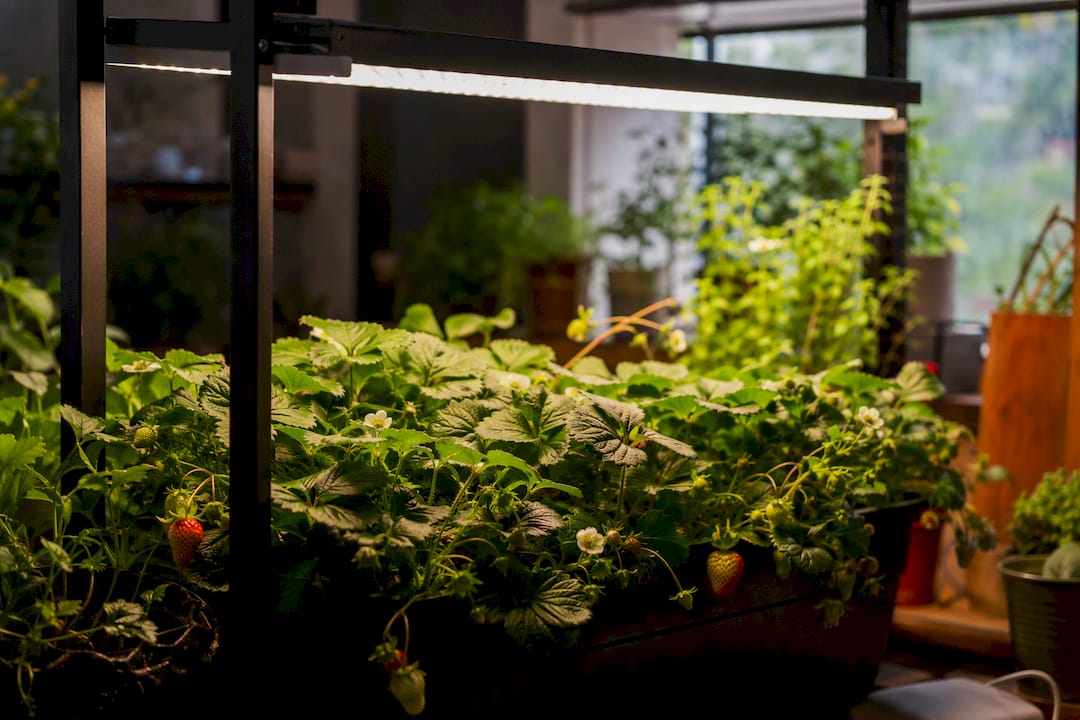
Air temperature matters almost as much as light, but in reverse: warm days and cool nights. Run roughly 65 to 80°F while lights are on, and let it drop to 50 to 60°F at night. That nighttime dip isn’t cosmetic. Cooler nights slow respiration, and Ohio State research ties that slower respiration directly to better sugar retention and sweeter fruit.
Root-zone temperature is the number growers miss most often. Even in a cool room, a reservoir sitting under warm LEDs can climb into the mid-80s Fahrenheit, and heat in that range damages pollen viability and invites root rot. Hold the root zone at 60 to 68°F using an insulated reservoir, a small chiller, or simply frozen water bottles rotated through the tank on hot days.
Airflow does double duty: it prevents the still, damp air that invites botrytis, and it mimics the breeze that helps pollen travel between flower parts.
Strawberry nutrient needs shift as the plant moves from rooting in to pushing out fruit, and feeding it the same strength solution the entire cycle is a common cause of stalled growth or weak fruit.
Hold pH at 5.5 to 6.2 throughout, with 5.8 to 6.2 the sweet spot for most substrate mixes. Check pH and EC daily with a basic meter, top up water lost to evaporation between full changes, and replace the reservoir entirely every one to two weeks depending on system size and plant count. Log every reading. A logbook is the fastest way to catch drift before it shows up as leaf damage.
One caution worth flagging: a controlled trial on recycling systems found that a two-thirds strength nutrient solution outperformed full-strength feeding for vegetative growth and fruit quality in one Korean cultivar. That result is promising but cultivar- and system-specific, not a universal rule to apply blindly.
Transplanting crowns or plugs correctly sets the tone for everything after. Inspect roots for firmness and white color before planting, anchor the crown so its base sits level with the substrate surface (buried too deep and it rots, too shallow and it dries out), then run a slightly weaker EC and shorter light cycle for the first several days while roots establish.
After that first harvest, day-neutral varieties keep flowering and fruiting continuously for months with steady care. Keep pinching runners, remove spent leaves, and expect production to gradually decline after 8 to 12 months, at which point replacing the plant beats trying to revive it.
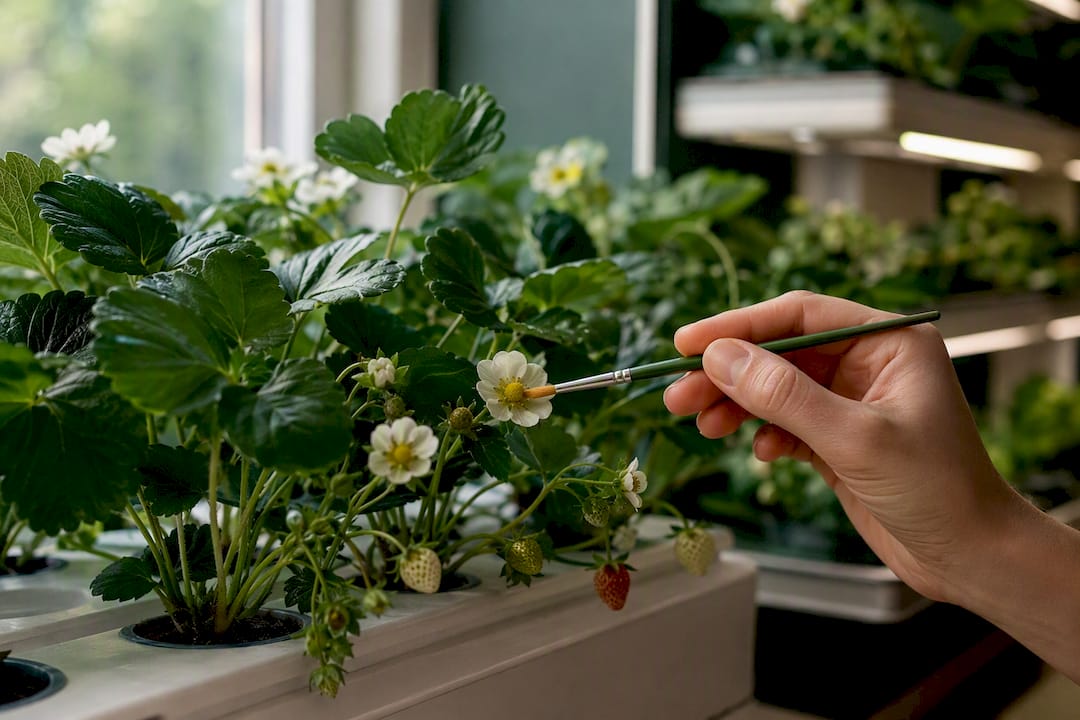
Without wind or bees, indoor strawberries won’t set fruit on their own, and skipped pollination is the single most common reason growers get flowers but no berries.
Pollen viability drops in heat and high humidity, so pollinating during the cooler morning hours after lights come on gives you the best results. If you’re scaling past a dozen plants, a small electric toothbrush touched to the flower stem (the “buzz pollination” trick) or a low-speed oscillating fan running most of the day can reduce the manual workload.
Pro Tip: Mark pollinated flowers with a small dab of colored thread or a twist tie so you don’t waste time repollinating fruit that’s already set.
Most indoor strawberry failures stem from common causes such as inappropriate variety choice or insufficient light to induce flowering. Choose day-neutral cultivars and provide adequate light to ensure successful fruiting.
When a plant shows rot or mold, isolate it from neighbors right away and sanitize any tools that touched it before moving to the next plant. Keep a simple log of symptoms and fixes; recurring problems in the same spot in your system usually point to a hardware issue, like a dead zone in circulation, not a plant issue.
Translating those numbers into hardware, a compact starter setup for 6 to 12 strawberry plants needs a reservoir of at least 10 to 15 gallons, a pump and air stone sized to keep dissolved oxygen high, a coco coir or perlite substrate blend, and an LED fixture rated for fruiting crops rather than seedlings.
Sprout-lab’s modular hydroponic systems are built around exactly this kind of compact, multi-plant footprint, which matters when floor space and shelf space are the real constraint for most indoor growers. Automated reservoirs help hold the pH and EC drift that otherwise creeps in daily, and vertical tower configurations let you fit a full strawberry crop into the same square footage a single tomato plant would take.
Pro Tip: shapes how this maintenance cadence gets built, and backs the numeric targets throughout this guide.
Water quality sets the ceiling on everything else you do right. Strawberries are sensitive to dissolved solids, chlorine, and mineral hardness in ways that hardier crops tolerate without complaint.
Start by testing your source water’s baseline EC before adding any nutrients. Tap water in many areas already carries an EC of 0.3 to 0.5 mS/cm from dissolved minerals, and that baseline eats into your nutrient headroom. If your tap water runs high, a reverse osmosis filter gives you a clean slate to build your nutrient solution on, rather than guessing how much of your target EC is actually fertilizer versus background minerals.
Chlorine and chloramine, common in municipal water, suppress beneficial microbial activity around the roots and can stress young transplants. Letting water sit uncovered for 24 hours off-gasses chlorine, though chloramine needs a carbon filter or dedicated dechlorinator to remove.
Water hardness matters too. High calcium and magnesium levels aren’t necessarily bad, strawberries need both, but they complicate nutrient dosing since you’re adding on top of an unknown baseline. Testing hardness once with a basic kit tells you whether to adjust your nutrient recipe down to account for what’s already present.
Whatever the source, keep it consistent. Switching between tap and filtered water mid-cycle introduces EC swings that are hard to diagnose later, since the fluctuation looks identical to a dosing mistake on your meter.
The mechanical side of a hydroponic strawberry system is simpler than it looks, but a few sizing mistakes cause most of the headaches growers report.
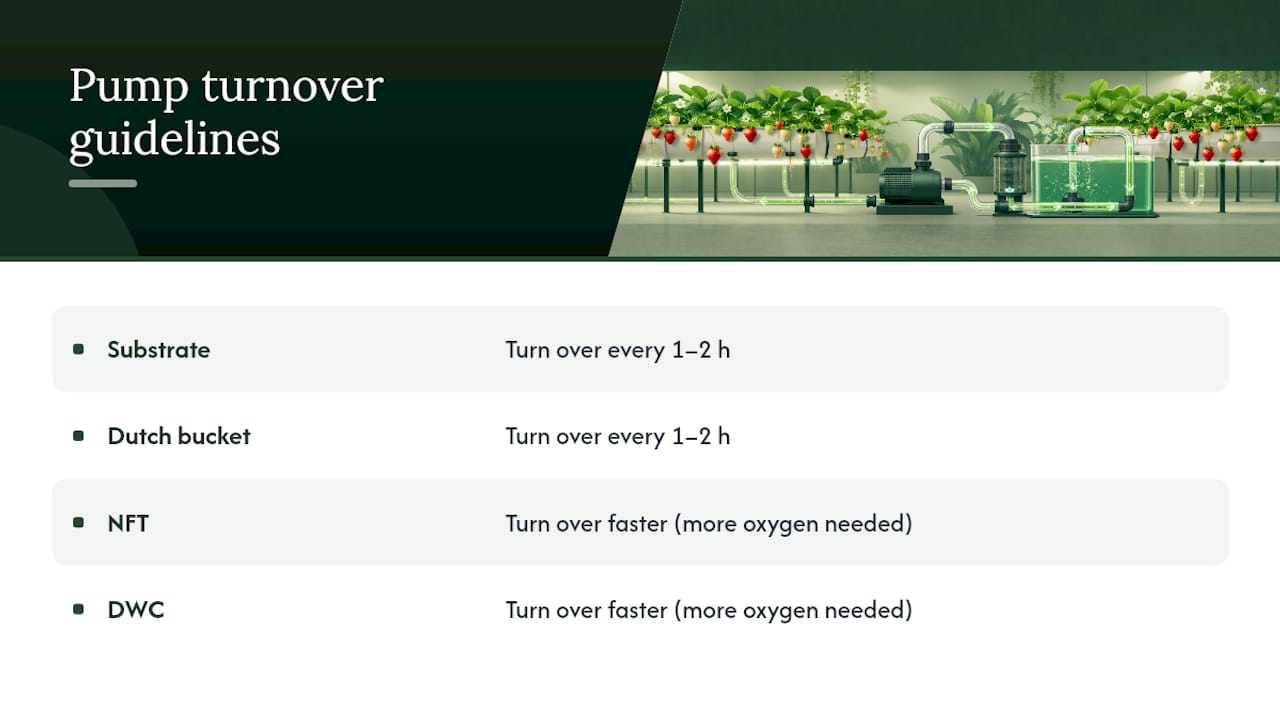
Size your pump to turn over the full reservoir volume every one to two hours for substrate and Dutch bucket systems, faster for NFT and DWC where oxygen depends more heavily on circulation. An undersized pump starves distant plants in a longer NFT channel; an oversized one wastes energy and can erode substrate around root balls.
Use food-grade vinyl or polyethylene tubing throughout, never standard hardware-store hosing, which can leach compounds into your nutrient solution over time. Keep tubing runs as short as practical, since long runs lose pressure and invite algae growth in warm, lit sections.
Reservoirs should be opaque or shielded from light entirely. Clear or translucent containers let light reach the nutrient solution, which fuels algae blooms that clog pumps and compete with roots for nutrients. A simple wrap of reflective insulation or a dark storage tote solves this and helps with the root-zone cooling goal at the same time.
Inspect the pump intake weekly for debris buildup, and flush tubing lines during your monthly reservoir change to clear any biofilm before it narrows flow. A beginner reservoir system guide walks through sizing and layout in more depth if you’re building your first setup from scratch rather than buying a pre-configured kit.
Harvest strawberries in the cool morning hours, right after lights come on, when fruit sugar concentration tends to be highest and the berries haven’t warmed under active lighting yet.
Pick with the green cap and a short stem still attached. Pulling the fruit itself rather than snipping the stem bruises the flesh and shortens shelf life dramatically. Handle each berry gently; strawberries don’t ripen further once picked, and any pressure damage shows up as soft, discolored spots within a day.
Don’t wash berries until you’re ready to eat them. Moisture on the surface accelerates mold growth in storage, so keep them dry until the moment before you serve or use them. Store unwashed berries in a single layer in a shallow, ventilated container in the refrigerator, ideally around 32 to 36°F, where they typically hold quality for 5 to 7 days, noticeably longer than store-bought fruit picked days before it reached the shelf.
If you’re harvesting more than you can eat within a week, freezing works well for baking or smoothies. Hull the berries, freeze them in a single layer on a tray until solid, then transfer to a sealed bag. This prevents them from clumping into one frozen mass and lets you pull out exactly the amount you need later.
Strawberries reward attention in a way few other hydroponic crops do. Get the root temperature and pollination routine right, and you’ll taste the difference against anything shipped from a warehouse.
Still, if pH swings and daily pollination sound like more than you want to take on right away, start with something forgiving, like leafy greens or herbs, and graduate to strawberries once that routine feels automatic.
— Luna
Everything in this guide, root-zone cooling, stable EC, consistent pollination access, comes down to whether your hardware makes those targets easy to hit or something you’re fighting daily. That’s the real gap between a grower who gets a full harvest and one who gives up after a few weeks of drifting pH readings.
Sprout-lab’s automated hydroponic setups handle the reservoir monitoring and circulation that otherwise eat up your evenings, while modular tower configurations fit a full strawberry planting into the footprint of a bookshelf. When you’re comparing options, prioritize a system with reservoir automation, easy-access cleaning, some form of root-zone cooling, and built-in aeration rather than piecing together separate pumps and controllers yourself. Check the automated setup options and match the plant count to your available light and shelf space before you order.
Hydroponic strawberries succeed when growers combine day-neutral genetics with tight control of root temperature, pH, EC, and manual pollination.
| Point | Details |
|---|---|
| Pick day-neutral varieties | Albion, Seascape, San Andreas, or Evie-2 flower continuously regardless of light schedule. |
| Cool the root zone | Hold roots at 60 to 68°F even if ambient air runs warmer to protect pollen and prevent rot. |
| Hold pH and EC tight | Keep pH at 5.5 to 6.2 and EC between 1.0 and 1.8 mS/cm, rising through growth stages. |
| Hand-pollinate every 2 to 3 days | Brush each open flower during flowering or expect empty stems instead of fruit. |
| Consider a modular system | Sprout-lab’s compact and automated hydroponic setups simplify reservoir and EC management for space-limited indoor growers. |
They’re not inherently better, but indoor hydroponic systems give you more control over sweetness through root-zone and night temperature management, and they avoid soil-borne pathogens entirely.
Yes, hydroponic strawberries are just as safe to eat as soil-grown fruit, provided you maintain clean reservoirs and follow the same washing practices you’d use for any fresh produce.
The recurring issues are failed pollination causing misshapen fruit, root rot from warm or poorly aerated root zones, botrytis mold from high humidity, and leaf tip burn from EC set too high for the growth stage.
Hydroponic strawberries grow in a soilless substrate or water-based system with nutrients delivered directly through the solution, while soil-grown strawberries rely on nutrients and moisture drawn from surrounding earth, which is harder to control precisely indoors.
Most day-neutral varieties started from crowns or plugs reach first harvest 60 to 90 days after transplant under controlled indoor conditions.