Free shipping for order over $50

Free shipping for order over $50
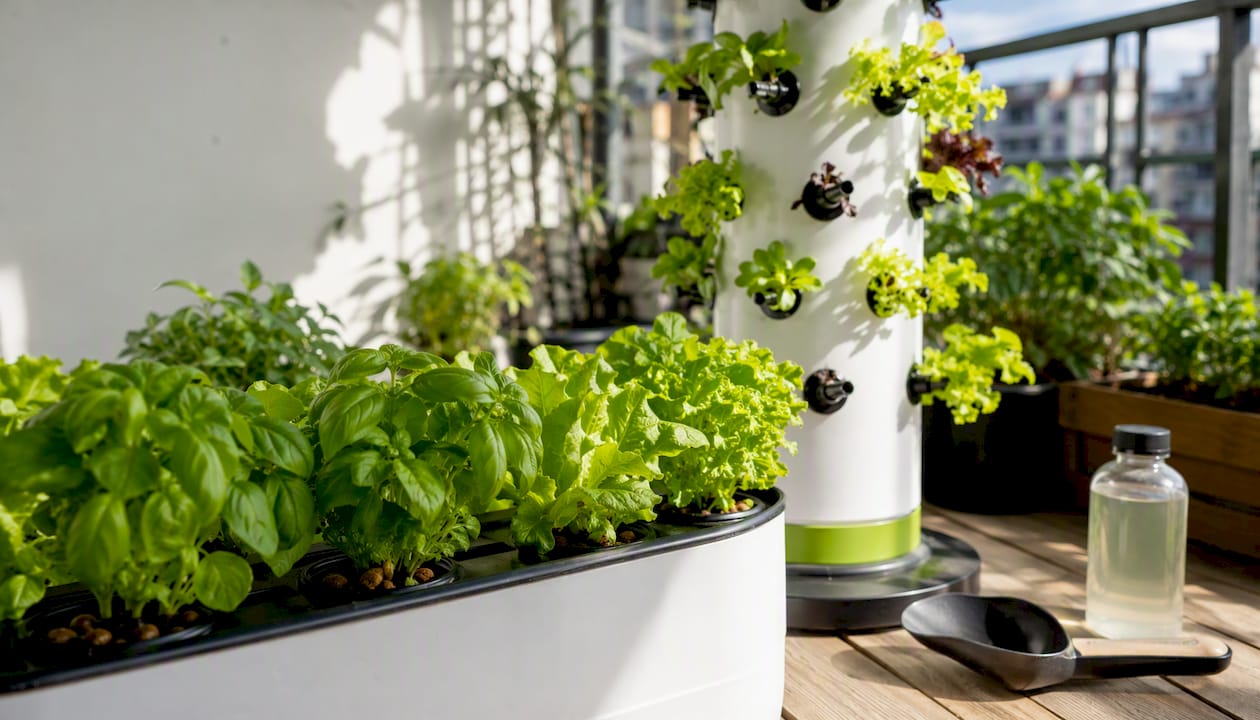
Hydroponics is the better starting point for most growers. Aeroponics wins on raw speed and resource efficiency, but it demands more technical skill, higher upfront cost, and tighter daily monitoring. Here is the short version by use case:
Hydroponics is the right starting system for most growers; aeroponics delivers faster growth and higher resource efficiency but demands more technical skill, higher upfront cost, and tighter daily monitoring.
| Point | Details |
|---|---|
| System choice by use case | Hydroponics suits beginners and home growers; aeroponics fits commercial, research, and high-value operations. |
| Growth rate difference | Aeroponics can cut lettuce harvest time to 18–21 days vs. 25–35 days in DWC under optimized conditions. |
| Core monitoring priorities | Track pH (5.5–6.5), EC, and dissolved oxygen daily; these three variables explain most underperformance. |
| Failure tolerance | Hydroponic pump failure gives hours to respond; aeroponic nozzle or pump failure stresses roots within minutes. |
| Sprout-lab for home growers | Sprout-lab’s modular hydroponic systems support up to 56 plants in compact spaces, with beginner and automated options available. |
Hydroponics grows plants in a nutrient-rich water solution instead of soil, delivering minerals directly to the root zone. Roots sit in or near that solution continuously, which removes the need for soil as a nutrient buffer and lets plants redirect energy from root expansion toward shoot and leaf growth.
The main system types differ in how they deliver that solution:
Equipment you need: reservoir, submersible or inline pump, air stone and air pump (for DWC), grow media (rockwool, clay pebbles, or coco coir), net pots, pH meter, EC/PPM meter, timer, and grow lights if indoors.
Hydroponics can speed growth by roughly 30–50% over soil in many reports, with tighter environmental control pushing yields per square foot higher than most outdoor beds. The trade-off is that recirculating systems can spread root disease fast if one plant gets infected, and pH drift in a shared reservoir affects every plant at once.
Aeroponics suspends plant roots in open air and delivers nutrients through a fine mist sprayed directly onto the root zone at timed intervals. No growing medium touches the roots. That air gap is the key: roots get oxygen continuously between mist cycles, which is why aeroponic systems tend to produce faster germination and growth than most hydroponic setups.
Low-pressure aeroponics (LPA) uses standard pond or garden pumps to push nutrient solution through spray nozzles. The droplets are coarser (typically above 50 microns), which means less surface area on the root and slightly lower oxygen transfer. LPA is cheaper and easier to maintain, and most consumer-grade aeroponic towers use this approach.
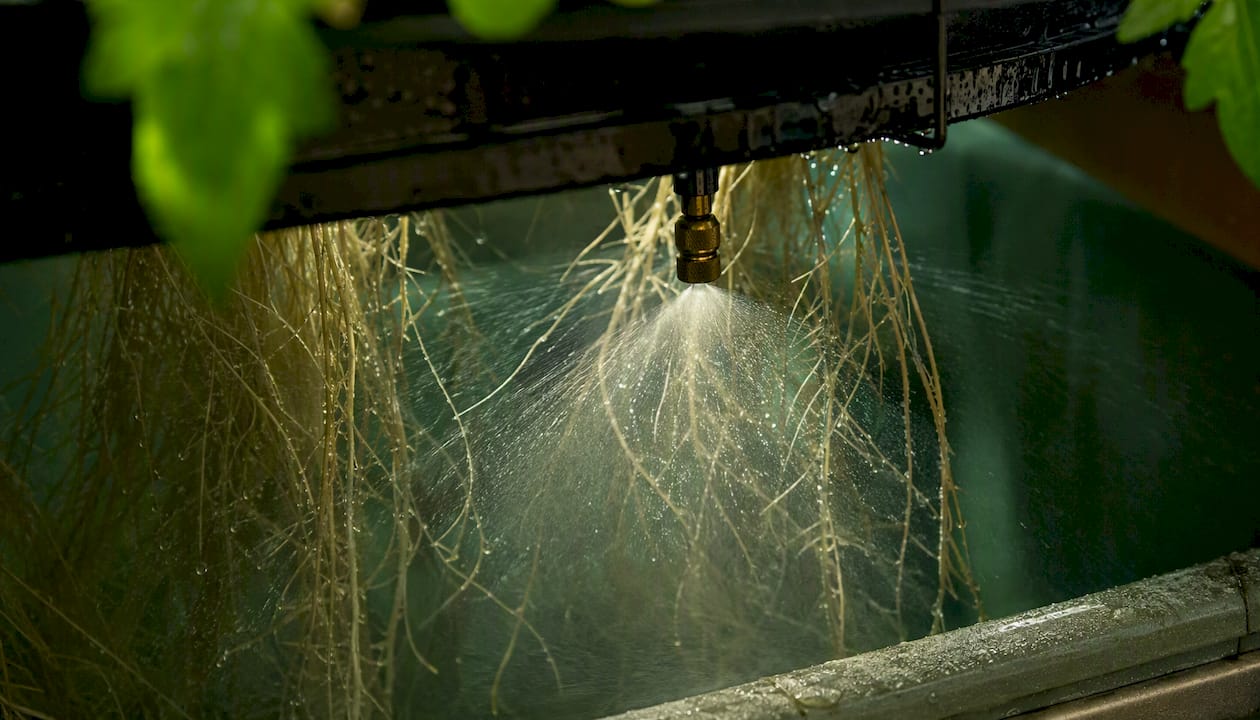
High-pressure aeroponics (HPA) runs a pump at 80–100 PSI or higher to produce a true fine mist, often below 50 microns. That droplet size maximizes root surface contact and oxygen exposure. HPA is what NASA’s original aeroponic research used, and it is what commercial operations deploy when they want the fastest possible growth rates. The downside: high-pressure pumps cost more, and the fine nozzles clog more easily.
Equipment checklist: misting nozzles (sized to your pressure), high-pressure diaphragm or accumulator pump (for HPA) or standard pump (for LPA), enclosed root chamber, collection basin with recirculation plumbing, inline filtration, pH and EC meters, and a programmable timer for mist cycles.
Aeroponic systems frequently report faster germination and growth because roots receive more oxygen and highly targeted nutrient misting. The vulnerability is the flip side of that precision: a clogged nozzle or pump failure can stress roots within minutes, since there is no reservoir of solution to buffer the interruption.
The central trade-off is this: aeroponics optimizes for performance; hydroponics optimizes for resilience. Every other difference flows from that.
| Dimension | Hydroponics | Aeroponics |
|---|---|---|
| Nutrient delivery | Continuous immersion or timed flooding | Timed mist cycles onto suspended roots |
| Oxygen at roots | Moderate (air stone helps); roots can waterlog | High; air gap between cycles maximizes O₂ |
| Water use | Efficient vs. soil; recirculating systems reuse most water | More efficient than hydroponics; mist uses less total volume |
| System complexity | Low to moderate; many beginner-friendly types | Moderate to high; pressure, nozzle spec, and cycle timing all matter |
| Maintenance and failure risk | Pump failure stresses plants over hours; root rot in recirculating systems | Nozzle clog or pump failure stresses roots within minutes |
| Energy use | Pump plus lights; air pump for DWC | Pump (higher pressure for HPA) plus lights; slightly higher pump energy |
| Initial cost | Low to moderate ($50–$500+ for hobby; $5,000+ for small commercial) | Moderate to high (around $200 for hobby; higher for commercial) |
| Operating cost | Nutrients, electricity, occasional media replacement | Nutrients, electricity, nozzle maintenance, filtration |
| Crop suitability | Leafy greens, herbs, fruiting plants, some root crops in modified setups | Leafy greens, herbs, high-value crops; poor for large root crops |
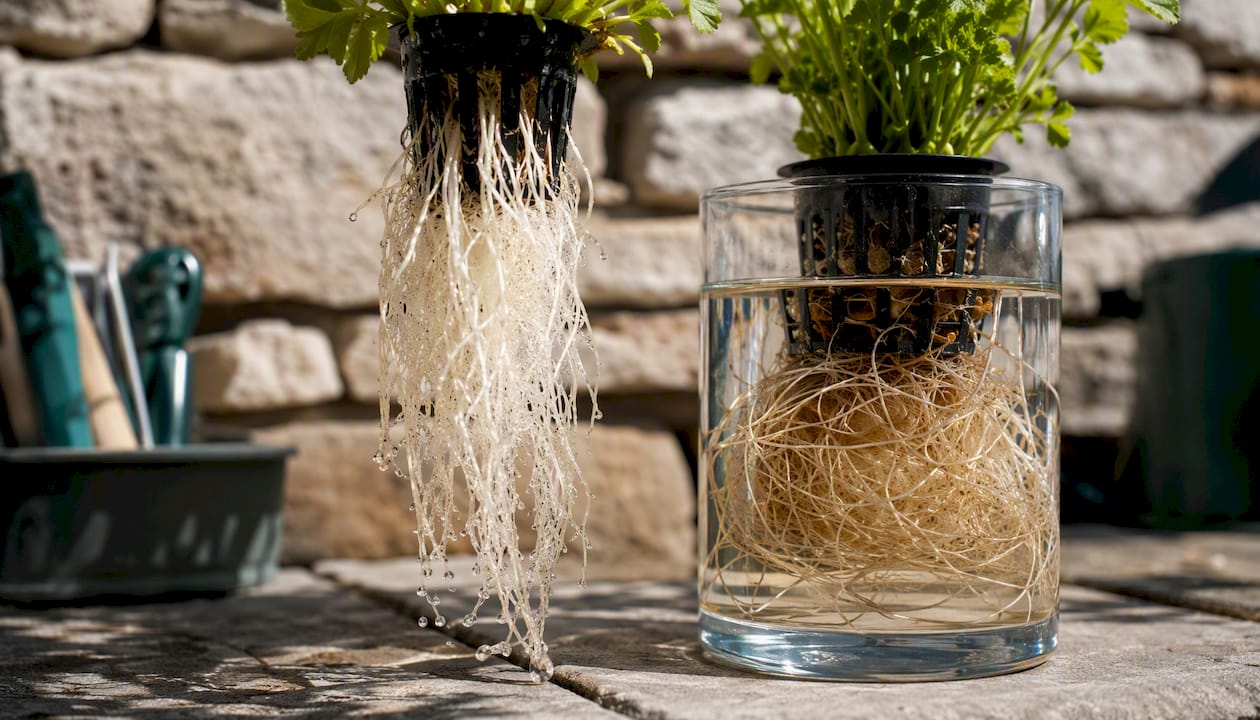
A 2025 comparative review confirms this pattern: hydroponics is more widely implemented because it balances cost, adaptability, and scalability, while aeroponics offers accelerated growth and higher resource-use efficiency at the cost of greater technical skill and higher initial investment.
Three differences that actually change outcomes.
A home grower raising basil on a kitchen counter gets the same fresh herbs from a $60 DWC jar with far less risk.
Hydroponics wins on accessibility. The range of system types means you can match complexity to your skill level, from a passive Kratky jar to a fully automated NFT rack. Failure modes are slower and more recoverable. Hydroponic growing systems consistently outperform soil for indoor growers on yield per square foot.
Hydroponics pros:
Hydroponics cons:
Aeroponics wins on performance. Faster germination, faster vegetative growth, and lower water use per gram of plant matter are consistent findings across comparative studies. The aeroponics advantages are real, but they come with a steeper learning curve and less margin for error.
Aeroponics pros:
Aeroponics cons:
Who each system fits:
Leafy greens and herbs are the sweet spot for both systems. Crops that need large soil volumes or deep, spreading root systems are poor candidates for either.
Crops that perform well in hydroponics:
Crops that perform well in aeroponics:
Crops to avoid in both systems (especially tower or compact setups):
Why some crops fail: root crops need physical resistance from a growing medium to develop properly shaped tubers. Heavy-fruiting plants like indeterminate tomatoes can work in hydroponics with structural support, but they push the limits of compact systems. Microbes in soil also play a role in flavor development for some crops — a trade-off worth knowing if you are growing for taste rather than yield.
Pro Tip: Start with lettuce or basil for your first build. Both crops are fast-cycling, tolerant of minor pH swings, and give you clear visual feedback on root health within a week of germination.
A reliable system, whether hydroponic or aeroponic, comes down to three things: the right hardware, consistent monitoring, and a plan for when something fails.
Minimum components for a functional build:
Parameters to track and target ranges:
Fail-safe recommendations:
Practical maintenance guides consistently flag nozzles and pumps as single points of failure in aeroponic systems. Redundancy is not optional if you are growing anything you cannot afford to lose.
Pro Tip: Treat tap water before using it in an aeroponic system. Untreated tap or well water raises nozzle-clog and nutrient-imbalance risks. A reverse osmosis filter or at minimum a carbon block filter gives you a clean baseline to build your nutrient solution from.
Aeroponics uses less water than hydroponics, which already uses far less than soil. The misting approach delivers solution only when roots need it, and recirculation captures the runoff. Industry guides estimate aeroponics can cut water use significantly compared with hydroponics, though exact figures vary by system design, recirculation efficiency, and crop type. Treat any specific percentage you see in vendor marketing with skepticism; the direction of the advantage is consistent, but the magnitude depends heavily on how well the system is sealed and recirculated.
Sustainability trade-offs:
At hobby scale, the sustainability differences between the two systems are small compared to the shared advantage both have over soil. At vertical farm scale, the energy cost of high-pressure pumps and the filtration burden of aeroponics become meaningful line items in an operating budget.
Hydroponics is cheaper to start at every scale. Aeroponics costs more upfront but can recover that gap through faster crop cycles if you are running a commercial operation.
Rough cost ranges by scale:
Hobby (1–20 plants):
Small commercial (20–200 plants):
Vertical farm (200+ plants):
Operating costs for both systems include nutrients, electricity (lights dominate this number), water, and replacement parts. Aeroponics adds nozzle replacement and filtration media. Labor is higher for aeroponics at any scale because maintenance is more frequent and more technically demanding.
For compact growing systems in apartments or small urban spaces, hydroponics is almost always the better financial decision. The payback period on an aeroponic system only makes sense when you are harvesting fast-cycling, high-value crops at a volume that justifies the complexity.
Both systems share some failure modes and have their own unique ones. Knowing the top five before you build saves a crop.
Top 5 failure modes:
Troubleshooting the top three:
Pump failure:
Nozzle clogging:
pH drift:
Preventive checklist:
The right system is the one you will actually maintain. Here is a practical checklist to work through before you buy anything.
Work through these questions in order:
Red flags that should push you toward hydroponics:
Low-risk test build: Start with a single-bucket DWC system, one grow light, and one crop (lettuce or basil). Run it for one full cycle before scaling. Track pH, EC, and reservoir temperature every day for the first two weeks. That data tells you more about your environment than any guide can.
The performance gap between aeroponics and hydroponics is not arbitrary. It comes down to plant physiology, specifically how oxygen and nutrient availability at the root zone drive uptake rate and, downstream, photosynthetic efficiency and growth.
Roots in an aeroponic system sit in air between mist cycles. Oxygen diffuses directly into root tissue without competing with water. That higher oxygen availability accelerates cellular respiration in the root, which drives nutrient uptake faster. More nutrients reaching the shoot means more substrate for photosynthesis, which means faster biomass accumulation. Hydroponics provides continuous nutrient access, which is why it is more forgiving when something goes wrong, but the dissolved oxygen ceiling in water is lower than in air, which is why growth rates tend to be slower.
The 2025 comparative review frames this practically: aeroponics is suited for high-value, space-constrained operations and research that needs rapid turnaround, while hydroponics is better for moderate-cost, scalable production where robustness and low-tech operation matter. For everyday growers, the physiology translates into one monitoring priority: dissolved oxygen in your reservoir (for hydroponics) or mist cycle timing and nozzle integrity (for aeroponics) are the single variables most likely to explain underperformance.
Neither hydroponics nor aeroponics is federally regulated as a distinct growing method for personal or commercial food production in the United States. However, several regulatory frameworks apply depending on your scale and intent.
USDA Organic certification is the most debated area. The National Organic Program (NOP) allows hydroponic and aeroponic operations to be certified organic, a position the USDA reaffirmed after a 2017 National Organic Standards Board recommendation to exclude them was not adopted. Some certifiers and advocacy groups still contest this, so if organic certification matters to your operation, confirm the current stance with your specific certifier before investing.
Food safety: Commercial operations selling produce are subject to the FDA’s Food Safety Modernization Act (FSMA), specifically the Produce Safety Rule. Water quality, sanitation, and worker hygiene requirements apply regardless of growing method. Aeroponic and hydroponic systems that recirculate water need documented water testing protocols to comply.
Local zoning and building codes govern indoor commercial growing facilities. Electrical load for grow lights, water drainage, and structural load for racking systems all require permits in most jurisdictions. Check with your local planning department before building anything at commercial scale.
State-level programs: Several states, including California, Colorado, and New York, have specific programs or incentives for controlled-environment agriculture. The USDA’s Agricultural Marketing Service and local Cooperative Extension offices are the best starting points for state-specific guidance.
For home hobby growers, no federal permits are required. Standard residential electrical and plumbing codes apply to any modifications you make to accommodate a system.
Growth rate differences between aeroponics and hydroponics are real but context-dependent. The gap is largest for fast-cycling crops like lettuce and herbs, and smallest for slow-maturing fruiting crops.
Germination: Aeroponic propagation consistently produces faster root development on cuttings and seedlings. Roots can emerge in 5–7 days in a well-tuned aeroponic propagator versus 10–14 days in a standard rockwool or DWC setup.
Vegetative growth: Lettuce grown in high-pressure aeroponics can reach harvest weight in 18–21 days under optimized conditions. The same variety in a well-managed DWC system typically takes 25–35 days.
Fruiting crops: The gap narrows for tomatoes, peppers, and cucumbers. Both systems produce faster than soil, but the aeroponic advantage is less pronounced because fruiting is driven more by light, temperature, and pollination than by root-zone oxygen alone.
Practical implication for commercial growers: A vertical farm running 15 lettuce cycles per year in hydroponics might run 18–20 cycles in aeroponics with the same footprint. At commercial pricing, that difference in cycle count can be the margin between profit and loss. For home growers harvesting one or two crops at a time, the difference is real but rarely worth the added complexity.
Home hobby: A studio apartment grower in Chicago runs a four-bucket DWC system under a 200-watt LED panel. She grows basil, mint, and butterhead lettuce year-round, harvesting every 4–5 weeks. Total setup cost was under $250. Her biggest challenge was pH drift in summer when the apartment warmed above 75°F, which she solved by moving the reservoir to a cooler closet and adding a small fan.
Vertical farming: AeroFarms, based in Newark, New Jersey, operates one of the largest indoor vertical farms in the United States using aeroponic misting across multi-story growing racks. Their system grows leafy greens without sunlight, soil, or pesticides, with water recirculation built into the design. The operation demonstrates what high-pressure aeroponics looks like at commercial scale: high capital cost, high technical complexity, and high yield per square foot.
Research: NASA has used aeroponic systems since the 1990s to study plant growth in microgravity. The precise control over root-zone environment, with no growing medium to introduce variables, makes aeroponics the standard for controlled plant-science experiments where root access and environmental precision matter.
Small commercial: A restaurant in Portland, Oregon, grows microgreens and specialty herbs using a combination of NFT channels and a low-pressure aeroponic tower. The NFT handles volume crops like arugula and watercress; the aeroponic tower handles high-value herbs where faster turnover justifies the extra maintenance. The hybrid approach is common among small commercial operators who want the reliability of hydroponics for their core crop and the speed of aeroponics for premium lines.
The most common mistake new growers make is choosing aeroponics because it sounds more advanced. Advanced is not the same as better for your situation. If you are growing food for your household or testing whether indoor growing fits your lifestyle, the complexity of aeroponics adds risk without adding proportional reward.
Start with a DWC or passive Kratky setup. Grow one crop through a full cycle. Track three numbers every day: pH, EC, and reservoir temperature. After two or three successful harvests, you will know whether your environment is stable enough to support the tighter tolerances aeroponics demands. Most home growers find that a well-tuned hydroponic system already produces more fresh food than they expected, and the case for switching never becomes compelling.
Aeroponics earns its place when you are growing commercially, running research, or have genuinely maxed out what hydroponics can deliver in your space. For everyone else, the best system is the one you will actually run consistently, and that is almost always hydroponics.
If you have worked through this comparison and landed on hydroponics as your starting point, the next question is which setup fits your space and schedule. Sprout-lab’s modular hydroponic systems are built specifically for urban growers who want real results without a steep learning curve. The systems support up to 56 plants in a compact footprint, which means a studio apartment or a spare corner of a kitchen qualifies.
Two paths worth looking at depending on where you are starting:
Sprout-lab carries a 4.9/5 rating across more than 25,000 completed orders. Browse the full range and pick the setup that matches your space.
It depends on your goals. Aeroponics generally produces faster growth and uses less water, but hydroponics is more forgiving, cheaper to start, and better suited to most home and small commercial growers. A 2025 comparative review concludes hydroponics is more widely implemented because it balances cost, adaptability, and scalability.
Nozzle clogging, pump failure, and high initial cost are the three biggest drawbacks. Roots in an aeroponic system have no buffer solution, so any interruption to misting causes rapid stress. The system also requires more technical knowledge to set up and maintain than most hydroponic configurations.
You can, but it carries real risk. Practical maintenance guides recommend filtering or treating tap water before use because untreated water increases nozzle-clog frequency and can introduce mineral imbalances that throw off your nutrient solution. A carbon block filter or reverse osmosis unit is the standard fix.
Large root crops like potatoes, carrots, parsnips, and beets are generally poor candidates for compact hydroponic and aeroponic systems. Grower guides explain that these crops need a large soil-like volume and physical resistance for proper tuber development, which tower and reservoir systems cannot provide.
Lettuce in a well-tuned high-pressure aeroponic system can reach harvest weight in 18–21 days; the same variety in a DWC hydroponic setup typically takes 25–35 days. The gap is most pronounced for fast-cycling leafy greens and herbs, and narrows considerably for slow-maturing fruiting crops like tomatoes and peppers.