Free shipping for order over $50

Free shipping for order over $50
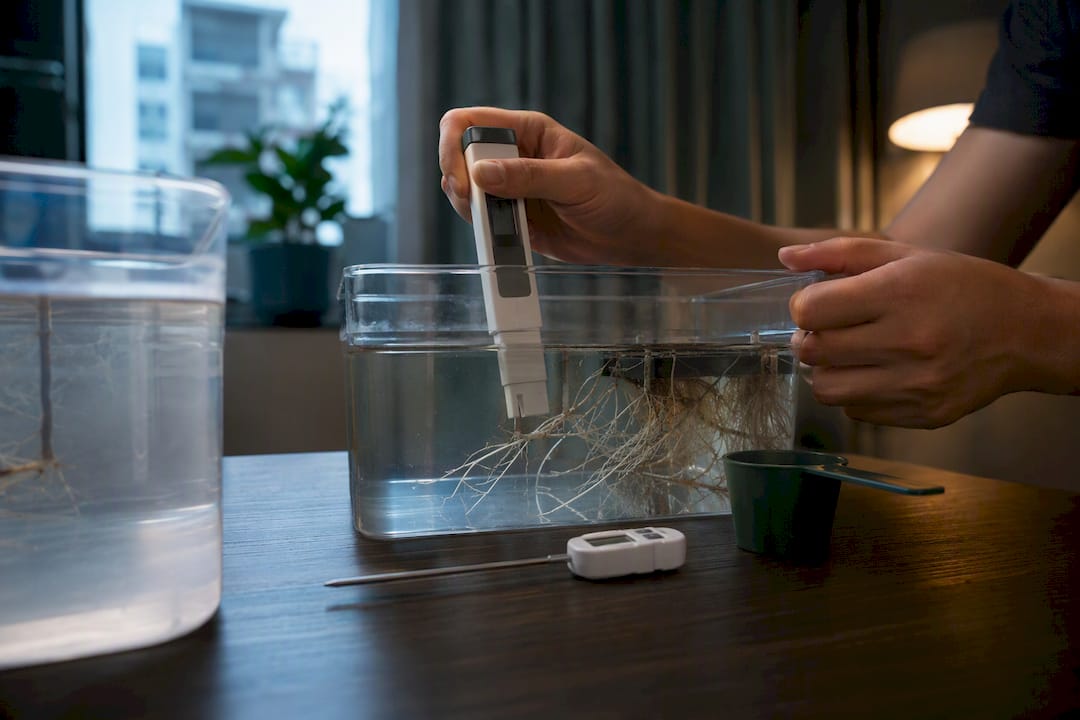
The ideal hydroponic pH range is 5.5 to 6.5, and a practical starting setpoint for most home systems is 6.0. This band keeps the widest set of nutrients dissolved and available to roots at once. Leafy greens tend to do best nearer 5.5 to 6.0, while fruiting crops like tomatoes and peppers lean toward 6.0 to 6.5. Your water source and its alkalinity determine how often you’ll need to step in and correct it.
TL;DR:
- Water alkalinity significantly influences how often pH adjustments are needed, especially with low-buffer tap water that can swing pH rapidly.
- Growing leafy greens near 5.5 to 6.0 and fruiting crops between 6.0 and 6.5 optimizes nutrient availability for most plants.
- Frequent testing with a calibrated digital pH meter, especially after reservoir changes, is crucial to maintain stable nutrient uptake.
- Small, incremental adjustments using proper acids or bases prevent overshooting the target pH range and minimize swings during the crop cycle.
- Chronic pH mismanagement leads to residue buildup, uneven root development, and reduced crop resilience, impacting yield over time.
The 5.5 to 6.5 window works for most hydroponic crops because it sits at the crossover point where the major and minor nutrients stay soluble together, according to extension guidance on hydroponic pH and EC. Starting at 6.0 gives you room to drift in either direction without leaving the safe zone.
Within that band, crop type still matters. Leafy greens and herbs like lettuce, basil, and spinach generally prefer 5.5 to 6.0, where nitrogen and potassium uptake run efficiently. Fruiting crops such as tomatoes, peppers, and strawberries do better closer to 6.0 to 6.5, which supports calcium and boron uptake during flowering and fruit set. Cucumbers are a common exception: many growers hold them slightly lower, around 5.5 to 5.8, to avoid the magnesium deficiency symptoms that show up when pH creeps past 6.0.

Here is a quick reference drawn from university extension tables:
These ranges come from crop-specific tables in extension literature on hydroponic nutrient solutions, which growers commonly used to fine-tune targets by crop rather than relying on one number for everything.
pH determines which nutrient ions can stay dissolved in solution and which precipitate out of reach. Iron, manganese, phosphorus, calcium, and magnesium are the most pH-sensitive: push pH above 6.5 and iron and manganese start locking out, causing the interveinal yellowing typical of iron deficiency. Push it below 5.5 and phosphorus and calcium uptake weaken, often showing up as stunted roots or blossom-end rot in fruiting crops.
Reservoir pH and root-zone pH are not the same thing. Roots release hydrogen or hydroxide ions as they take up nutrients, which shifts the pH right at the root surface even when your reservoir reading looks stable. That’s part of why a tank that tested fine yesterday can show deficiency symptoms today: the drift happened locally before it showed up in the tank. A study on lettuce grown at different nutrient solution pH levels found that plant mass and macronutrient uptake peaked near pH 5.5 to 6.5, with phosphorus uptake and overall biomass dropping noticeably once pH climbed higher. Watching for early symptoms, curled new growth, dulling leaf color, slowed root development, gives you a head start before a full reservoir test confirms the cause.
A handheld digital pH meter is the most reliable tool for home systems: it’s more accurate than pH strips or liquid test kits and holds its accuracy longer when you calibrate it properly. Calibration matters more than the meter itself.
Test daily for the first week after setting up a new reservoir or changing nutrient strength, then settle into checking every two to three days once the system stabilizes.
Pro Tip: Keep a spare set of calibration buffers on hand. A meter calibrated on old, contaminated buffer solution will give you a confident, wrong reading every time.
Mix your nutrients into the reservoir first, then measure pH, and only then adjust. Dosing acid or base into plain water and assuming the same result once nutrients dissolve is a common mistake, since nutrients change the solution’s buffering capacity and shift the final pH, according to practical hydroponic pH management guidance.
For lowering pH, phosphoric, nitric, and sulfuric acid are the standard choices because they stay stable in recirculating systems. Organic acids like vinegar or citric acid biodegrade quickly in a reservoir and tend to need repeated dosing that never quite holds, the same source notes. For raising pH, potassium hydroxide or standard pH-up solutions work at moderate concentrations. Avoid highly concentrated stock solutions of either type since a small dosing error can send pH swinging past your target.
Pro Tip: When you find yourself dosing the same reservoir three or more times in a day, the problem usually isn’t your dosing, it’s your water’s alkalinity fighting back.
pH and alkalinity are different measurements. pH tells you how acidic or basic the water is right now; alkalinity tells you how much acid or base it would take to move that number, because it measures the water’s buffering capacity. High alkalinity water resists pH changes and pulls the reading back up after you correct it, which is often the real reason pH keeps drifting back rather than staying put, according to Purdue Extension’s guidance on water alkalinity and substrate pH.
Tap water commonly runs a pH between 6.5 and 8.5, with low carbonate hardness around 1 to 3 dKH, and is treated with chloramine, according to reporting on tap water composition. Lowish water like this can actually swing pH faster than high-alkalinity water once you start dosing nutrients, since there’s less buffering to resist the shift.
Chasing an exact pH number invites constant micro-corrections and overshoot. A band approach works better: set a range like 5.8 to 6.4 with 6.0 as the midpoint, and only intervene when a reading falls outside it, an approach recommended in guidance on automated pH control.
Pro Tip: A simple notebook log of pH and EC readings over a few weeks will often show you the drift pattern faster than any single test can.
When pH drifts, plant symptoms usually point to the direction of the problem before a test confirms it. High pH commonly shows as interveinal yellowing on new leaves, an early sign of iron or manganese lockout. Low pH can show as leaf tip burn or dark, brittle new growth, sometimes from micronutrient toxicity as metals become too available.
Young seedlings and clones are the most sensitive to pH swings because their root systems are small and have little buffering capacity of their own. A swing that a mature plant shrugs off can stall a seedling’s early root development for days. During vegetative growth, sustained pH outside the 5.5 to 6.5 band slows nitrogen uptake, which shows up as smaller leaves and a slower overall growth rate rather than a dramatic symptom.
The flowering and fruiting stages are where pH mistakes cost the most. Calcium and boron uptake, both pH-sensitive, peak in importance right as fruit is setting, and a swing toward high pH during this window is a common cause of blossom-end rot in tomatoes and peppers even when calcium levels in the reservoir look adequate on paper. The nutrient was there, but the plant couldn’t take it up fast enough.
Repeated swings, even brief ones, tend to cost more yield than a single sustained deviation. A plant that recovers from one pH excursion can often catch up, but a system that oscillates between 5.0 and 7.0 every few days keeps roots in a constant state of adjusting rather than growing, and that shows up at harvest as smaller fruit, later maturity, or a shorter overall production window.
pH doesn’t work alone. Nutrient uptake depends on the combination of pH, electrical conductivity (EC), and root-zone temperature, and getting one wrong can mask or worsen problems with the others. A reservoir sitting at the right pH but with EC too high can still show nutrient lockout symptoms, because excess salt concentration interferes with uptake regardless of solubility.
Temperature adds another layer. Warmer reservoir water, especially above 75°F, holds less dissolved oxygen and tends to accelerate pH drift as biological activity in the system speeds up. Cooler root zones slow nutrient uptake generally, which can make a borderline pH reading look worse than it is because the plant simply isn’t pulling nutrients as fast. When you’re troubleshooting a deficiency symptom, checking EC and temperature alongside pH gives a clearer picture than checking pH in isolation. A plant showing yellowing leaves might be dealing with high pH, but it might also be dealing with EC that’s crept up from evaporation concentrating the nutrient solution, and the fix for each is different.
Keeping all three in their target ranges together, rather than fixing pH and hoping the rest follows, is what separates a stable system from one that needs constant intervention.
A single pH excursion is a hiccup. Months of poor pH control is a different problem entirely. Nutrient salts that repeatedly precipitate out of solution at the wrong pH build up as residue in tubing, drippers, and pumps, gradually restricting flow and creating dead zones where algae and root pathogens take hold.

Root systems chronically exposed to pH outside the 5.5 to 6.5 range develop unevenly, often thinner and more prone to rot, since the same conditions that lock out nutrients tend to favor pathogenic organisms over beneficial ones. A system that limps along at pH 7.0 for a full season doesn’t just yield less, it tends to need more frequent cleaning, more nutrient waste from plants that can’t fully use what’s dosed, and shorter equipment life as mineral scale accumulates on pumps and sensors.
The plants themselves also lose resilience. A crop grown under stable pH develops normally and handles the occasional stressor, heat, a missed feeding, well. A crop grown under chronic pH swings enters every growth stage already behind, which compounds: weaker vegetative growth leads to a smaller root system, which struggles more during flowering, which shows up as a disappointing harvest that often gets blamed on the wrong cause. Consistent pH management, more than any single input, is what keeps a hydroponic system productive across repeated crop cycles rather than degrading a little more with each one.
Most home growers treat pH as something to fix once and forget. It isn’t. It’s a moving target that shifts with every feeding, every bit of water the plant transpires, and every change in your source water. The growers who struggle most aren’t the ones who get a bad reading, they’re the ones who don’t have a routine for catching it early.
The bigger blind spot is alkalinity. Growers obsess over pH-up and pH-down bottles while ignoring the buffering capacity of their source water, which is often the real reason a “stable” system suddenly starts drifting again two weeks in. Testing your water once, at setup, and never again is like checking the weather once and packing for the whole season based on it.
If there’s one habit worth building, it’s this: treat pH management as a rhythm, not a repair. A quick daily glance at the reservoir catches small drifts before they become deficiency symptoms that take a week to correct.
— Irwin Lee
Getting pH right starts with knowing your water, and Sprout Lab’s hydroponic systems are built around that same principle: a compact, modular setup that makes it easier to monitor and correct conditions across up to 56 plants without needing a separate station for every check.
If you’re setting up a new reservoir this week, start with a water test, then stock up on what keeps pH stable rather than reactive:
Browse the full range of hydroponic systems and supplies to build a setup that makes pH management routine instead of a recurring scramble.
A good pH level for hydroponics falls between 5.5 and 6.5, with 6.0 working as a reliable starting point for most crops. This range keeps iron, phosphorus, calcium, and other key nutrients dissolved and available to roots, according to extension guidance on hydroponic pH.
Yes, a pH far above 6.5 is too high for a hydroponic nutrient solution. At elevated pH levels, most micronutrients, including iron and manganese, precipitate out of solution and become unavailable to roots, causing deficiency symptoms even when nutrients are present in the tank.
High pH causes nutrient lockout, most visibly with iron and manganese, which shows up as yellowing between the veins of new leaves. Left uncorrected, it slows growth and reduces yield, since research on lettuce grown at different pH levels found reduced phosphorus uptake and lower biomass as pH climbed.
Raise pH by adding a small measured dose of a standard pH-up solution or potassium hydroxide after your nutrients are already mixed in, then circulate and retest before adding more. Dosing in small increments avoids overshooting past your target range of 5.5 to 6.5.