Free shipping for order over $50

Free shipping for order over $50
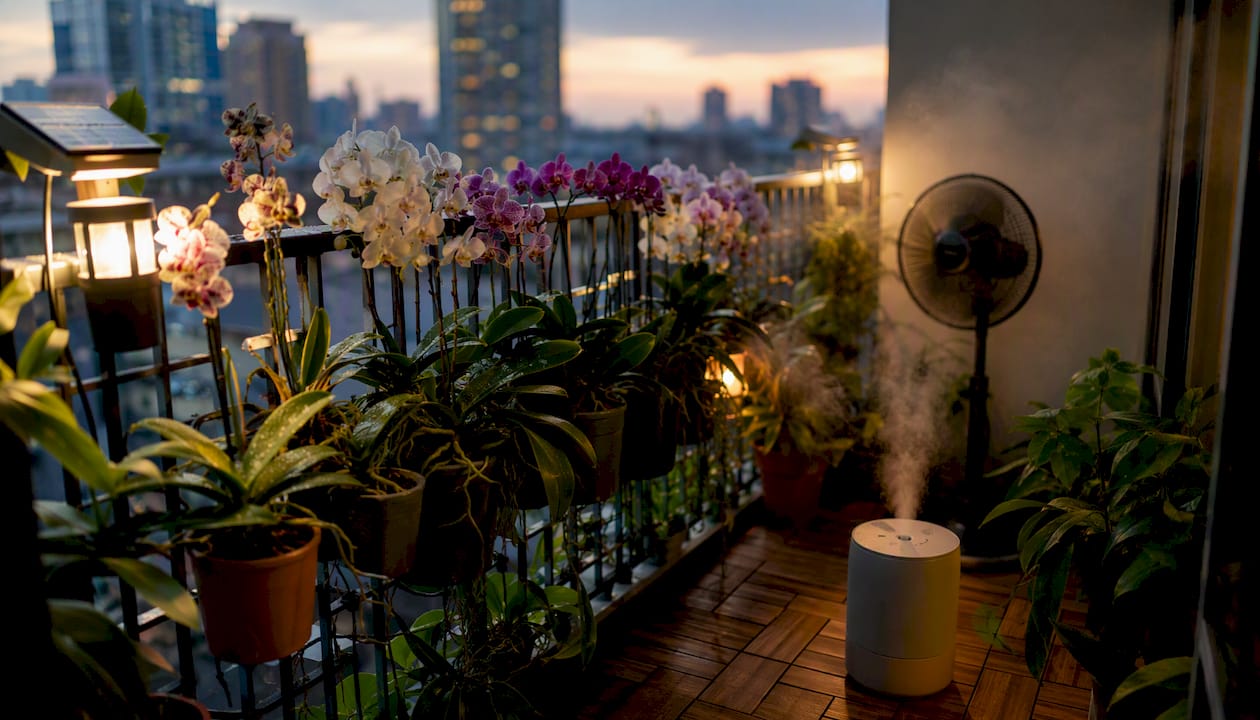
Most orchids thrive at 50%–70% relative humidity (RH), and the NYBG Mertz Library confirms that species-specific needs range from roughly 40% up to 80%. If you’re not sure where your home sits, here are three things to do right now:
Thick-leaved orchids like Phalaenopsis tolerate the lower end of that range. Thin-leaved types — Vandas, many Pleurothallids — need the upper half. CAM orchids open their stomata at night, so daytime dips matter less for them than for C3 species.
| Point | Details |
|---|---|
| Target RH range | Aim for 50%–70% for most orchids; thin-leaved types need the upper half of that range. |
| Measure at plant height | Place a digital hygrometer within 12 inches of leaves, away from vents and windows. |
| Humidifier over misting | Misting raises humidity for only about 20 minutes; a room humidifier is the reliable fix. |
| Airflow is non-negotiable | Pair any humidity increase above 65% with a fan to prevent rot and fungal disease. |
| Adjust by season | Winter heating drops indoor RH to 20%–30%; run a humidifier continuously and water more often. |
Humidity controls how fast water moves out of a leaf. When RH drops, the vapor pressure gradient between leaf tissue and dry air steepens, pulling moisture out faster than roots can replace it. The result shows up as visible stress before any soil dryness does.
Signs of low humidity:
Pseudobulbs or leaves shriveling despite adequate watering
Flower buds blasting (dropping before opening)
Potting media drying out noticeably faster than usual
Leaf tips browning or becoming papery
Water droplets sitting on leaves for hours
Black or brown soft spots, especially at the crown or base
Powdery or fuzzy fungal patches on leaves or bark media
A musty smell around the growing area
The cause-and-effect is direct: shriveling pseudobulbs point to low RH or low VPD; soft rot at the crown points to high RH combined with stagnant air. Knowing which direction you’re off in saves a lot of guesswork.
The Clemson Home & Garden Information Center recommends 40%–60% RH as a year-round target for most home orchids, and that range works as a safe household compromise for mixed collections. Species-specific targets vary, though.
| Orchid group | Practical RH target | Notes |
|---|---|---|
| Phalaenopsis | 50%–70% | Tolerates 40% short-term; thick leaves buffer dryness |
| Cattleya alliance | 45%–65% | Pseudobulbs store water; tolerates brief dips |
| Vanda / Ascocenda | 60%–80% | Thin, strap leaves; needs consistent high RH |
| Paphiopedilum | 50%–70% | Terrestrial; prefers steady mid-range humidity |
| CAM orchids (e.g., some Dendrobiums) | 40%–60% daytime | Stomata open at night; daytime dips less stressful |
| Thin-leaved C3 species (Pleurothallids, etc.) | 65%–80% | Most sensitive; needs a humidifier or terrarium |
The American Orchid Society’s humidity guidance notes that misting does not raise ambient room humidity for long, so hitting that target requires a more persistent strategy than a spray bottle.
A digital hygrometer is the only reliable tool. Analog dial models drift over time and can read 10–15 percentage points off without any obvious sign of failure.
Placement matters as much as the device itself:
Pro Tip: Place a second hygrometer at floor level if you keep orchids on low shelves — cold air sinks and holds less moisture, so floor-level RH can run 5–10 points lower than the reading at countertop height.
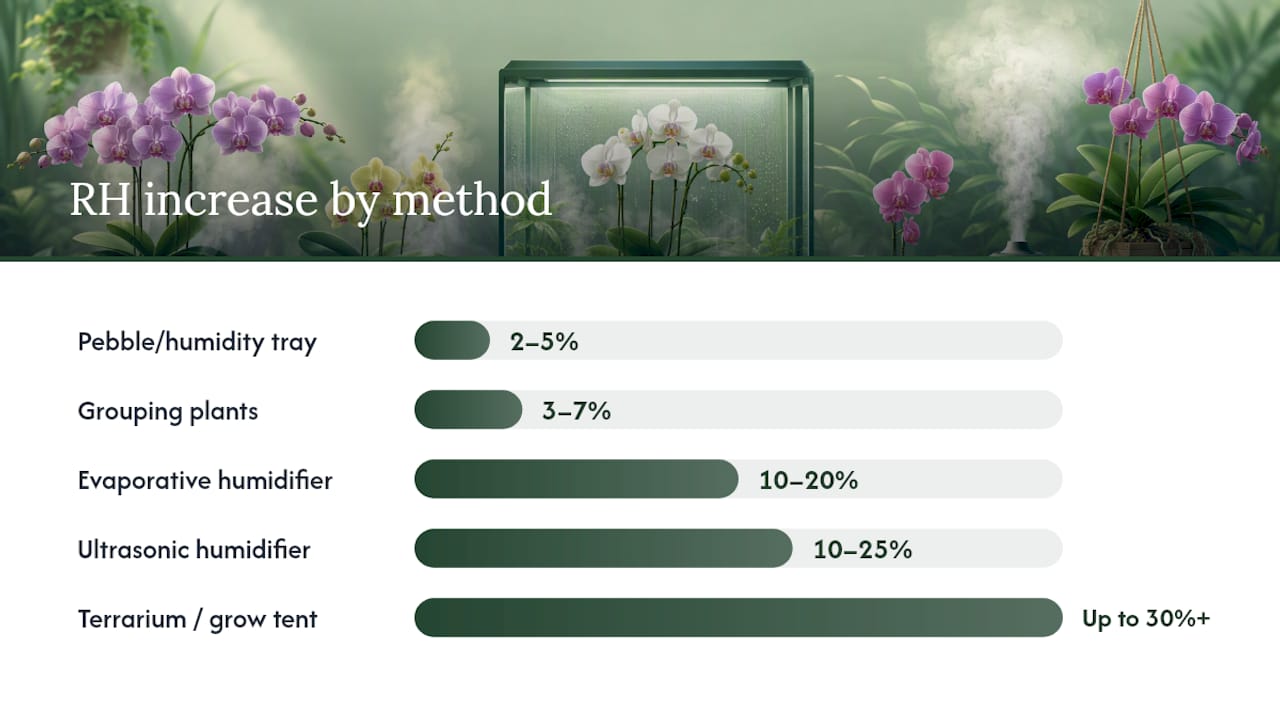
The honest answer is that most low-effort fixes raise RH only a few percentage points in a typical room. Knowing what each method actually delivers helps you combine them sensibly.
| Method | Realistic RH lift | Best for | Limitations |
|---|---|---|---|
| Pebble/humidity tray | 2–5% (very local) | Single plant or small grouping | Negligible for mounted plants or larger rooms |
| Grouping plants | 3–7% (local) | Small collections on one shelf | Limited in very dry homes below 30% RH |
| Ultrasonic humidifier | 10–25% (room-scale) | Most apartment setups | Requires distilled water; white mineral dust with tap water |
| Evaporative humidifier | 10–20% (room-scale) | Larger rooms; self-regulating | Slower response; filter maintenance needed |
| Warm-mist humidifier | 10–20% (room-scale) | Cooler rooms in winter | Higher energy use; hot steam near plants is risky |
| Terrarium / grow tent | Up to 30%+ (enclosed) | Thin-leaved species; seedlings | Requires active airflow management to prevent rot |
Misting gets a lot of attention, but the American Orchid Society is clear: the effect dissipates within about 20 minutes and stays localized to the leaf surface. It refreshes leaves temporarily but does nothing for ambient RH. A room humidifier is the only method that reliably shifts the number on your hygrometer.
For small humidifiers: match output (quarts per hour) to your room’s volume. A unit sized for a 150-square-foot room won’t move the needle in an open-plan apartment. Grouping orchids with moisture-loving companions like ferns adds a modest local boost, but as Gardening Know How notes, grouping alone rarely compensates for persistently dry indoor air.
For indoor gardening in small spaces, a mini-greenhouse or grow tent creates a contained microclimate where a small humidifier can actually reach target RH without fighting the whole apartment’s dry air.
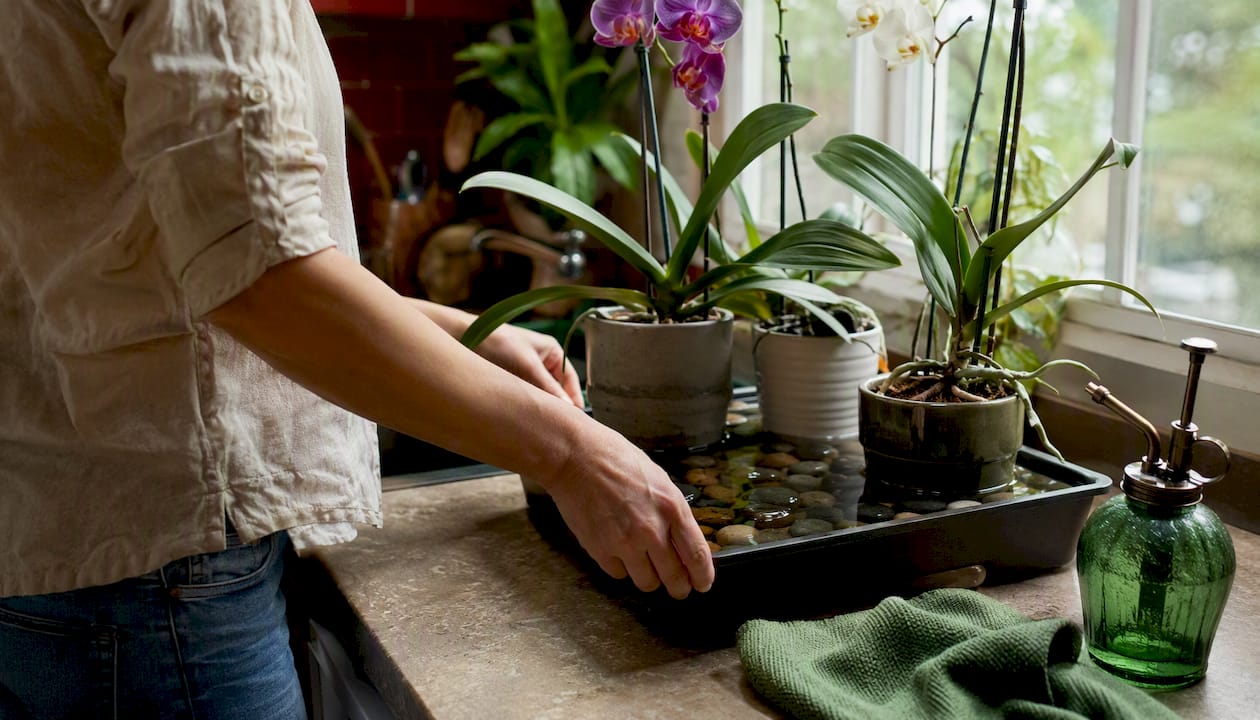
A pebble tray is worth building for a small grouping even knowing its limits. Done correctly, it keeps the immediate air around your plants slightly more humid and reduces how fast pots dry out from below.
What you need:
Assembly:
Safety notes: Rinse the tray and replace the gravel every two to three weeks. Standing water that sits too long breeds fungus gnats and algae. Never let potting bark or moss wick water up from the tray — that’s a direct path to root rot. The American Orchid Society notes that trays raise humidity only in a very localized zone, so pair the tray with a humidifier if your room RH consistently reads below 45%.
High humidity without air movement is the fastest route to crown rot and fungal leaf spots. The American Orchid Society puts it plainly: air circulation is as critical as moisture itself.
A small oscillating fan set to its lowest speed, positioned so it moves air across (not directly into) the plants, is enough. You want leaves to sway slightly, not thrash. Intermittent circulation — a fan on a timer for 15 minutes every hour — works well for small rooms and uses less energy than running it continuously.
Watch for these early warning signs of stagnant air: water droplets sitting on leaves more than two hours after watering, a musty smell near the growing area, or soft brown patches appearing at leaf bases or the crown. Catching these early means the difference between wiping off a fungal spot with diluted hydrogen peroxide and losing the plant entirely.
Pro Tip: If you’re running a humidifier and a fan in the same room, point the fan so it circulates air around the plants rather than blowing directly at the humidifier’s output — you want the moist air to linger near the leaves, not get pushed straight to the ceiling.
Watering frequency is not a fixed schedule. It’s a function of RH, temperature, and how fast your potting medium dries. The American Orchid Society’s VPD resource makes the case that Vapor Pressure Deficit (VPD) predicts plant water stress better than RH alone, because VPD accounts for temperature’s effect on how aggressively air pulls moisture from leaves.
VPD is the difference between how much water vapor air could hold at a given temperature and how much it actually holds. For most thin-leaved orchids, a VPD of roughly 0.5–1.2 kPa keeps transpiration in a healthy range. Below 0.5 kPa (very humid, cool air), transpiration slows and nutrient uptake can stall. Above 1.2 kPa (warm, dry air), plants lose water faster than roots can supply it.
For practical watering decisions, consider options like the bridal bouquet orchids that showcase popular orchid uses and care needs.
For growers who want to take the guesswork out of timing, automating your watering system with a moisture sensor removes the daily lift-and-check routine entirely.
Winter (heating season): Forced-air furnaces and baseboard heaters are the biggest threat to orchid humidity. Missouri Botanical Garden’s orchid culture guide notes that indoor RH commonly drops to 20%–30% in heated homes, well below the 40% floor most orchids need.
Summer (air-conditioning season): AC removes moisture from the air, though usually less aggressively than winter heating.
Spring and fall: These transitional seasons are the easiest for orchid humidity. Use the calmer conditions to recalibrate your hygrometer and clean your humidifier before the next heating season.
Most humidity problems come down to a handful of repeatable errors.
Troubleshooting by symptom:
When small fixes don’t move the needle, a grow tent or enclosed compact growing system lets you control the microclimate of a small collection without humidifying your entire apartment.
Most growers spend too much time worrying about the exact RH percentage and not enough time watching the plants themselves. A hygrometer is a tool for calibration, not a substitute for observation. The most reliable signal that your humidity is right is a plant that produces firm, plump pseudobulbs, opens buds without blasting, and shows no soft spots at the crown.
One placement tip that changed how I think about apartment orchid care: put your hygrometer at the same height as the leaf canopy, not on a shelf above or below it. The reading at countertop height in a small room can differ from the reading at floor level by enough to push a Vanda into stress territory while your Phalaenopsis looks fine. Two hygrometers, two heights, one honest picture of what your collection is actually experiencing.
Sprout-lab’s resources for indoor plant care cover humidity strategies that translate directly to orchid collections, particularly for growers managing multiple species in compact spaces.
If you’re managing a small indoor collection and want a growing setup that makes humidity control easier from the start, Sprout-lab’s compact growing systems are designed for exactly this kind of apartment-scale challenge.

Explore home garden automation options to add humidity sensors and timers that take the daily monitoring off your plate entirely.
Yes.
Fill a shallow tray with an inch of washed pea gravel or LECA, add water to just below the gravel surface, and set orchid pots on top so drainage holes never touch the waterline. Rinse and refill every two to three weeks to prevent algae and fungus gnats.
Watering frequency depends on RH and temperature, not a fixed schedule.
Most common orchids tolerate brief exposure to 50°F (10°C), but sustained cold at that temperature stresses tropical genera like Phalaenopsis and Vandas. Cold air also holds less moisture, so RH drops and watering needs increase. Keep orchids above 60°F whenever possible and away from cold windowsills in winter.