Free shipping for order over $50

Free shipping for order over $50
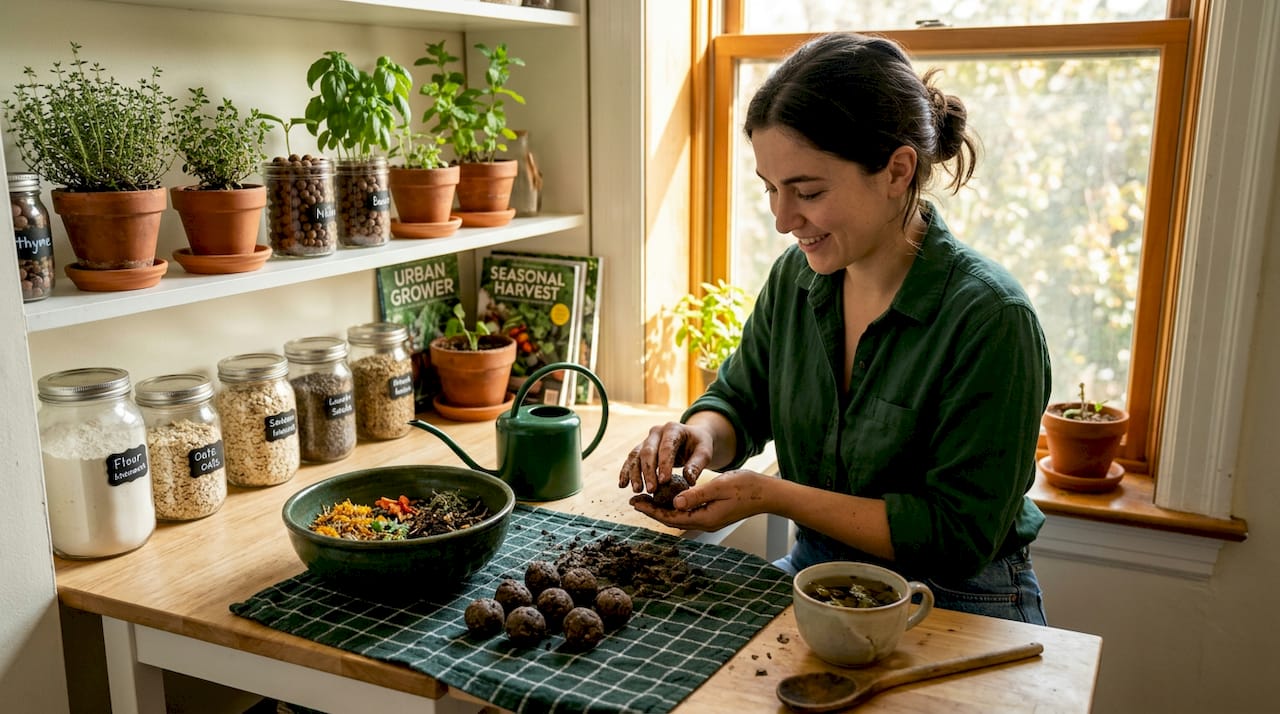
If you searched “growing balls” hoping to find gardening advice, you are in the right place. If you landed here looking for something else entirely, note that inflating testicles with saline is a medically dangerous practice with no place in this article. This guide is about two genuinely useful growing ball techniques for food gardeners working with tight spaces: seed balls, a centuries-old planting method, and LECA (lightweight expanded clay aggregate), the hydroponic medium urban growers swear by. Both let you grow edible plants with less soil, less mess, and less watering than traditional methods demand.
| Point | Details |
|---|---|
| Seed balls need surface contact | Place them directly on soil without burying to trigger germination through moisture. |
| LECA requires nutrient solution | These clay balls hold no nutrients, so you must add a hydroponic feed to every watering. |
| Site choice beats recipe | Seed ball success depends more on moisture and sunlight than on the exact clay-to-seed ratio. |
| LECA is not a soil additive | Mixing LECA into potting soil risks root rot; use it as a standalone hydroponic medium. |
| Both methods suit small spaces | Seed balls need no digging; LECA setups grow up to 56 plants in compact modular systems. |
The term “growing balls” covers two distinct techniques in modern gardening. Understanding ball growth starts with knowing what each method is made of and why it works.
Seed balls are compact spheres made from three ingredients: seeds, dry clay powder, and compost or aged manure. The clay acts as a protective shell. The compost feeds the seedling once germination begins. The seeds sit dormant inside until moisture softens the clay and signals them to sprout. According to the Maricopa Native Seed Library, seed balls are placed whole on the soil surface rather than buried, and they rely on rain or manual watering to trigger that clay disintegration.
This design solves a real problem for small-space and urban gardeners. You do not need to break ground, disturb existing soil, or space seeds with precision. Drop them on a patch of exposed earth, a rooftop planter, or a balcony container, and let moisture do the work.
LECA balls are a completely different product. These are small, round pellets made by firing clay at extremely high temperatures. That process creates an internal porous structure that absorbs water and releases it gradually. LECA holds no nutrients at all. It functions as a physical growing medium that delivers two things roots need most: consistent moisture and oxygen. For small urban growing setups, LECA is particularly effective because the system is reusable, lightweight, and produces almost no mess.
Here is the key distinction most new gardeners miss. Seed balls are a planting method. You use them once, the plant grows, and the ball is gone. LECA is a reusable medium that replaces soil in a hydroponic or semi-hydroponic container. They serve different purposes, but both belong in the toolkit of anyone asking how to grow balls of the edible variety.
Seed balls trace back to Japanese farmer Masanobu Fukuoka, who used them to broadcast seeds across large areas without plowing. The approach works just as well on a three-square-foot balcony planter as it does on an acre of wild land.
The standard composition breaks down like this:
The ratio matters less than most tutorials suggest. Seed ball success depends more on site selection and moisture availability than on hitting a precise recipe. A ball placed on bare soil in partial sun with regular rain will consistently outperform a perfectly crafted ball dropped in full shade on packed gravel.
Pro Tip: Make seed balls slightly smaller than a golf ball for food plants. Smaller balls dry out faster after rain, which reduces mold risk, and they are easier to tuck into container edges or tight corner spots on a balcony.
For food plants specifically, herbs like basil, cilantro, and dill germinate reliably in seed balls. Leafy greens such as spinach and arugula also work well. Root vegetables are not a good fit because the ball cannot control depth, and carrots or radishes need loose, deep soil below the germination point.
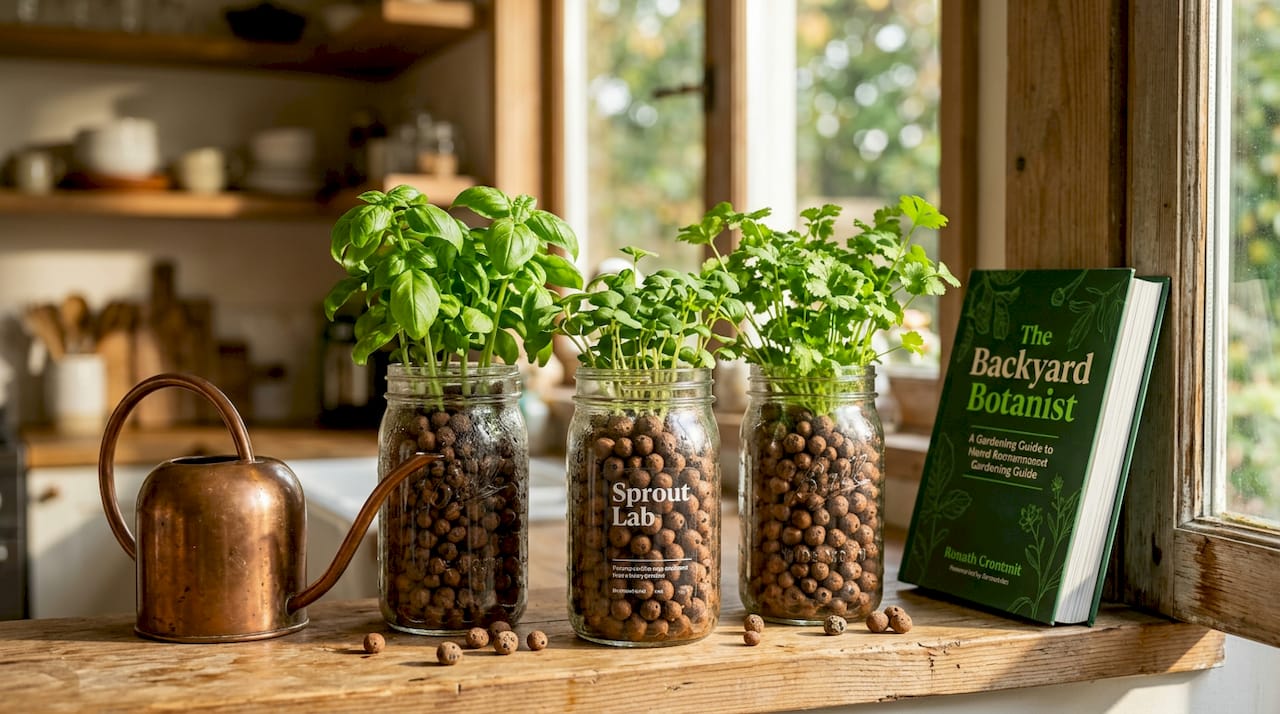
The sprouted grain connection is worth noting here too. Seed balls essentially do what a sprouted grain does in food production: they pre-load the seed in a nutrient-dense environment and release it only when conditions are right, reducing waste and improving germination rates.
LECA is the technique most apartment gardeners discover after their first failed attempt with soil in a windowsill planter. The benefits are real and worth understanding in detail.
What LECA actually does for your plants:
The critical limitation is nutrition. LECA is completely inert. It provides zero nutrients. Every mineral your plant needs must come through the water you add. This means using a balanced hydroponic nutrient solution and monitoring water pH, ideally keeping it between 5.5 and 6.5 for most food crops.
Pro Tip: Before setting up any LECA system, soak the pellets in clean water for 24 hours and rinse them thoroughly. Fresh LECA often has a high pH from the firing process, which will stress roots if you skip this step.
The mistake that kills most first-time LECA setups is treating it like a soil amendment. Mixing LECA with potting soil creates an uneven water table inside the pot and can starve roots of oxygen. Use LECA alone, in a purpose-built hydroponic container, or in a passive semi-hydroponic setup where a reservoir sits below the root zone.
Choosing between seed balls and LECA comes down to what you are trying to grow, where you are growing it, and how much time you want to spend on maintenance.
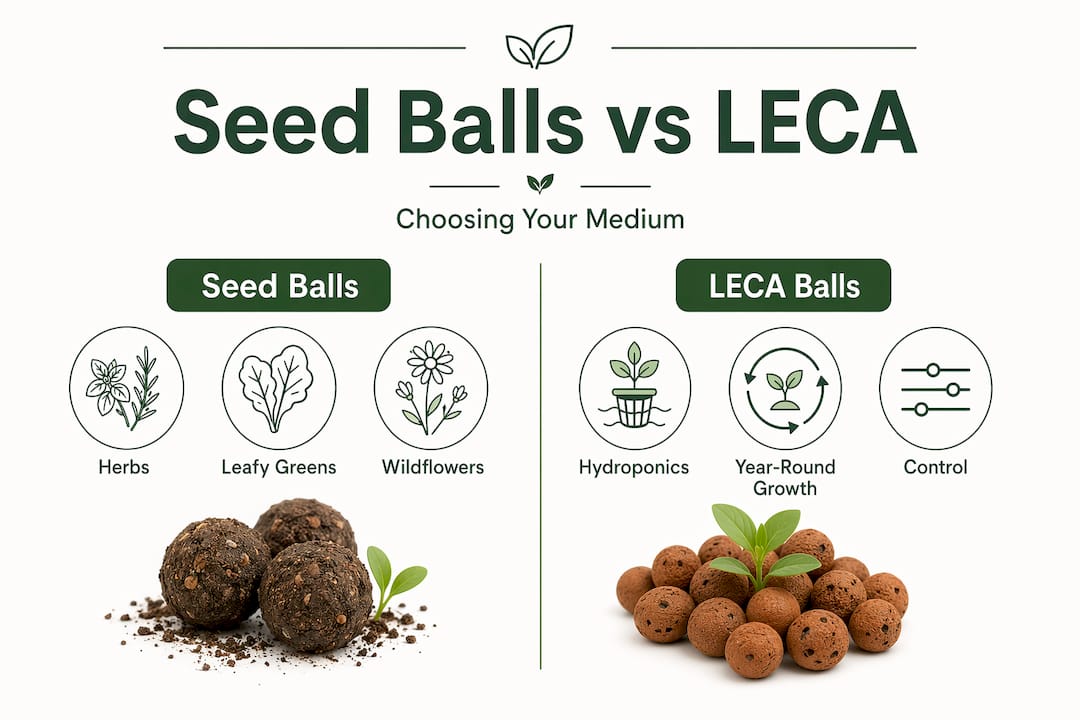
| Feature | Seed balls | LECA balls |
|---|---|---|
| Best for | Herbs, leafy greens, wildflowers | Herbs, lettuce, leafy greens, indoor food crops |
| Watering needs | Rain or occasional manual watering | Regular hydroponic nutrient solution |
| Nutrients | Built in (compost layer) | Must be added every watering |
| Reusability | Single use | Indefinitely reusable |
| Setup complexity | Very low | Moderate (requires container and nutrients) |
| Indoor suitability | Limited (needs natural light and outdoor exposure) | High |
| Space required | Minimal (scatter on any exposed soil) | Minimal (stacks vertically in modular systems) |
| Pest risk | Low | Very low |
Seed balls win on simplicity. If you have a patch of outdoor soil, a rooftop, or a balcony with decent rainfall, seed balls are the lower-effort entry point into unconventional food growing. You spend about 20 minutes making them, place them, and check back in two to three weeks.
LECA wins on control and year-round performance. Indoors under grow lights, a LECA-based semi-hydroponic setup can produce lettuce, herbs, and leafy greens continuously regardless of season. The upfront learning curve is steeper, but the long-term results are more consistent.
Both techniques are straightforward once you know the steps. Here is how to get started with each.
For seed balls:
For a passive LECA setup:
Pro Tip: For food crops in LECA, start with herbs like mint or basil. They adapt to semi-hydroponic conditions faster than almost any other edible plant and will give you visible growth within two weeks, which helps you dial in your nutrient and pH routine before moving to more demanding crops.
Planting is the easy part. Keeping your system healthy over weeks and months is where most gardeners lose momentum. These ball growth techniques are lower maintenance than soil, but they are not zero maintenance.
Key care habits to build:
Seed balls, once the plant has established, transition into a normal grow. The ball itself disappears into the soil. Your job from that point is the same as with any container or garden bed plant.
I have worked with both seed balls and LECA systems in setups ranging from a single kitchen windowsill to a 30-plant balcony rack. My experience is that both methods are genuinely better for small-space gardeners than most soil-based approaches, but for completely different reasons.
Seed balls surprised me with how forgiving they are. My first batch used a rough clay-to-compost ratio and inexpensive herb seeds. Most germinated. The ones that failed were the ones I accidentally placed in a shadier corner, not anything to do with the ball itself. This confirmed what the research shows: site matters more than recipe.
LECA took longer to click. My first setup failed because I did not clean the roots properly when transplanting a basil plant from soil. Root rot set in within ten days. Once I started clean with seedlings grown directly in LECA from the start, everything changed. The system design matters enormously. The LECA itself is not magic. The reservoir level, the pH, the nutrient concentration: these are the actual variables.
What most beginners miss is that these methods reward patience and observation more than effort. You do not need to water more, fertilize more, or hover over your plants. You need to check the right things at the right intervals and adjust when something looks off. Start with one herb in LECA and a half-dozen seed balls outdoors. See what happens. That first successful harvest from an unconventional setup is genuinely motivating, and it teaches you more than any guide can.
For deeper reading, Sprout-lab’s low-touch growing guide covers these principles in more detail for busy urban gardeners.
— Luna
If you are ready to move from reading to growing, Sprout-lab has the products to make either method work from day one. The passive hydroponic system setup is purpose-built for LECA-based growing in compact spaces, supporting up to 56 plants without a single square foot of outdoor soil. For seed ball gardeners, Sprout-lab’s soil mixes and planting mediums give you the compost base that makes every ball more effective. All products are backed by a 4.9/5 star rating from over 25,000 orders, and the team’s growing guides walk you through setup step by step so you are not guessing at nutrient ratios or pH levels.
In gardening, “growing balls” refers to seed balls and LECA clay pellets. Seed balls are clay-and-compost spheres that protect seeds until moisture triggers germination, while LECA balls are porous clay pellets used as a soil-free hydroponic growing medium.
Seed balls are placed directly on the soil surface where moisture softens the clay, releasing seeds to germinate. They work well for herbs and leafy greens but are not suitable for root vegetables that need deep, loose soil.
Yes. LECA supports food crops including herbs, lettuce, and leafy greens when used with a hydroponic nutrient solution. Because LECA is inert, the nutrient solution provides everything the plant needs to grow.
Mixing LECA into potting soil is the most common error. LECA should be used as a standalone medium in a container with a water reservoir. Mixing it with soil disrupts drainage and oxygen flow, leading to root rot.
No. Seed balls placed in rain-prone outdoor spots often need no supplemental watering at all. In drier conditions, light watering after placement and during dry spells is enough to trigger and sustain germination.