Free shipping for order over $50

Free shipping for order over $50
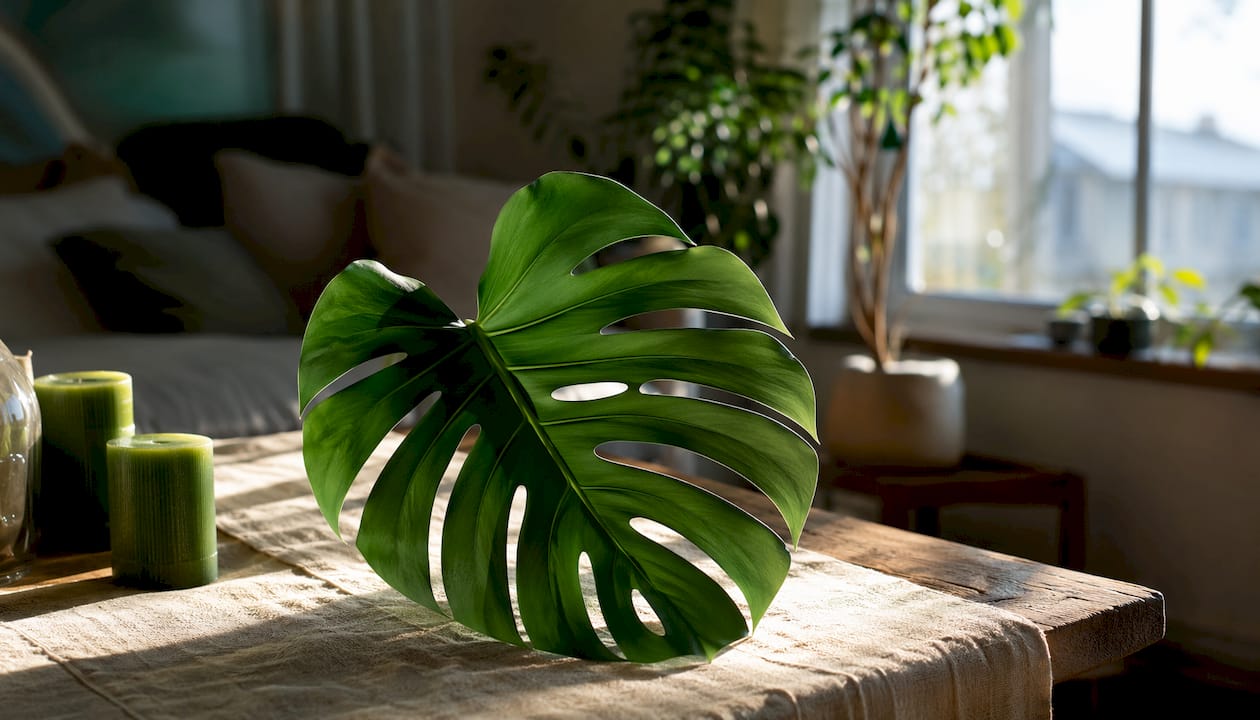
Fenestration in aroids is the natural formation of holes, slits, or perforations in the leaf blade — not damage, not disease, just the plant doing exactly what it evolved to do. The word comes from the Latin fenestratus, meaning “provided with openings,” and it describes those iconic gaps you see in a mature Monstera deliciosa or the Swiss-cheese-like holes punching through a Monstera adansonii leaf. If you’ve ever wondered whether something was wrong with your plant, the short answer is no. Those holes are the point.
Fenestrations develop through programmed cell death during early leaf development. Specific regions of the leaf lamina stop growing or die off before the leaf fully expands, and as the rest of the blade stretches outward, those gaps become holes or slashes. The timing of that cell death determines the shape:
Pro Tip: If you see irregular, ragged holes with brown or yellowing margins on a leaf that was previously whole, that’s pest or pathogen damage — not fenestration. True fenestrations have clean, smooth edges and appear as the leaf opens.
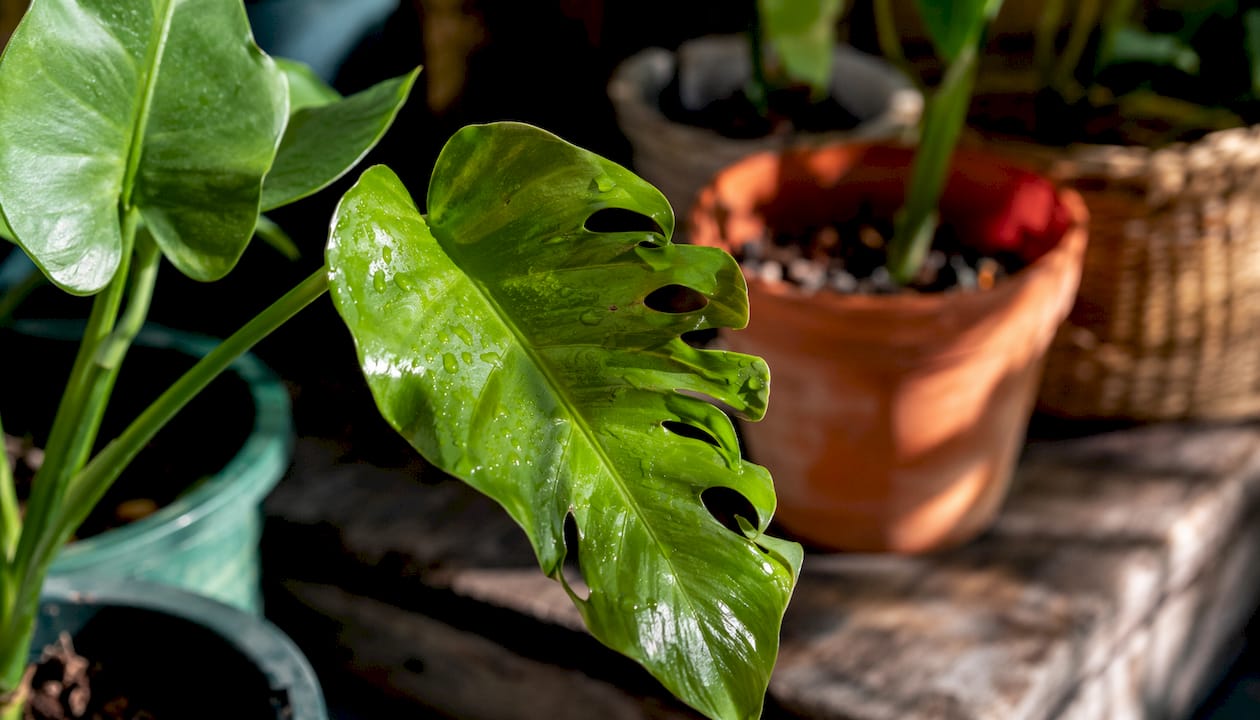
Botanists have proposed several adaptive advantages for fenestration, and the honest answer is that more than one may be true simultaneously. Field research on Monstera suggests that fenestrated leaves direct water more efficiently toward the root zone than solid leaves — a meaningful advantage for a climbing plant whose roots may be meters below the canopy where rain hits.
The leading hypotheses, ranked roughly by current evidence:
Evidence varies by study, and no single hypothesis has been confirmed as universal across all fenestrated aroids. Water-routing currently has the strongest field support in Monstera populations, but the other mechanisms likely contribute in different species or habitats.
Monstera is the genus most people associate with fenestrated leaves, but it’s not the only one. Here’s a quick breakdown of the species you’re most likely to encounter:
Not all aroids fenestrate. Pothos (Epipremnum), peace lily (Spathiphyllum), and most Aglaonema species produce solid leaves throughout their lives. Fenestration is a trait of specific genera, not a family-wide characteristic.
Here’s the thing most growers don’t hear clearly: fenestration indoors is largely aesthetic. The ecological pressures that selected for holes in the wild — torrential rain, competing canopy, high winds — are absent in your living room. Your Monstera doesn’t need fenestration to survive. But you probably want it, and that’s a fair goal.
The path to fenestrated leaves runs through maturity and consistent culture, not tricks:
Pro Tip: Never cut holes into a leaf to simulate fenestration. The plant won’t “learn” from it, and you’ll just have a damaged leaf. Real fenestration only happens during leaf development, before the leaf unfurls.
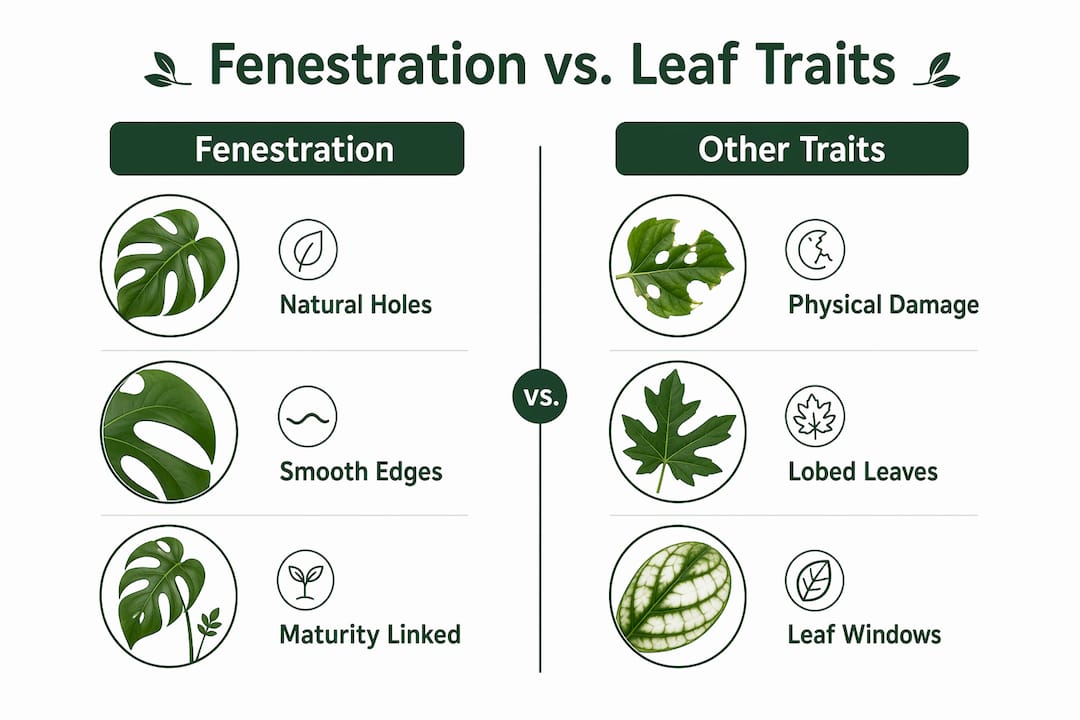
| Feature | Fenestration (aroids) | Physical damage | Lobed leaves | Leaf windows (succulents) |
|---|---|---|---|---|
| Cause | Programmed cell death | Mechanical or pest injury | Developmental blade division | Translucent epidermal tissue |
| Margins | Smooth, clean | Ragged, brown, or yellowing | Smooth, continuous with blade | No opening — tissue is solid |
| Pattern | Consistent per species | Random, irregular | Species-specific symmetry | Patches or streaks on leaf surface |
| Present in juveniles? | Rarely | Can occur at any stage | Sometimes | Yes |
| Structural opening? | Yes — hole through blade | Yes — but unintended | No — indentation only | No — translucent, not perforated |
The leaf window in succulents like Haworthia and Fenestraria shares the name “fenestration” in some botanical texts but describes something entirely different: translucent epidermal tissue that channels light into buried photosynthetic cells. No hole, no perforation — just a window of clear tissue. The two strategies solve different problems in different environments and shouldn’t be conflated.
Fenestration in aroids is a maturity-linked developmental trait produced by programmed cell death, not damage, and indoors it functions primarily as an aesthetic marker of a well-grown, mature plant.
| Point | Details |
|---|---|
| Definition and etymology | Fenestration means natural holes or slits in the leaf blade; from Latin fenestratus, “provided with openings.” |
| Developmental cause | Programmed cell death during leaf expansion creates the perforations; timing determines whether slashes or round holes form. |
| Maturity signal | Juvenile aroid leaves rarely fenestrate; consistent holes signal the plant has reached adult growth stage. |
| Indoor implications | Fenestration is largely aesthetic indoors; bright indirect light, vertical support, and steady nutrition encourage it. |
| Not the same as damage | True fenestrations have smooth, clean margins; ragged or discolored holes indicate pests or physical injury. |
Most growers fixate on getting holes fast. The better question is whether the plant has the conditions to mature at all. A Monstera kept in low light on a flat surface will produce solid, juvenile leaves indefinitely — not because it’s unhealthy, but because nothing is signaling it to climb and develop adult morphology. Give it a pole, give it light, and give it time. The fenestration follows naturally.
Sprout-lab’s soil mixes are formulated for the drainage and aeration aroids need to build strong root systems — the foundation for the consistent growth that eventually produces those fenestrated adult leaves. Pair a well-draining mix with a grow pole and a reliable fertilizer schedule, and you’ve covered the three variables that matter most.
Fenestration refers to the natural holes, slits, or perforations that form in the leaf blade of certain aroid plants. The term comes from the Latin fenestratus, meaning “provided with openings.”
Juvenile Monstera leaves rarely fenestrate — holes develop as the plant matures. Insufficient light, lack of vertical support, or young plant age are the most common reasons a Monstera stays solid-leaved.
No. Fenestrations have smooth, clean margins and appear as the leaf opens; damage from pests or physical tearing produces ragged, irregular holes, often with brown or yellowing edges.
Monstera deliciosa and Monstera adansonii are the most reliably fenestrated aroids in home settings. Rhaphidophora tetrasperma produces similar-looking splits, though these are technically deep lobes rather than true perforations.
You can’t create holes on demand, but you can encourage faster maturity. Bright indirect light, a moss pole or grow pole for vertical climbing, consistent humidity above 50%, and a balanced fertilizer during the growing season all support the adult leaf development that brings fenestration.