Free shipping for order over $50

Free shipping for order over $50
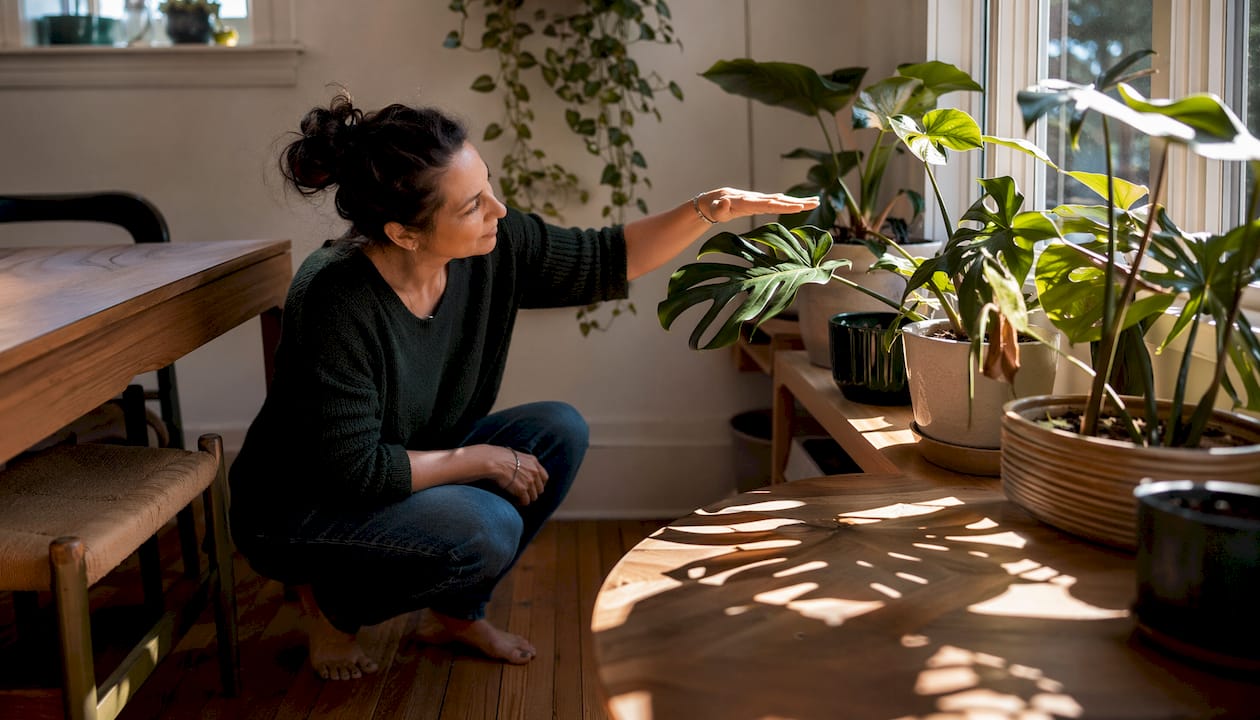
Most aroids thrive indoors at bright indirect light levels suitable for most species. That range covers everything from a Monstera sitting close to an east-facing window to a velvet Philodendron under a slim LED bar. The key phrase you keep reading, “bright indirect light,” actually means something measurable: a room bright enough to read comfortably all day, no direct sun touching the leaves, and enough ambient light to cast a faint, soft shadow on the wall.
Here is what that looks like in practice:
Pro Tip: Hold your hand about a foot above the plant and look at the shadow it casts. A soft but clear shadow means there is enough usable light for photosynthesis. No shadow at all, and your plant is almost certainly getting less light than you think.
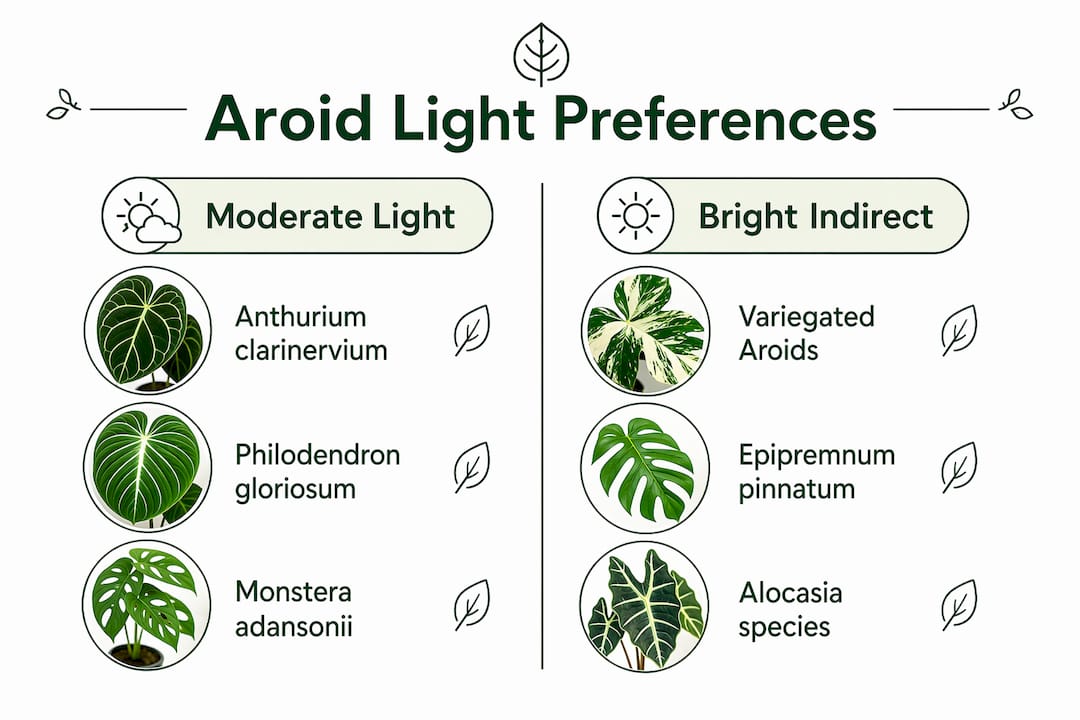
Not every aroid wants the same thing, and the differences matter more than most growers expect. Leaf texture, color, and growth habit all shift the ideal intensity. Velvet-leaved species, for example, absorb and reflect light differently than glossy-leaved ones, making them more sensitive to both too much and too little.
| Species/Group | Light preference | Notes |
|---|---|---|
| Anthurium clarinervium | moderate bright indirect light | Texture holds at modest light; avoid hotspots |
| Anthurium crystallinum | moderate bright indirect light | Sheen improves with brighter light |
| Philodendron verrucosum | lower to moderate bright indirect light | Velvet leaves scorch sooner; keep humidity moderate |
| Philodendron gloriosum | moderate bright indirect light | Broad blades prefer even light |
| Monstera deliciosa (green) | moderate to bright indirect light | Leaf splits improve with brighter light |
| Monstera Thai Constellation | bright indirect light | Keep leaf surface cool using shade or airflow |
| Alocasia (jewel types) | moderate bright indirect light | East window ideal; avoid harsh afternoon sun |
| Syngonium | moderate bright indirect light | Brighter light produces compact growth and better color |
Variegated plants are worth a separate note. The white or cream tissue in a variegated leaf contains no chlorophyll, so the green portions have to work harder. That is why variegates generally need more light than their all-green relatives, not less. Monitor the newest leaf every two weeks; if it comes in smaller than the previous one, light is usually the first thing to check.
Your plant will tell you when the light is wrong. The tricky part is that light stress and watering problems look similar at first glance, so knowing which symptoms belong to which cause saves a lot of unnecessary repotting and schedule changes.
The confusion with watering is real. A plant in low light uses water slowly, so the soil stays wet longer. Many growers interpret that wet soil as a sign they are watering correctly, when actually the plant is sitting in stagnant moisture because it lacks the light energy to drive transpiration. Light is often the limiting factor for indoor aroid growth, and many issues attributed to watering or nutrients start with insufficient light.
Measuring light removes the guesswork that causes most indoor aroid problems. Human eyes adapt to varying light conditions and consistently overestimate how bright a room actually is for a plant. What feels like a well-lit corner to you may register as dim shade at the leaf surface.
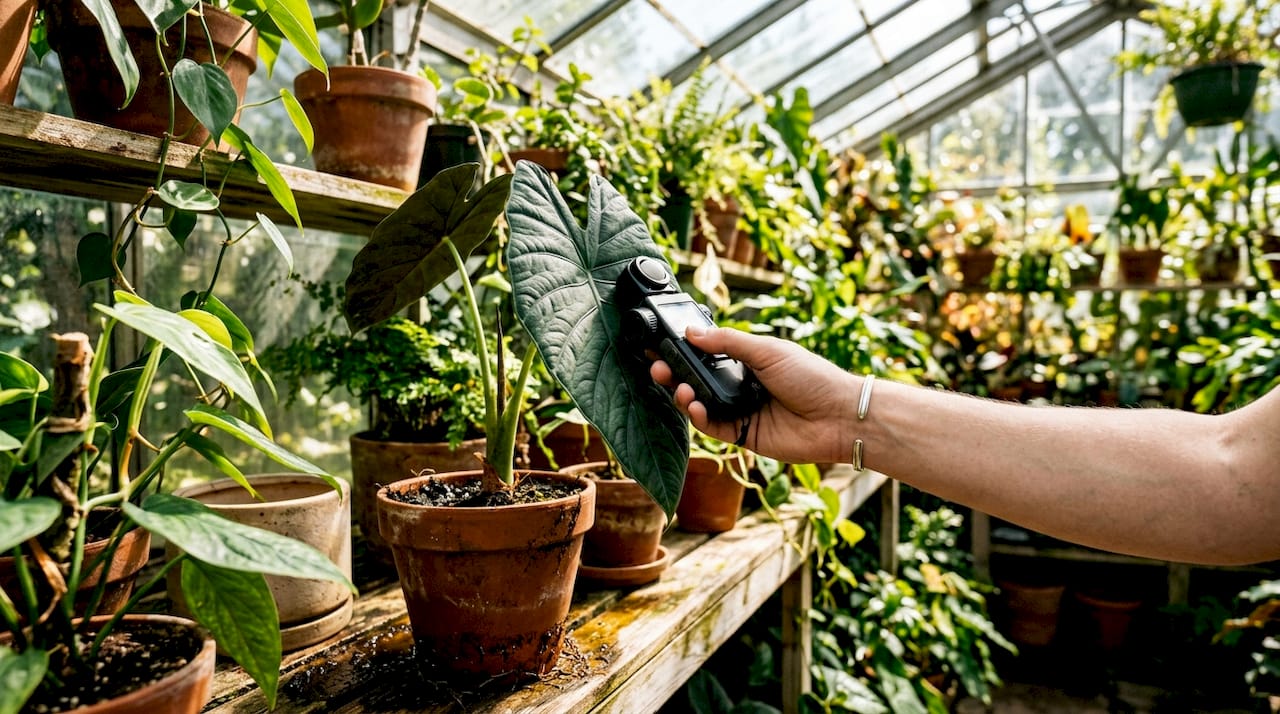
PPFD (photosynthetic photon flux density, measured in µmol/m²/s) is the most useful number for aroid growers. It measures only the wavelengths of light that plants can actually use for photosynthesis (400–700 nm). Lux measures total illuminance and is easier to read on a basic handheld meter, making it a practical proxy for hobbyists. The two are not directly interchangeable across all light sources, but for white-spectrum LEDs and natural light, lux gives you a reliable working estimate.
Pro Tip: Increase light in +10 PPFD steps every two weeks, and only if the newest leaf matches or exceeds the previous leaf in size with no signs of stress. If crisping or bronzing appears, step back 10 PPFD and hold for two to three weeks before trying again. Also keep an eye on leaf surface temperature: anything above 27–28°C (80–82°F) will cause scorching even at a “safe” PPFD level.
Light does more than just keep a plant alive. The intensity, spectrum, and daily duration of light directly determine leaf size, internode spacing, foliage color, and how efficiently the plant uses water and nutrients.
Aroids are shade-adapted plants, not shade-loving ones. They evolved under a forest canopy where light is filtered, consistent, and present for a predictable number of hours each day. Indoors, replicating that consistency matters as much as hitting the right intensity. A plant that gets 10–12 hours of steady, moderate light will almost always outperform one that gets two hours of intense sun followed by eight hours of near-darkness.
The photoperiod, meaning the number of hours of light per day, sets the pace for growth. Most aroids perform best at 10–12 hours. Extending beyond 12 hours does not accelerate growth and can cause stress, particularly in velvet-leaved species, which may produce thinner, less textured leaves under excessive light durations.
| Light factor | Effect on aroids | Practical target |
|---|---|---|
| PPFD too low (below 50) | Long internodes, small leaves, slow root development | Move closer to window or add grow bar |
| PPFD in range (50–120) | Steady growth, full leaf size, good color | Maintain with seasonal adjustments |
| PPFD too high (above 130+) | Bronzing, crisping, leaf curl | Add sheer curtain or increase distance |
| Photoperiod under 10 h | Stalled growth, reduced leaf size | Use a timer to extend to 10–12 h |
| Photoperiod over 12 hours | Stress, thin leaves in velvet species | Cap at 12 h with a smart timer |
| Leaf surface temp above 82°F | Scorching even at safe PPFD | Add distance, sheer, or airflow |
Insufficient light also slows water uptake directly. When a plant cannot photosynthesize at a normal rate, it does not transpire at a normal rate either. The soil stays wet longer, oxygen in the root zone decreases, and root rot risk climbs. This is why insufficient light slows water uptake and creates the conditions for root problems, even when watering technique is perfectly fine.
Leaf coloration is another reliable indicator. Variegated aroids need enough light to keep their patterning vivid; too little and the plant may push out increasingly green leaves as it compensates for reduced photosynthetic capacity. Velvet texture, meanwhile, becomes more pronounced and richer under stable, moderate light rather than high intensity.
Getting light right is mostly about placement, consistency, and not overcorrecting. Here is what actually works:
Light, watering, and feeding are not independent variables. Get light wrong and the other two become nearly impossible to calibrate correctly.
Most aroid problems trace back to a handful of lighting errors that are easy to avoid once you know what to look for.
Trusting your eyes over a meter. Human vision adapts to low light automatically, which makes a dim room feel adequately bright. A corner that looks fine to you may be delivering less than 1,000 lux to your plant. A basic lux meter or a light meter app removes that bias entirely.
Placing aroids too far from windows “to be safe.” The fear of burning leaves leads many growers to push plants into corners that are genuinely too dark. Velvet aroids burn from direct sun, not from proximity to a window. A plant 6 feet from a north-facing window in winter is often getting almost nothing usable.
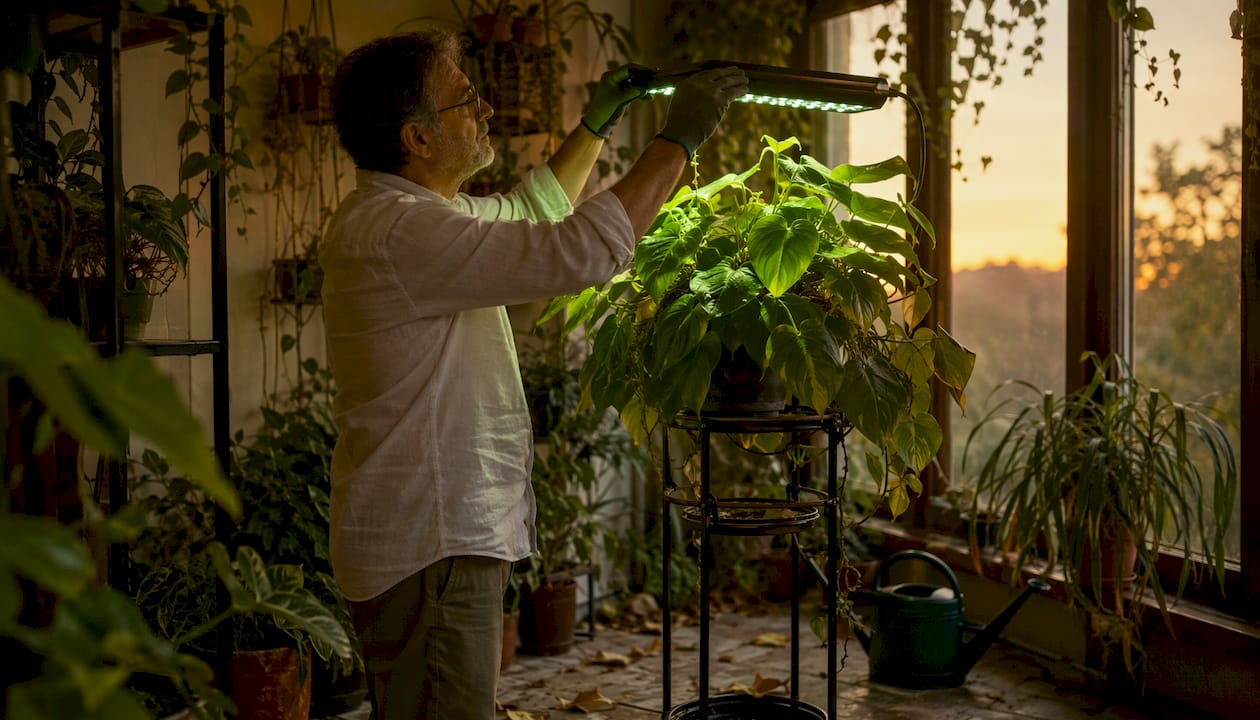
Running grow lights too long to compensate for low intensity. More hours do not make up for insufficient PPFD. A plant getting 30 PPFD for 16 hours is still light-starved. Fix intensity first, then set the timer to 10–12 hours. Explore top LED grow lights if you are unsure which fixture delivers the right output for your space.
Jumping intensity too fast. Moving a plant from 40 PPFD to 100 PPFD in one step is a common cause of sudden leaf crisping and bronzing. The +10 PPFD every two weeks rule exists precisely because aroids acclimate slowly. Patience here pays off in undamaged foliage.
Ignoring seasonal shifts. The sun’s angle and intensity change dramatically between june and december in most of the United States. A plant that was perfectly placed in april may be getting scorched by july or starved by november. Seasonal adjustments, whether moving the plant, adding a sheer, or switching on a grow bar, are part of routine aroid care, not a one-time setup.
Assuming all aroids want the same light. A Monstera deliciosa and a Philodendron verrucosum sitting side by side at the same distance from a window are getting the same light, but the Monstera is probably happy and the verrucosum may be stressed. Species-specific ranges exist for a reason. Use the table in the species section as a starting reference and let each plant’s newest leaf tell you whether to adjust.
Skipping leaf temperature checks under grow lights. A “safe” PPFD reading at the meter does not account for heat buildup at the leaf surface. South-facing windows and high-output grow lights can push leaf temperatures above 82°F (28°C) even in a cool room. That heat, not the light intensity itself, is often what causes the bronze sheen growers blame on too-high PPFD.
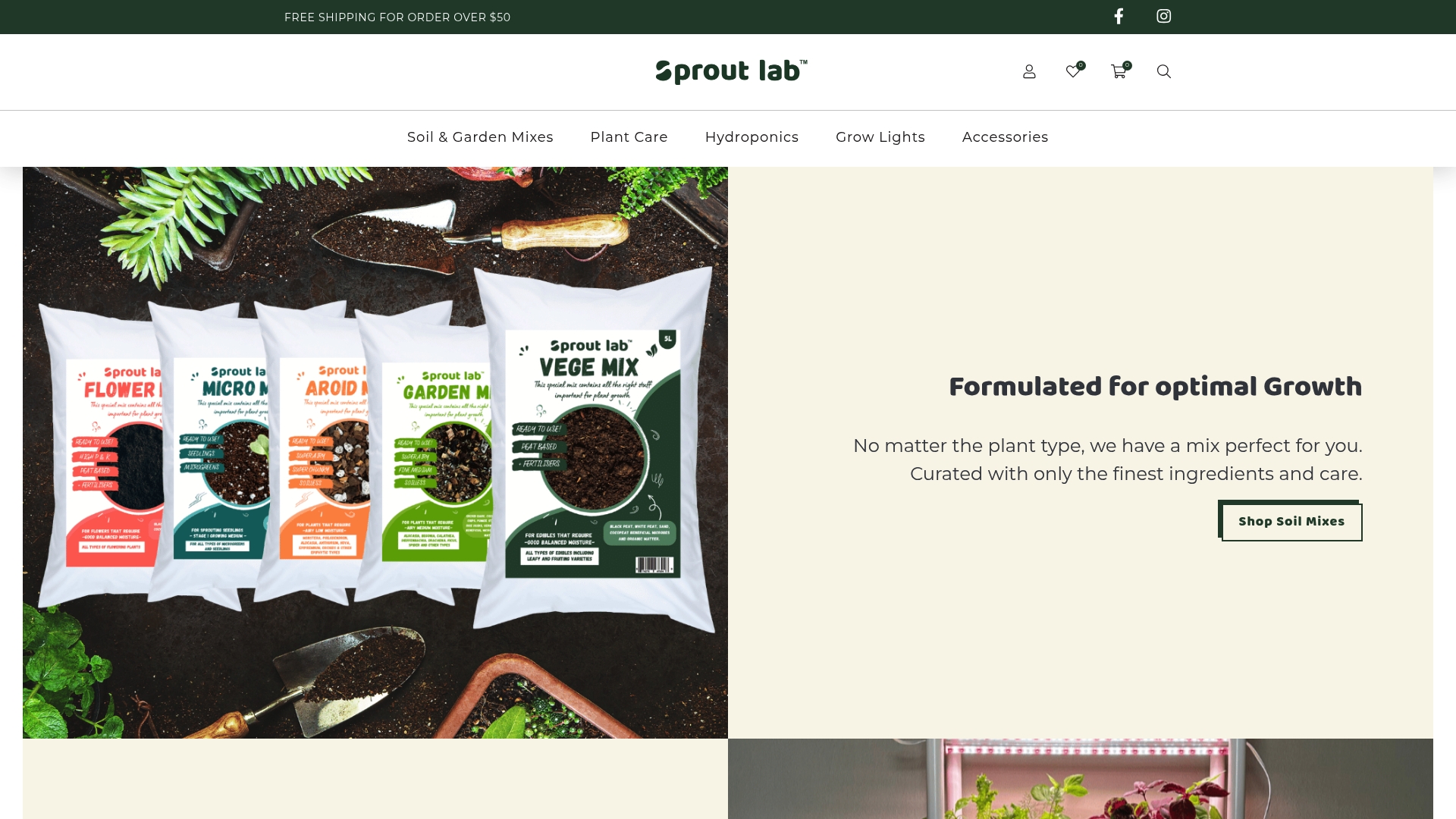
Getting light right is the foundation, but the full picture of healthy indoor aroid care includes the right growing medium and a setup that works with your space. Sprout-lab’s aroid-ready soil mixes are built to stay airy and well-draining, giving roots the oxygen they need even when light conditions are less than perfect. For growers who want to take their indoor setup further, Sprout-lab’s compact growing systems make it possible to maintain ideal conditions for multiple plants without needing a dedicated grow room. With a 4.9/5 star rating across more than 25,000 completed orders, Sprout-lab is the go-to resource for indoor growers who want results, not guesswork.
Most indoor aroids grow best at 50–120 PPFD at the leaf surface for 10–12 hours daily, with species, leaf type, and seasonal conditions determining where in that range each plant belongs.
| Point | Details |
|---|---|
| Target PPFD range | Most aroids thrive at 50–120 PPFD; variegated forms prefer 70–100 PPFD for stable patterning. |
| Lux as a practical proxy | Aim for 5,000–6,000 lux at the leaf surface for the majority of aroid species. |
| Photoperiod matters | A consistent 10–12 hour light period outperforms longer hours at lower intensity. |
| Adjust in small steps | Increase light by +10 PPFD every two weeks only when the newest leaf shows no stress. |
| Light drives watering needs | Low light slows water uptake; always check light before adjusting your watering schedule. |
Most aroids need 50–120 PPFD at the leaf surface, equivalent to roughly 5,000–6,000 lux, for 10–12 hours daily. Variegated forms and Monstera generally prefer the upper half of that range.
Far-red and infrared wavelengths outside the 400–700 nm PAR range contribute little to photosynthesis. For home growers, white-spectrum LEDs cover the full usable range and are preferred over colored grow lights for both plant health and ease of inspection.
A 10–12 hour photoperiod is the standard for most indoor aroids. Running lights beyond 12 hours does not accelerate growth and can stress velvet-leaved species.
Use the shadow test: hold your hand about 12 inches above the plant. A soft but clearly defined shadow indicates enough usable light for most aroids. Long internodes, small new leaves, and soil that stays wet for days are the most reliable plant-level signals that light is insufficient.
Insufficient light slows water uptake, leaving the soil wet far longer than expected and depleting oxygen in the root zone. Improving light is usually the first fix, followed by switching to a chunkier, more aerated soil mix.