Free shipping for order over $50

Free shipping for order over $50
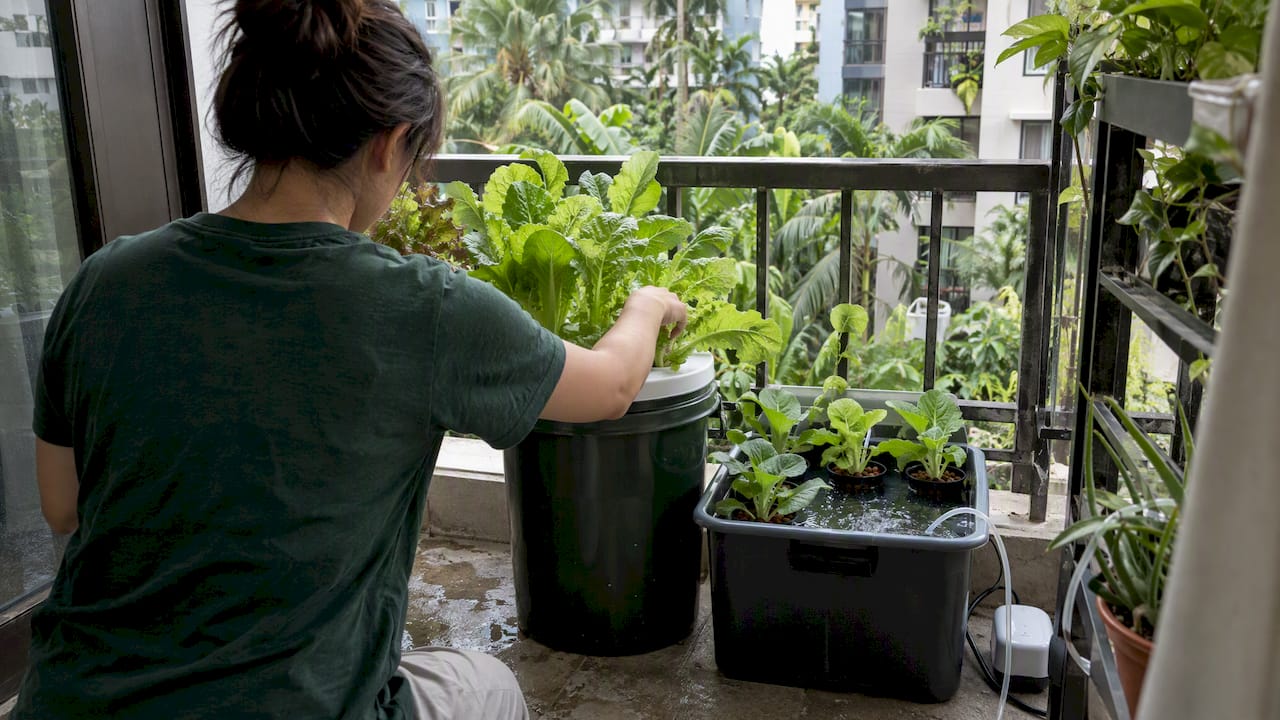
For most balconies, a Kratky bucket or a small deep water culture (DWC) raft gives the best balance of space, cost, and reliability. Kratky needs no pump and suits busy schedules, while compact DWC grows faster if you can check it a few times a week. Both handle heat better when you manage shade and water temperature, and the build steps below get you started this weekend.
TL;DR:
- Kratky systems are cheapest and require no electricity, making them ideal for quick, short-term leafy greens on a balcony.
- Small DWC systems grow faster and support more frequent harvesting but need power, aeration, and closer monitoring.
- Proper site prep involves ensuring balcony weight capacity, sufficient filtered light, and access to water, especially in hot or windy conditions.
- Maintaining pH between 5.5 and 6.2 and checking nutrient levels weekly prevents common issues like nutrient lockout and algae buildup.
- Leafy greens and herbs like lettuce, basil, and choy sum are best suited for small hydroponic setups, with larger crops requiring more advanced systems.
Three approaches dominate small-space hydroponics, and each fits a different kind of grower.
The Kratky method is a passive, non-circulating technique: no pumps, no electricity, just a bucket, a net pot, and a nutrient reservoir that drops as roots grow into the air gap. It is forgiving for short-cycle leafy crops and ideal if you travel often or forget to check plants daily. The tradeoff is slower growth than active systems and a practical limit on plant size, since the method works best for crops you harvest before the reservoir runs dry.
Small DWC systems suspend roots in an oxygenated nutrient solution using an air pump and air stone. The constant aeration speeds up growth and supports continuous harvesting, but it demands more attention: pumps can fail, algae can build up in uncovered reservoirs, and you need a power outlet on the balcony.
Compact vertical or NFT setups stack more plants into a tight footprint, which matters if your balcony is narrow rather than shallow. They cost more to build and need more frequent monitoring of flow and drainage, so they suit growers who already have a working single-level system and want to scale up.
Pick based on three questions:
For layout inspiration suited to tight footprints, our balcony food garden ideas page covers common arrangements that work in compact spaces.
Start with site prep before buying anything. Check that your balcony railing or floor slab can bear the weight of a filled reservoir (water alone runs about 3.8 kilograms per gallon, plus the container and media), confirm you have at least four to six hours of filtered or direct light, and make sure you can reach a tap for refills without hauling buckets through your living room.
Building a Kratky bucket:
Building a compact DWC raft:
If your balcony gets intense midday sun, rig light shade cloth over the setup rather than full shade, which protects roots without starving the plants of light.
Pro Tip: Paint or wrap any clear container with opaque tape or fabric before adding water, since light reaching the roots invites algae within days.

A minimal Kratky build is the cheapest entry point. You need a handful of recurring items regardless of method, and a few tools you may already own.
Budget bands run roughly from a minimal Kratky bucket using repurposed containers, to a mid-range small DWC setup with a pump and multiple net pots, to a higher-cost compact vertical system with multiple tiers. Buy food-safe containers specifically, since some plastics leach chemicals when they hold nutrient solution for weeks. Our practical guide to small apartment systems breaks down these cost tiers in more detail if you want to compare before buying.
Balconies run hotter and windier than ground-level gardens, which changes how you place and protect a hydroponic system. Track your sun exposure for a few days: four to six hours of filtered light suits leafy greens, while more than six hours of direct tropical sun can push water and root temperatures too high.
Tropical heat-stress thresholds for many leafy greens sit around 29 to 32 degrees Celsius, so a reservoir sitting in full afternoon sun can cross that line quickly. Shade cloth over the hottest hours, reservoir insulation, or simply timing your plantings to avoid the hottest months all reduce stress. Best-practice guidance for Asian greens in tropical climates specifically flags climate-aware shading and ventilation as part of a workable setup, not an afterthought.
Wind matters too: secure containers against railings rather than balancing them on ledges, and distribute weight across multiple smaller reservoirs rather than one heavy tank near the railing edge. When natural light runs short in shaded or covered units, a grow light extends your options rather than forcing you indoors. For more on heat tactics specific to tropical balconies, see our guide on managing plant heat stress.
Pro Tip: Check your floor slab or railing’s rated load before mounting multiple full reservoirs, since water weight adds up faster than most people expect.
Leafy greens and herbs dominate successful balcony hydroponics because they tolerate the light and space limits of a bucket or raft, and they reach harvest fast enough to keep you motivated.
A single 5-gallon Kratky bucket typically holds one to two mature lettuce plants, while a small DWC raft with six to eight net-pot sites fits comfortably on a 60 by 60 centimeter footprint. Space net pots far enough apart that leaves do not shade each other once mature, usually 15 to 20 centimeters center to center for lettuce and similar greens.
Fruiting crops like tomatoes or peppers need deeper reservoirs, sturdier support, and far more light than most balconies provide, so treat them as a second-stage project once your leafy green system runs smoothly. Our plant selection guide covers a wider range of crop options if you want to plan a rotation.
Consistent monitoring prevents almost every common hydroponic failure, and the routine takes only a few minutes once you have a meter.
University extension programs consistently recommend checking pH and EC two to three times weekly, since this simple habit catches nutrient lockout before it visibly damages plants.
A lettuce plant grown in a small Kratky system typically draws through roughly 1 to 1.5 gallons of water over its full cycle from seed to harvest, which gives you a rough refill budget per plant.
Weekly checklist:
Most balcony hydroponic problems show clear warning signs before they become serious, so quick diagnosis matters more than complicated fixes.
Building your own system rewards patience, but a tested modular setup solves the sizing, aeration, and layout questions in one purchase. Hydroponic systems designed for compact spaces can scale up to many plants within a small footprint, which suits a balcony grower who wants structured capacity without redesigning a DIY reservoir from scratch.
If you have ten minutes a day and a balcony with decent light, start with a single Kratky bucket of lettuce or basil before building anything more complex. Seed it tonight, check pH by the weekend, and let the first harvest tell you whether to expand into DWC.
— Irwin Lee
If drilling buckets and balancing air pumps sounds like one project too many, our modular hydroponic systems handle the layout and capacity questions for you, ready to plant the same day it arrives.
Hydroponic systems need closer monitoring of pH and nutrient levels than soil gardening, and equipment failures like a dead air pump can stress plants quickly. Setup costs more upfront than a soil pot, power outages affect active systems like DWC, algae can build up in exposed reservoirs, and a leak risks water damage on a balcony floor.
A Kratky bucket or small DWC raft works well for apartments because both fit on a balcony or windowsill without needing extensive plumbing. For a scaled-up option, a modular system like Sprout Lab’s hydroponic setup handles higher plant counts without adding separate DIY builds.
Loose-leaf lettuce, basil, mint, cilantro, and short-cycle Asian greens like choy sum or baby bok choy all do well in balcony hydroponics because they tolerate the light and space limits of small containers. Lettuce in a Kratky system often reaches harvest in 30 to 45 days.
A single Kratky bucket is the simplest entry point since it needs no pump, no electricity, and minimal daily attention beyond checking the water level. Once that works reliably, a small DWC raft or a ready-made modular system adds capacity without starting the learning curve over.