Free shipping for order over $50

Free shipping for order over $50
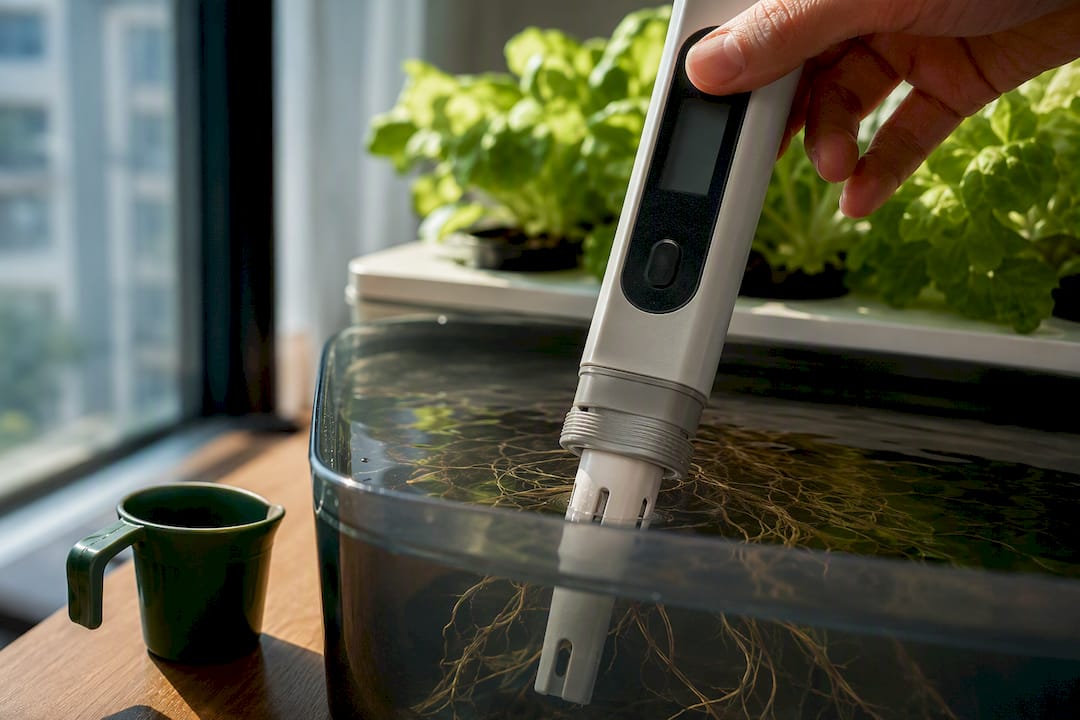
Seedlings and clones want EC between 0.4 and 0.8 mS/cm, leafy greens and herbs run best between 1.0 and 1.6 mS/cm, and fruiting crops like tomatoes and peppers peak between 2.0 and 3.5 mS/cm. Work in mS/cm, not PPM, because that is the unit your meter actually measures. Check EC daily. Add nutrient concentrate to raise it, plain water to lower it, and move in small steps each time.
TL;DR:
- Growers should adjust EC gradually by small increments of 0.2 to 0.3 mS/cm every few days to prevent root damage or growth issues.
- Always calibrate EC meters monthly for casual growers or weekly for high-frequency users to ensure accurate readings, especially if water temperature fluctuates.
- Measure source water EC before adding nutrients and subtract that baseline to avoid over- or under-fertilizing, particularly when using reverse osmosis or municipal water.
- Maintain nutrient solution EC within crop-specific ranges: seedlings at 0.4–0.8, leafy greens at 1.0–1.6, and fruiting crops at 2.0–3.5 mS/cm, adjusting as plants grow.
- Check EC and pH daily in active systems, perform reservoir changes on a schedule, and watch for symptoms like tip burn or stunted growth to correct issues early.
Electrical conductivity tells you how many dissolved salts are floating in your nutrient solution. Water itself barely conducts electricity, but the mineral salts you dissolve in it, nitrogen, potassium, calcium, and the rest, carry a charge. The more concentrated the solution, the more current it conducts, and the higher the EC reading climbs. That’s the whole mechanism: EC is a proxy for concentration, not a direct nutrient count.
You’ll see EC expressed in millisiemens per centimeter (mS/cm), and this is the number to trust. PPM, or parts per million, is a converted estimate, and different meter brands use different conversion factors: 500, 640, or 700. A reading of 1.0 mS/cm becomes 500 PPM on one meter and 700 PPM on another, with nothing about your actual nutrient strength changing at all. That inconsistency is exactly why growers who mix and match meters end up confused about whether their solution is weak or strong.
Here’s the catch worth remembering: EC tells you quantity, never composition. Two solutions can read identically on the meter while one is loaded with nitrogen and short on calcium. A correct EC number doesn’t guarantee a balanced nutrient solution, so don’t treat it as your only health check.
Optimal EC levels in hydroponics shift as plants move from germination to full production, and matching the range to the growth stage is one of the biggest levers you have over yield. Start too strong on a seedling and the roots take damage that never fully heals. Start too weak on a fruiting tomato at peak season and you’ll watch growth stall and blossoms drop.
| Crop / stage | Target EC (mS/cm) | Notes |
|---|---|---|
| Seedlings and clones | 0.4–0.8 | Delicate roots; ramp up gradually over the first 1–2 weeks |
| Leafy greens and herbs (lettuce, basil, mint) | 1.0–1.6 | Stays fairly flat through the growth cycle |
| Vining greens, early vegetative (most crops) | 1.0–1.6 | Transition zone before fruiting crops diverge |
| Tomatoes, peppers, cucumbers (vegetative) | 2.0–3.5 | Building foliage and root mass before fruit set |
| Tomatoes, peppers, cucumbers (peak fruiting) | 2.0–3.5 | Higher end for established plants with strong root systems |
Ramp gradually rather than jumping straight to a target number. A clone that goes from tap water to 1.8 mS/cm overnight will show tip burn within days. Step it up by roughly 0.2 to 0.3 mS/cm every few days instead, watching leaf response as you go.
If you’re growing leafy greens and fruiting crops in the same setup, separate reservoirs. A single tank forces a compromise EC that shortchanges one crop or the other. Beginner-friendly hydroponic vegetables like lettuce and basil are forgiving enough to share a line, but a tomato plant sharing water with basil is going to underperform on one side no matter what number you pick.
Your meter needs to read in mS/cm, and Automatic Temperature Compensation (ATC) is worth paying for. Without ATC, a warm reservoir in a Singapore apartment can throw your reading off by 10 to 20 percent depending on the temperature swing, which is enough to make a correctly mixed solution look wrong.
Calibration is not optional, and it drifts faster than most growers expect.
For the reading itself, submerge the probe past the vent hole (usually 2 to 3 centimeters), stir gently, and wait 15 to 30 seconds for the number to settle before recording it. If you’re not sure which PPM scale your meter uses, check the manual or manufacturer page. An affordable option like the 4-in-1 TDS tester from Gridwise Living is a solid entry point if you’re shopping for your first meter and want something that states its conversion factor clearly.
Pro Tip: Keep a small logbook (paper or notes app) of your EC readings alongside the date and temperature. Patterns that look random day to day often make obvious sense once you see two weeks of data side by side.
Raising EC means adding concentrated nutrient solution in small, measured doses, never dumping in a large amount and hoping it settles evenly.
Lowering EC works the opposite direction. If your reading has drifted high, which usually means plants are drinking water faster than nutrients, top up the reservoir with plain water and recheck. If EC is significantly out of range or the solution has been sitting for over a week, a partial or full reservoir change beats trying to dilute your way back to normal.
Mixing sequence matters more than growers give it credit for: fill your reservoir with water first, add nutrients and dissolve fully, adjust pH, then take your final EC reading. Checking EC before the pH adjustment gives you a number that won’t hold once the pH shifts. For step-by-step dosing order, the mixing hydroponic nutrients guide walks through the sequence in more detail.
Pro Tip: Always factor in your water’s starting EC before adding nutrients. If your tap water reads 0.3 mS/cm on its own, your nutrient concentrate only needs to close the gap to your target, not hit that number from zero.
Check cadence depends on your system type. Active, circulating systems like DWC or NFT need a daily check, twice daily during hot stretches or peak fruiting when plants are drinking fast. Passive Kratky setups can go every 48 hours since there’s no pump cycling the solution constantly.
Your tap or filtered water has its own baseline EC before you add a single drop of nutrient, and skipping that measurement throws off every target range you’re trying to hit. Measure your source water first, subtract that baseline from your target EC, and add nutrients to close the remaining gap.
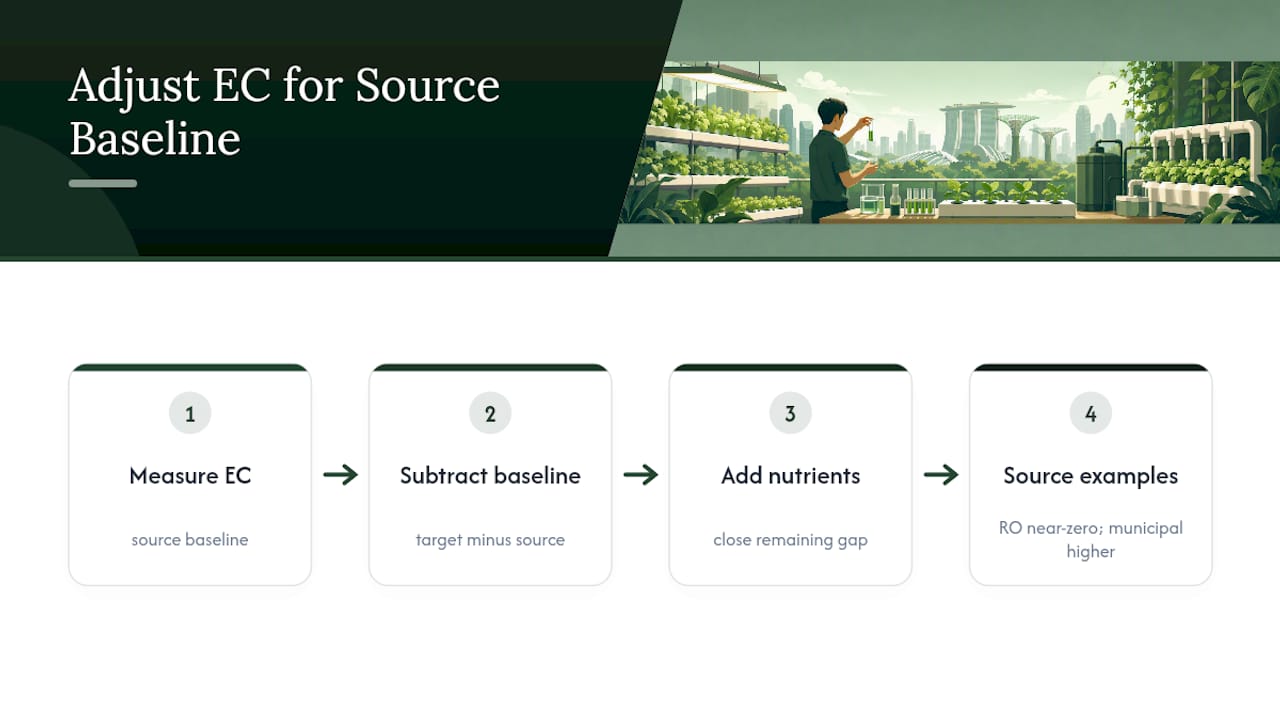
Reverse osmosis (RO) water starts at close to zero EC, which gives you precise control but strips out calcium and magnesium along with everything else. Growers using RO usually need to add a CalMag supplement to avoid deficiencies that show up as blotchy or curled new growth.
Municipal water with high sodium or alkalinity is trickier. It can hold pH artificially high while contributing its own EC that doesn’t come from usable nutrients, which means your meter reads a number that overstates how much food your plants are actually getting. Understanding how pH interacts with EC helps explain why two systems reading the same EC can perform completely differently based on water source alone.
Running a tight EC schedule at home comes down to a handful of habits repeated consistently, not complicated equipment.
Sprout Lab’s Hydroponic Plant Food nutrient concentrate is formulated for consistent dosing, which cuts down on the guesswork that leads to overshooting EC targets. Paired with a modular system that keeps reservoirs sized appropriately for plant count, it’s a lot easier to keep EC steady across dozens of plants than when you’re eyeballing concentrate into a single mismatched tank.
The two mistakes I see most often aren’t complicated: growers skip calibration because the reading “looks fine,” and growers chase a PPM number pulled from a chart without checking which conversion factor their own meter uses. Both are avoidable with five extra minutes of attention.
The mental model that actually holds up is simple. EC equals concentration, nothing more. Change it slowly, recheck before changing it again, and don’t trust a single reading you haven’t calibrated for. Build the daily habit and the rest of hydroponic nutrient management gets a lot less mysterious.
— Irwin Lee
Manual mixing puts you one measuring mistake away from shocked roots or stalled fruiting, and juggling separate tanks for different crops only multiplies that risk. Sprout Lab’s modular systems are built to hold consistent nutrient concentration across as many as 56 plants in a compact footprint, so you’re managing one reliable setup instead of babysitting several improvised containers.
If you want a system where EC stays predictable without constant manual dosing, the automated hydroponic setups for urban growers page walks through which configuration fits your space and crop mix. Check it out and see which setup matches what you’re growing.
For readers who want to go deeper on the technical side, these resources cover the mechanics behind everything above:
It depends on the crop and stage: seedlings do best at 0.4 to 0.8 mS/cm, leafy greens and herbs at 1.0 to 1.6 mS/cm, and fruiting crops like tomatoes or peppers at 2.0 to 3.5 mS/cm during peak production.
A normal reading depends entirely on what you’re growing and what stage it’s in. There’s no single universal number, which is why matching your reading against the crop-specific ranges above matters more than chasing one fixed target.
Add nutrient concentrate in small measured amounts, mix thoroughly, wait 10 to 15 minutes, then recheck before adding more. Sprout Lab’s nutrient concentrate is designed for this kind of incremental dosing.
Anything meaningfully above your crop’s target range counts as high, and readings above 3.5 mS/cm for most fruiting crops or above 1.6 mS/cm for leafy greens typically show up as leaf tip burn or slowed growth.