Free shipping for order over $50

Free shipping for order over $50
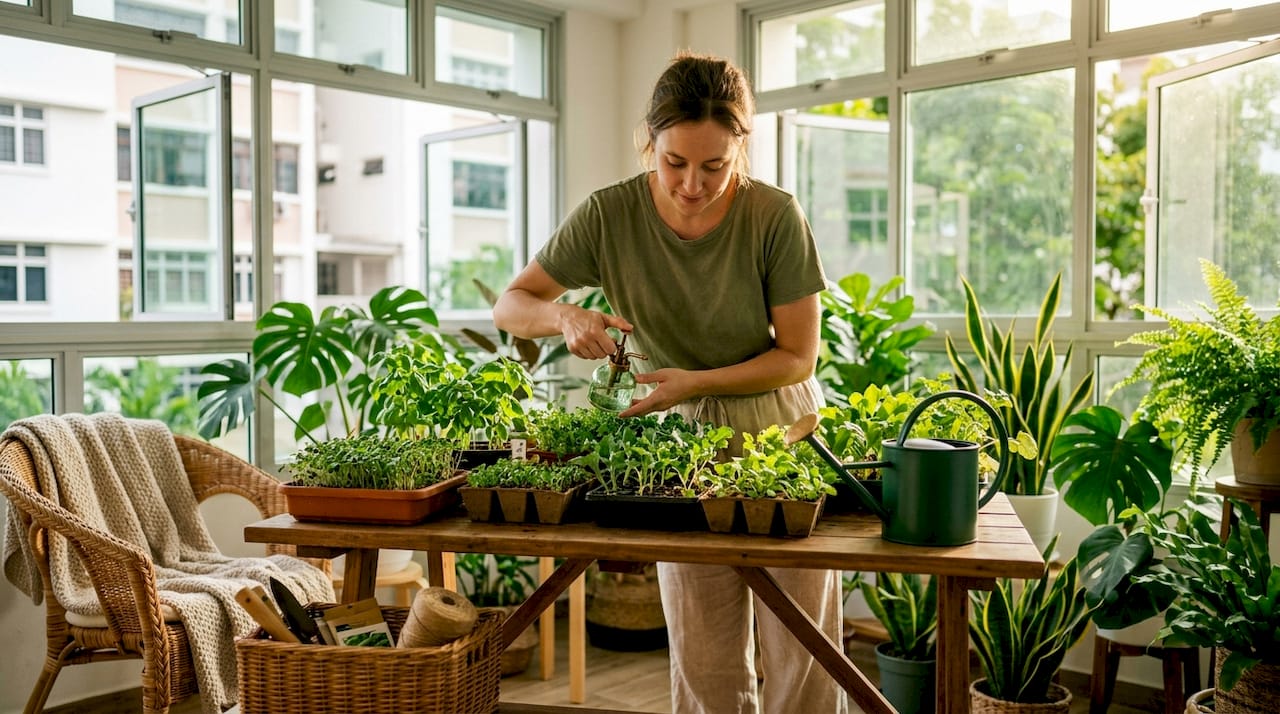
Singapore’s compact apartments and year-round tropical heat make fresh food growing feel like a challenge reserved for people with more space or time. But year round indoor growing Singapore residents are quietly pulling off is more accessible than most people realize. With no cold winters to interrupt growth cycles, indoor temperatures between 20 and 32°C create a permanent growing window. What you actually need is the right method, the right crops, and a clear understanding of what works in your specific space.
| Point | Details |
|---|---|
| No dormancy period needed | Singapore’s tropical indoor climate allows plants to grow 365 days a year without seasonal breaks. |
| System choice matters more than space | Hydroponic and vertical setups let you grow up to 56 plants in a single compact unit. |
| Airflow is non-negotiable | Humidity management and root oxygenation prevent the most common failures in Singapore indoor gardens. |
| Stagger your planting schedule | Adding new trays or pots every few days keeps harvests steady instead of creating feast-or-famine cycles. |
| Match your crops to your light | Leafy greens tolerate low-light north-facing balconies; fruiting crops need bright south-facing exposure or grow lights. |
Singapore’s climate is both your biggest advantage and your greatest challenge. The lack of a true winter means continuous plant growth indoors without dormancy periods. Plants that would go dormant in temperate climates keep producing indefinitely here. That sounds great. But it also means pests stay active year round, humidity hovers around 70 to 90 percent, and heat stress can build up faster than in air-conditioned offices or cooler climates.
Understanding this climate reality is what separates successful indoor gardeners from frustrated ones. Your setup needs to address moisture, airflow, and light. Space is a constraint, but it is rarely the real reason gardens fail indoors in Singapore.
Before spending money on any system, evaluate your actual growing conditions honestly. Here is what matters most.
Pro Tip: Before buying any system, spend one week observing how much light your intended growing spot actually receives throughout the day. Morning light and afternoon light behave very differently in Singapore’s tropical sun angle.
Container gardening using quality potting mix is the lowest-cost entry point for indoor food growing. You do not need any special equipment, and beginners can get herbs like basil and coriander growing within a week.
The key limitation in Singapore is soil moisture. Because it is always warm, evaporation is slow but root rot risk is real if drainage is poor. Choosing a well-draining indoor soil mix designed for tropical conditions matters more here than in cooler climates. Standard garden soil compacts in pots and suffocates roots.
Container setups work best for windowsill herbs, small leafy greens, and shallow-rooted crops. They are not efficient for scale, but for a household wanting fresh basil or mint daily, a few well-placed pots on a bright windowsill get the job done reliably.
Deep water culture (DWC) is one of the most popular hydroponic systems Singapore growers use for leafy greens and herbs. Plant roots sit suspended in an oxygenated nutrient solution, and an air pump keeps oxygen levels high.
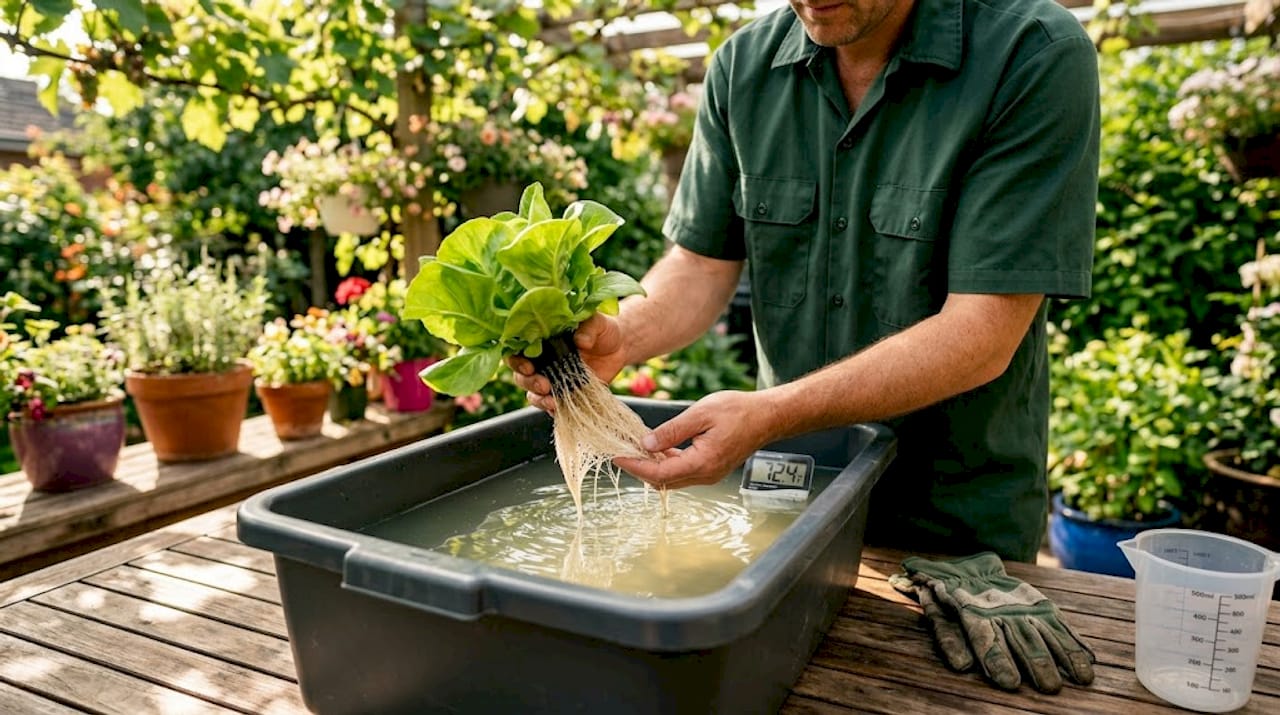
DWC works well for lettuce, kang kong, and kai lan. The setup is relatively inexpensive compared to more complex systems, and it produces fast results. Lettuce can be ready in three weeks under good conditions.
The challenge in Singapore’s heat is keeping the nutrient solution temperature below 24°C to prevent root disease. Without climate control, the water absorbs ambient heat and roots can suffer. If your growing area stays above 28°C consistently, you will want an insulated reservoir or an air-conditioned space.
Drip systems work well for fruiting plants like cherry tomatoes and chili, which need more controlled watering than DWC provides. Nutrients are delivered on a timer, which also means better oxygenation between watering cycles. Ebb-and-flow (flood and drain) systems work on a similar principle and are popular for larger plant varieties.
Both systems require more components, more monitoring, and more space than DWC. For urban Singapore gardeners who want to grow a variety of crop types, they offer flexibility. Just know that poor airflow in humid conditions accelerates problems in these systems faster than in drier climates. A small oscillating fan near your setup is not optional. It is required.
Vertical tower systems take the same nutrient solution approach as other hydroponics but stack plants vertically to multiply your output per square foot of floor space. A well-designed hydroponic tower can fit 20 to 56 plants in the footprint of a single pot.
These systems are a smart fit for Singapore’s apartment constraints. You get real scale without needing a yard or a large balcony. The nutrient solution recirculates from top to bottom, which keeps roots moist and reduces water use compared to soil. Singapore’s growing interest in urban food production follows the same logic that drives projects like Greenphyto’s 2,000-tonne annual output facility, just at a scale that fits your home rather than an $80 million building.
Tower systems work best with leafy greens and herbs. They are not ideal for large fruiting crops, which need more structural support and root space.
Countertop kits like automated pod gardens take the complexity out of hydroponics. You insert pre-seeded pods, fill the water reservoir, plug in the grow light, and the system manages most of the rest. These units are designed for complete beginners and fit on a kitchen counter.
The trade-off is cost per harvest. The pods are proprietary in most systems, making ongoing expenses higher than buying seeds and managing a simple hydroponic setup yourself. For households who value convenience over savings, these kits deliver fresh herbs year round with minimal effort. They are also a practical gateway for people not yet ready to manage nutrient levels and pH manually.
Aeroponics mists plant roots with nutrient solution rather than submerging them. This maximizes root oxygenation and produces faster growth than most other methods. Commercial farms use aeroponic systems widely because of those speed advantages.
For home use in Singapore, aeroponics is an advanced setup. Pumps and misters require careful maintenance, and any clog or pump failure can stress plants within hours in the heat. It is a rewarding method for gardeners with some experience who want to push their yields further. For most beginners, mastering a simpler hydroponic system first is a smarter path.
| System | Setup cost | Space needed | Complexity | Best crops | Typical harvest time |
|---|---|---|---|---|---|
| Container/soil | Low | Small (windowsill) | Low | Herbs, leafy greens | 3 to 6 weeks |
| Deep water culture | Low to medium | Medium | Medium | Lettuce, kang kong, herbs | 2 to 4 weeks |
| Drip/ebb-and-flow | Medium | Medium to large | Medium to high | Fruiting crops, larger herbs | 4 to 10 weeks |
| Vertical tower | Medium to high | Small (vertical) | Medium | Leafy greens, herbs | 2 to 4 weeks |
| Countertop kit | Medium | Very small | Low | Herbs, microgreens | 1 to 3 weeks |
| Aeroponics | High | Medium | High | Most edibles | 2 to 5 weeks |
Pro Tip: If you are choosing between systems for the first time, start with vertical tower hydroponics or a simple DWC setup. Both offer a fast feedback loop, which helps you build skills before investing in more complex equipment.
Getting your setup right is half the work. Keeping it productive is the other half. These are the practices that make the biggest difference indoors in Singapore specifically.
Not every edible plant performs well indoors in Singapore. Heat stress, humidity, and limited light rule out certain crops and make others thrive. Here are the plants that consistently deliver.
The wellness benefits of gardening extend beyond just the food itself. Regular interaction with plants has documented positive effects on stress and focus, which makes the daily maintenance routine genuinely enjoyable rather than a chore.
I spent months believing that light was the most critical variable in my indoor setup. Once I switched to a proper vertical tower and added grow lights, I assumed the hard work was done. It was not.
What actually changed my results was fixing airflow and getting serious about staggered planting. In Singapore’s humidity, stagnant air around your plants is where problems start. The moment I added a small oscillating fan and began placing new planting trays every other day, my harvests became consistent instead of chaotic.
The other thing I underestimated was nutrient solution drift. In humid tropical conditions, pH and EC shift faster than any guide written for temperate climates will tell you. “Set and forget” does not apply here. Twice-weekly checks became part of my routine, and failures became rare.
The good news is that Singapore’s permanent growing season makes all of this effort pay off faster than it would anywhere else. You are not waiting for spring. Every week of good management translates directly into food on your table. Start simple, learn the system, then scale up once you understand what your specific space needs.
— Luna
Whether you are setting up your first countertop herb garden or expanding to a full vertical tower system, Sprout-lab has the equipment and guidance built specifically for Singapore’s growing conditions.
Sprout-lab’s hydroponic systems and supplies are designed for urban growers who want real results from limited spaces. Their modular vertical tower lets you grow up to 56 plants in a compact footprint, with no prior experience needed. Pair that with their beginner hydroponic kits and purpose-formulated soil mixes, and you have everything required to start producing food year round. With over 25,000 completed orders and a 4.9/5 star rating, Sprout-lab is the go-to resource for Singapore’s urban food gardeners.
Yes. Singapore’s indoor temperatures eliminate dormancy periods entirely, allowing continuous plant growth without seasonal breaks. Leafy greens, herbs, and many fruiting crops produce year round with the right setup.
Countertop automated kits and simple deep water culture hydroponic systems are the most beginner-friendly options. Both require minimal technical knowledge and produce results quickly, often within two to three weeks.
Not always. South and east-facing spots with good natural light can support leafy greens and herbs without artificial lighting. North-facing spaces or rooms without direct sunlight benefit significantly from full-spectrum LED grow lights to maintain consistent year-round production.
In Singapore’s tropical conditions, checking pH and EC levels at least twice per week is recommended. Warm temperatures accelerate nutrient uptake and solution drift, so less frequent monitoring leads to faster plant stress than growers in cooler climates typically experience.
Kang kong, kai lan, basil, mint, and chili are among the most reliable choices. These crops are heat-tolerant, productive in limited space, and well-suited to both hydroponic setups and container gardening in typical HDB apartments.