Free shipping for order over $50

Free shipping for order over $50
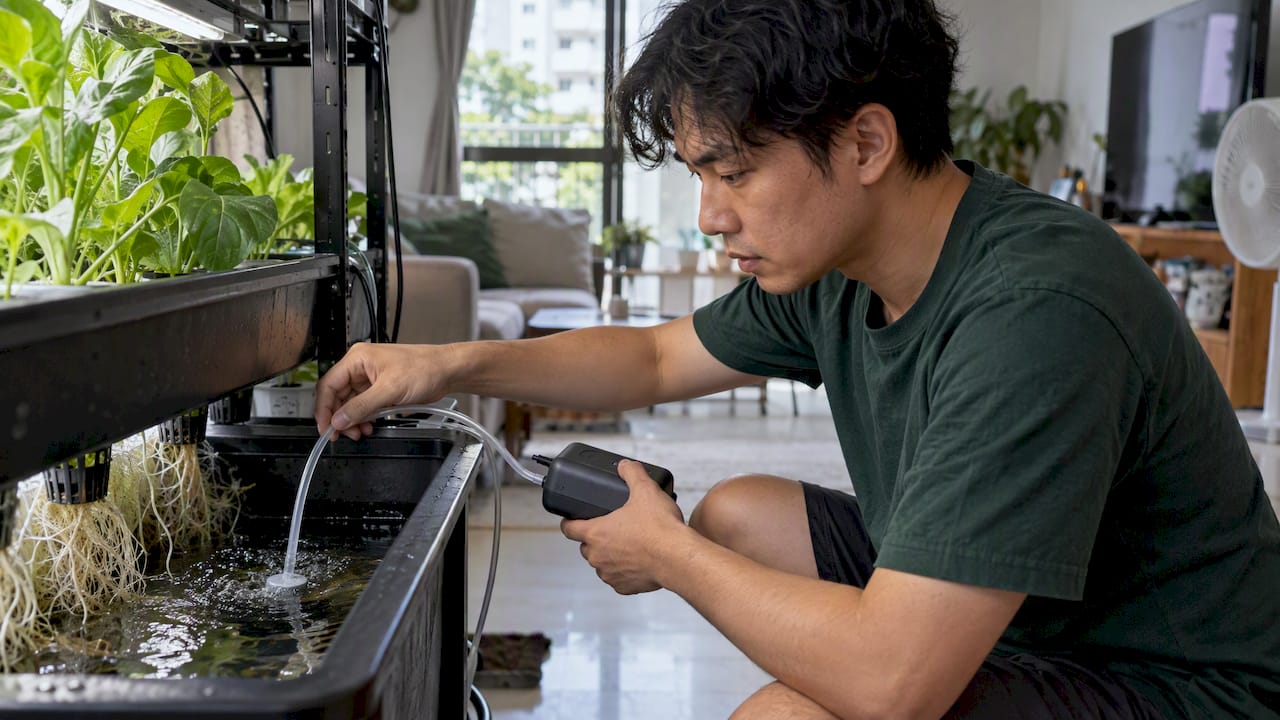
When a hydroponic system loses power, the first priority is keeping dissolved oxygen above roughly 5 mg/L by restoring circulation, not by rushing to save your lights. Root suffocation starts within hours, well before most crops show visible stress. The sections below walk through the first six hours, backup power options, and how to build a system that shrugs off a hydroponic power outage instead of losing a harvest to one.
TL;DR:
- Start battery aeration or manual agitation within 15 to 30 minutes, keep dissolved oxygen at 5 to 8 mg/L, and shade warm reservoirs.
- Cut lighting before aeration, since crops tolerate reduced light for a day or two; prioritize seedlings and leafy greens, especially in deep water culture.
- Use a UPS or battery air pump for outages under two hours; longer disruptions call for a deep cycle battery or generator.
- A grid tied solar array will not provide outage power without battery storage and a backup capable inverter, while generators must operate outdoors.
- Check dissolved oxygen every 1 to 2 hours during outages, then test TDS after circulation returns and dilute any reading above roughly 2,000 ppm.
The first few minutes decide whether your roots recover cleanly or start dying back. Work through this order, not light fixtures first and pumps second.
Lights can wait. A few hours without light rarely sets a crop back much, but a few hours without oxygenated, circulating water can cause root dieback that shows up as wilting two or three days later.
Pro Tip: Keep a cheap battery-powered aquarium air pump and a spare 9-volt or D-cell battery pack in your grow area at all times. It costs very little and buys you the first critical hour for free.
Roots submerged in nutrient solution rely entirely on dissolved oxygen (DO) in the water, since there is no soil structure to hold air pockets. Extension guidance for hydroponic systems puts the target range at 5 to 8 mg/L, and when levels drop below that, roots start to suffocate and become far more vulnerable to root-rot pathogens like Pythium.
Dissolved oxygen above 5 to 8 mg/L is the single number that matters most in the first hours of an outage. Below that range, nutrient uptake slows and pathogen pressure rises quickly, especially in warm water.
Practical ways to maintain DO without mains power:
Temperature compounds the oxygen problem, since warmer water carries less dissolved oxygen and speeds up pathogen growth. Shade reservoirs from direct sun, move tanks away from warm equipment, and if you must add water, add it gradually to avoid shocking roots with a sudden temperature swing. Our guide to ideal hydroponic water temperature covers target ranges and cooling tactics in more detail.
Redundancy matters more than most growers assume. Running two small air pumps on separate battery packs, rather than one larger pump on a single battery, means a single dead battery or failed pump does not leave your roots with zero aeration. Alternating pumps on one-hour cycles, running pump A while pump B rests, can stretch battery life while still keeping oxygen levels in a safe range, a tactic borrowed from small-scale aquaculture aeration design.
Stagnant water also invites algae once power returns and light resumes, so keep an eye on DO after restoration too, since our guide to stopping algae in hydroponics recommends keeping DO above 6 ppm as part of algae prevention.

Not every outage needs a generator. Match the tool to the expected outage length.
Pro Tip: Before assuming your solar panels will save you during a blackout, check with your installer whether your inverter supports battery backup or islanding mode. Many residential solar setups do not, by design.
As a rough decision guide: under 2 hours, a UPS or battery air pump is usually enough. Between 2 and 12 hours, a deep-cycle battery setup or a borrowed generator covers you. Beyond 12 to 24 hours, you want either a properly sized generator or a solar-plus-battery system built for backup, which the next section covers in more detail.
A load-tier framework, recommended in extension guidance on backup power planning, separates equipment into critical loads (aeration and water pumps) and lower-priority loads (grow lights, controllers, display screens). Size your backup around the critical tier first.
Worked example: say your critical tier is one 8-watt air pump and one 20-watt water pump, and you want 24 hours of coverage. That is 672 watt-hours (28 watts times 24 hours).
Reducing your critical-tier wattage, which the next section covers, lowers every number in that calculation and makes a smaller, cheaper backup system viable.
Every watt you shave off your critical load buys you proportionally more backup runtime. Energy-efficiency measures on backup power can extend runtime by a similar percentage to the reduction in demand, so a 20% cut in load gives you roughly 20% more hours from the same battery.
A low-power air stone and a small, efficient pump sized correctly for your tank, rather than an oversized one, often give the best runtime improvement per dollar spent on backup gear.
Four readings tell you almost everything you need to know: dissolved oxygen, water temperature, EC or TDS, and your battery’s remaining charge.
Once mains power returns, check DO and temperature again within the hour, then every few hours for the next 24 hours, since residual stress and any sediment stirred up during manual agitation can keep readings unstable even after pumps restart.
Keep a kit ready before you need it: a spare battery air pump, a charged UPS or power bank, voltage adapters, spare meter batteries, and, if you rely on a generator, a fuel plan with at least one full tank stored safely.
| Outage length | Priority action | Backup tool |
|---|---|---|
| Under 2 hours | Restore aeration, skip lights | Battery air pump or UPS |
| 2 to 12 hours | Maintain circulation, shade reservoir | Deep-cycle battery or generator |
| 12 to 24 hours | Cut lighting, monitor DO every 1 to 2 hours | Sized generator or solar plus battery |
| 24+ hours | Full critical-load backup, consider water change | Generator with ATS or solar plus battery |
After restoring mains power, flush lines of any sediment, inspect pumps for debris or overheating, and monitor DO for a full 24 hours before assuming the system has stabilized. Our guide to post-disruption sanitation covers draining, scrubbing, and disinfecting steps worth following after any extended outage.
Reduced circulation changes how nutrients behave in your reservoir, even before you notice any visible plant stress. Without pump movement, nutrient salts can settle unevenly and evaporation can concentrate the solution, pushing TDS toward the phytotoxicity range above roughly 2,000 ppm.
Check TDS as soon as you restore any circulation, even manual agitation, and dilute with plain, dechlorinated water if the reading has climbed noticeably above your normal target. Avoid adding a full new dose of nutrients during the outage itself, since reduced oxygen already strains root uptake and a concentrated solution on top of that can scorch roots.
If the outage has stretched past 24 hours, a partial water change once power is restored, rather than topping off, clears out any stagnant buildup and resets the solution to a known baseline. Our guide to partial water changes with a top-up log explains when a full change helps versus when it just adds unnecessary stress. Hold off on pH correction until circulation is fully restored and stable, since isolated low-flow pockets can give misleading readings; our pH management guide covers quick fixes once your meter is reading consistently again.
Most outage emergencies are made worse by equipment that was already due for maintenance. A pump with a partially clogged intake or an aging air stone has far less margin when it suddenly has to run on battery power.
Build a simple maintenance rhythm: inspect and clean air stones monthly, since mineral buildup reduces airflow long before it fails outright. Test your backup battery packs every few months under real load, not just a quick voltage check, since batteries that read fine at rest can still fail under a pump’s actual draw. Replace pump diaphragms or check valves on the schedule the manufacturer recommends rather than waiting for failure.
Keep your critical-tier equipment, the air and water pumps you identified in your load-tier plan, on a separate circuit or power strip from non-critical items, so a single tripped breaker does not take down everything at once. Label that circuit clearly so anyone in the household can find it during a stressful moment.
Finally, rehearse your outage response once or twice a year. A checklist you have actually practiced gets followed correctly in the first ten minutes, which is exactly when it matters most.
Each backup technology trades off cost, complexity, and runtime differently, and none of them is the right choice for every grower.
Solar plus battery offers quiet, fuel-free operation and can run indefinitely in good sunlight, but the upfront cost is higher and a grid-tied array without battery storage will not work as backup at all, due to anti-islanding shutoffs. It suits growers expecting frequent short outages in a sunny climate who are willing to invest once.

Fuel generators start quickly, handle high loads including water pumps and even some lighting, and cost less upfront, but they need outdoor ventilation, ongoing fuel costs, and regular maintenance to start reliably when needed. They suit growers facing occasional longer outages who have safe outdoor space to run one.
Battery banks alone, without solar or a generator, are the simplest and cheapest option but have a hard runtime limit once depleted, with no way to recharge until mains power returns. They suit short, infrequent outages or as a bridge while a generator gets started.
For most home hydroponic setups, a layered approach works best: a small battery bank for the first few hours, paired with either solar-plus-battery or a generator for anything longer, rather than betting on one technology alone.
A single short outage, handled well, rarely leaves lasting damage. Repeated or prolonged outages are a different problem, because root stress compounds.
Each low-oxygen episode weakens root tissue slightly, and roots that have already been stressed once are more vulnerable to pathogen establishment the next time DO drops, even if that next drop is brief. Growers who experience outages monthly or more often tend to see a gradual decline in root mass and nutrient uptake efficiency, which shows up as smaller yields and slower growth cycles even when the plants never show dramatic symptoms.
Crops in deep water culture systems, where roots sit fully submerged, are generally more exposed to this cumulative effect than crops grown in media-based systems with more oxygen buffering around the root zone. If your area experiences frequent grid instability, that is a strong argument for investing in the load-tier backup plan described earlier rather than treating each outage as a one-off event.
The cumulative effect also means post-outage recovery monitoring matters more than it might seem after any single event. Tracking DO and root health for 24 to 48 hours after each outage, not just during it, helps catch the slow decline before it shows up in a disappointing harvest.
Most home growers do not need a whole-house generator to protect a hydroponic setup. A charged battery air pump and a basic plan to escalate if the outage runs long cover the vast majority of real-world scenarios, and that costs very little compared to the crop value most home systems represent.
Simple redundancy, two small pumps instead of one, tends to be the better first purchase over any single expensive backup device, because it protects against the pump failing on its own, not just against the grid failing. Whatever plan you land on, walk through it once a year as if the power had actually just gone out. The plan that sits untested is the one that fails exactly when you need it.
— Irwin Lee
Some of the biggest outage risks trace back to the original system design rather than anything that happens during the blackout itself. A modular hydroponic setup that lets you isolate sections, rather than one single tank feeding everything, means a pump failure or a battery running low only affects part of your crop instead of all of it.
Our modular hydroponic systems are built around this kind of segmented design, supporting up to 56 plants in a compact footprint while keeping individual sections easy to isolate or back up separately. A few product choices make a real difference during outages:
With a 4.9-star average from more than 25,000 orders behind our hydroponic systems and soil mixes, and personalized guidance available for anyone building out a backup plan, our full product range at Sprout Lab is worth a look if you want a setup designed with resilience built in rather than bolted on later.
Small-scale hydroponic setups can run briefly without electricity using manual agitation, battery-powered air pumps, or gravity-fed systems, but sustained operation without any power source is difficult because roots need continuous oxygen. Most growers treat a no-electricity setup as a short-term emergency measure rather than a permanent arrangement.
A hydroponic system’s electricity use depends mainly on pump wattage and lighting hours, with small air and water pumps typically drawing only a few watts to a few dozen watts each. Grow lights usually account for the largest share of total power draw, which is why cutting lighting first during an outage makes the biggest difference to backup runtime.
The most common problems are pump or aeration failures that drop dissolved oxygen, nutrient imbalances from poor monitoring, and root disease linked to low oxygen or warm, stagnant water. Many of these issues trace back to the same root cause: insufficient circulation, which is why maintaining DO above 5 to 8 mg/L is treated as the top priority during any disruption.
Nutrient film technique (NFT) and deep water culture (DWC) each have different outage risk profiles: NFT systems rely on a thin, constantly moving film of nutrient solution and can fail faster if circulation stops, while DWC systems hold a larger reservoir of oxygenated water that gives roots a bit more buffer time. Neither is universally better, since the right choice depends on your crop type, available space, and how reliable your power supply is.