Free shipping for order over $50

Free shipping for order over $50
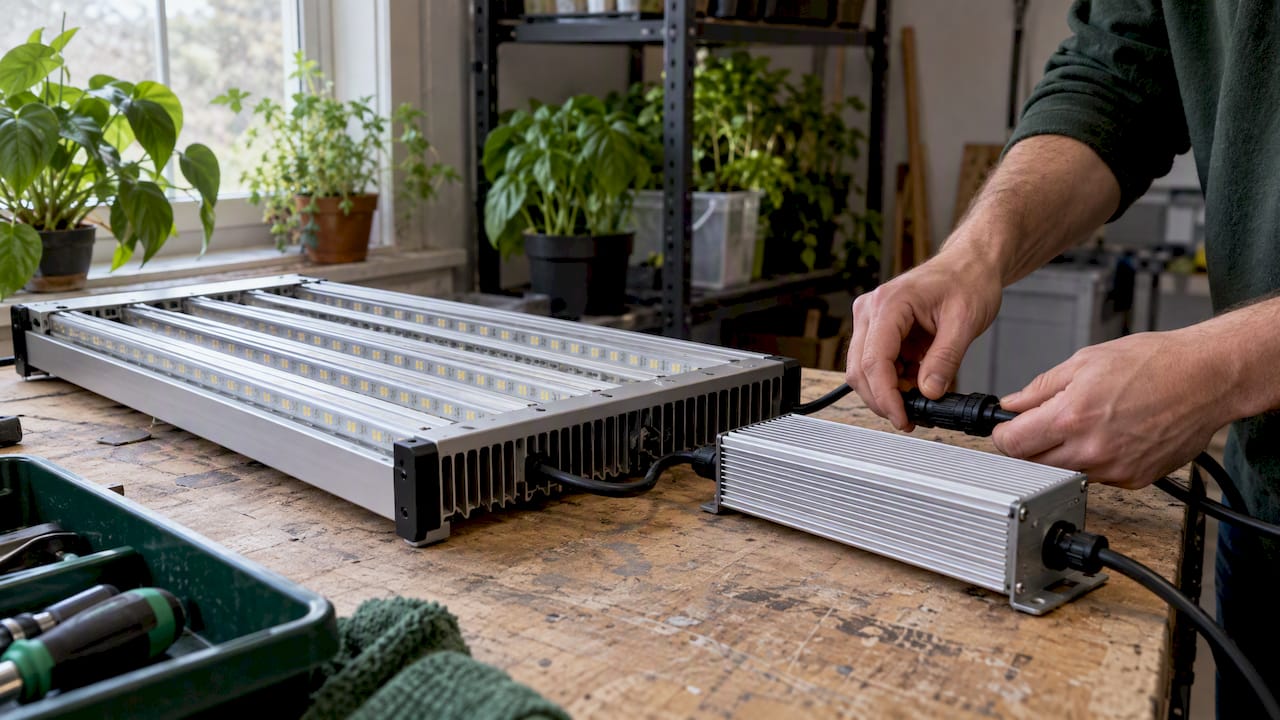
Expect a well-designed LED grow light to deliver useful plant light for roughly 10 to 15 years at home scale, provided its thermal design and driver quality match the claimed rating. The catch: quoted hours almost always describe LED-package lumen maintenance, not how long the whole fixture will survive. Drivers, optics, and connectors often fail first, so the number on the box tells you less than you’d think.
TL;DR:
- Fixture lifespan depends heavily on driver and optical quality, with thermal management and component replacement playing key roles in durability.
- Industry standards limit TM-21 projection calculations to six times the LM-80 testing hours, making long-term claims beyond that unsupported.
- Maintaining proper airflow, moderate humidity, and stable operation conditions can significantly extend the real-world life of LED grow lights.
- Choosing fixtures with replaceable, external drivers and verifying actual LM-80 data ensures more reliable, longer-lasting performance.
- Budget fixtures targeting L70 ratings may last around 8 years, while high-quality options with L90 ratings can provide over 10 years of effective use.
LED diodes rarely burn out the way old bulbs did. Instead, they dim gradually, a process called lumen depreciation. A fixture “rated for a duration often claimed” is really saying it should stay above a specific L-threshold for that many hours, and that threshold matters as much as the hour count itself.
Converting hours into calendar years depends entirely on your photoperiod:
According to Oklahoma State University Extension, average horticultural LED systems maintain around 90% output (L90) for roughly around several tens of thousands of hours, while premium models target up to around 100,000 hours claimed for diode components alone. That gap between L90 and L70 claims explains why two fixtures with similar hour numbers can deliver very different usable light over a decade: once output drops below L80, many growers notice yield or growth-rate declines that justify replacement even though the diodes technically still work.
The LED chips are often the most durable part of a grow light. The parts that fail first tend to be everything built around them. Electrolytic capacitors inside drivers degrade with heat and age, solder joints crack under thermal cycling, connectors corrode in humid grow tents, and optical lenses or potting compounds can yellow or crack over time.
Research from the U.S. Department of Energy’s SSL accelerated stress testing program found that fixture lifetime is frequently set by drivers, thermal stress, and optical materials rather than by the LED packages themselves. Elevated temperature and humidity accelerate both lumen depreciation and these component failures.
It helps to separate two failure patterns:
Catastrophic failures are obvious and often repairable if the driver is external and swappable. Parametric failures are sneakier: a fixture that looks fine can be under-delivering PPFD for months before a grower notices stunted growth.
Pro Tip: Choose fixtures with drivers that can be replaced rather than those sealed inside the heatsink body, since replacing the driver is usually more economical than replacing the entire unit.
When shopping, favor designs that expose the driver separately from the light engine, use name-brand capacitors where specs are published, and avoid fixtures that rely on glued-in optics with no ventilation path.

Two industry standards govern how manufacturers are supposed to arrive at hour claims. LM-80 is a test method: it measures how much an LED package’s lumen output declines over a fixed test period at controlled temperatures. TM-21 is the projection method that takes LM-80 data and extrapolates it forward to estimate when the package will cross L70, L80, or L90.
The critical limit most buyers never hear about:
The IES position statement on LM-80 and TM-21 warns that this extrapolation limit exists specifically to prevent unsupported lifetime marketing, and that TM-21 projections alone cannot determine full luminaire life, since drivers and optics are not covered by the LED-only test.
If a manufacturer cannot tell you the LM-80 test duration, test temperature, and which component the hours describe, the lifetime figure on the box is effectively unverifiable.
Before trusting a number, ask for those three details directly. A supplier with real LM-80 data behind its claims will usually provide them without hesitation.
Temperature is the single biggest lever growers control, as explained in this homeowner’s guide to LED lighting outdoors, which covers thermal management and fixture durability. Per the Oklahoma State Extension fact sheet, each 10°C rise above a diode’s design temperature roughly halves its expected life, a pattern confirmed by DOE accelerated stress testing as well. Mounting fixtures too close to canopy, blocking heatsink airflow, or running in a poorly ventilated tent all push junction temperature up and shorten real-world life, even when the rated hours look generous.

Frequent on/off cycling adds thermal stress too, so planning a stable photoperiod with a timer tends to be gentler on components than manual switching throughout the day.
A short maintenance routine goes a long way:
Pro Tip: Running fixtures below their maximum rated drive current can reduce heat and may extend usable life, even if it slightly lowers peak output.
We design our grow lights around the same principles this article covers: full-spectrum diodes, attention to thermal paths, and serviceable builds rather than sealed black boxes. For hobby herb growing, an L80 target is usually fine. For precision leafy greens where even output matters for uniform growth, we recommend favoring fixtures closer to an L90 target.
Our buying checklist before you purchase any grow light:
Spending more upfront on an L90-rated fixture with a serious thermal design pays off when you’re running lights daily for years, since you avoid replacing drivers or entire units mid-cycle. If you’re experimenting with a small herb setup or testing whether indoor growing suits you at all, a lower-cost L70-targeted fixture is a reasonable, pragmatic starting point. The right choice depends on how long you expect to keep growing, not just on the sticker price.
If you want a fixture that already matches the checklist above, our grow lights are built with full-spectrum diodes and serviceable components sized for compact indoor setups. Full-spectrum options within that line are detailed on our full-spectrum grow lights page, and our broader shop covers the hydroponic systems and soil mixes many growers pair with them.
| Buying check | Why it matters |
|---|---|
| LM-80 test duration and temperature | Confirms the hour claim has real data behind it |
| L-rating and which component it covers | Tells you if the number is LED-only or system-wide |
| External, replaceable driver | Lets you fix the part that usually fails first |
Most quality horticultural LEDs maintain 70 to 90% of their original output somewhere between 30,000 and 100,000 hours, depending on build quality and which L-rating the manufacturer targets, according to Oklahoma State Extension. At a typical 12 to 16 hour daily photoperiod, that translates to roughly 8 to 15 years of usable light for the diodes themselves.
Running lights continuously accelerates lumen depreciation and thermal wear on both diodes and drivers, since there’s no cool-down period. Most plants also need dark hours to grow properly, so 24/7 operation is rarely useful agronomically and adds unnecessary stress to the fixture.
A well-built fixture with a strong L90 rating and solid thermal design can reasonably reach 10 years or more at typical indoor photoperiods. Whether it actually does depends heavily on driver quality and operating temperature, not just the LED packages, since those non-diode parts often fail first according to DOE accelerated stress testing.
Higher upfront cost compared to older lighting technology is the most common drawback, along with the difficulty of verifying manufacturer lifetime claims without requesting LM-80 and TM-21 data directly. Drivers and optics can also limit real-world lifespan well before the LED diodes themselves degrade, so the headline hour figure can overstate how long the whole fixture will perform as expected.