Free shipping for order over $50

Free shipping for order over $50
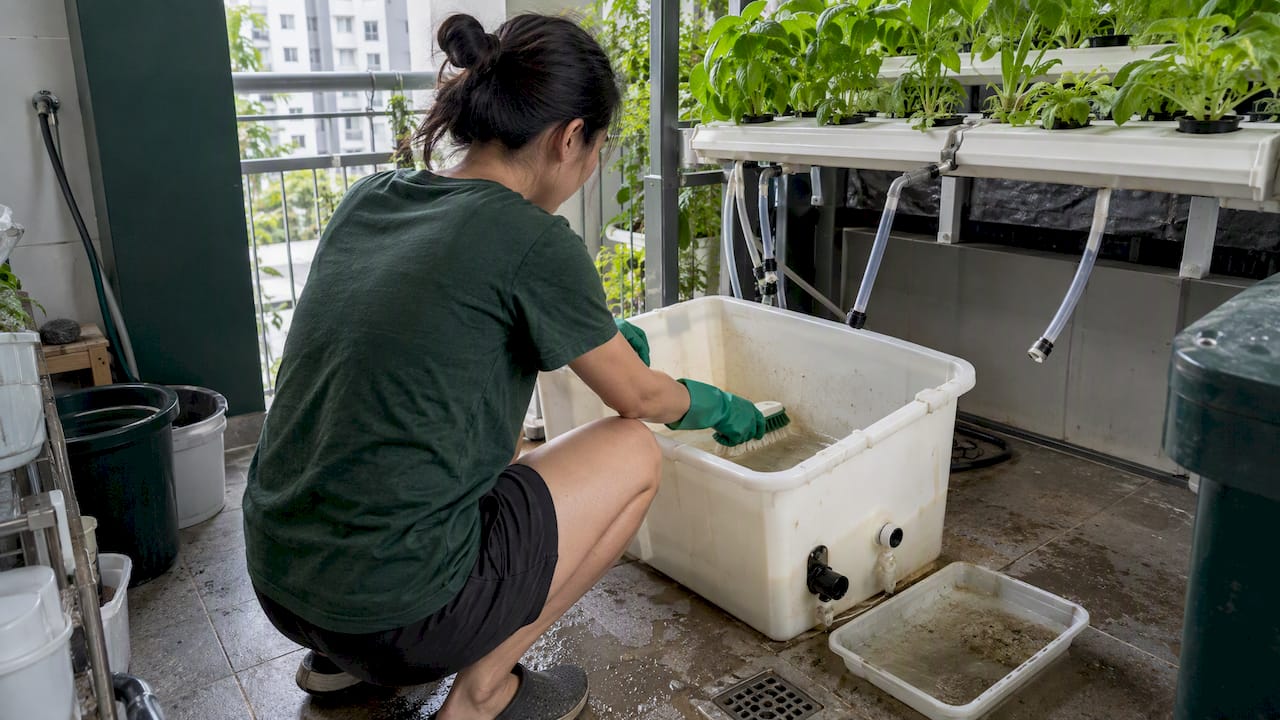
Hydroponic produce is not automatically safer than soil-grown produce, and treating it that way is the most common mistake growers make. A 2025 systematic review found that safety depends on how well a system controls water, surfaces, and people, not on the growing method itself. The first priorities: treat and monitor your nutrient solution, remove biofilm before disinfecting, and write down your hygiene routine so it actually gets followed.
TL;DR:
- Proper water treatment and continuous monitoring of residual disinfectant, turbidity, and E. coli levels are essential to prevent pathogen spread in hydroponic systems.
- Contamination risks are concentrated through recirculating water, multiple contact surfaces, and the potential for algae and biofilm buildup in warm or illuminated environments.
- Mechanical removal of biofilms before disinfection and hygienic design choices, such as opaque reservoirs and accessible components, improve sanitation effectiveness.
- Strict SOPs for worker hygiene, tool sanitization, and regular cleaning schedules significantly reduce human and environmental contamination sources.
- Maintaining detailed records and establishing clear control points enable quick response and traceability when contamination or system failures occur.
Soil-grown crops face contamination risks spread across a field: uneven irrigation, patchy manure application, scattered wildlife intrusion. Hydroponic systems concentrate that risk differently. A single contaminated reservoir touches every plant in the loop within hours, because the same water recirculates through every root zone in the system. There is no soil buffer to dilute or filter out a pathogen once it gets into the line.
This recirculation is the defining hazard of hydroponic production. If generic E. coli or another pathogen enters the nutrient solution, upstream of the crop, it reaches the entire batch rather than a localized patch. A comparative study of hydroponic and soil-grown lettuce found that hydroponic samples can carry similar microbial profiles to soil-grown produce, and in some cases tested positive for Salmonella and E. coli, which undercuts the assumption that a soilless system is inherently cleaner.
Hydroponics also introduces more food-contact surfaces than a field ever has. Trays, channels, net pots, pumps, tubing, and reservoir walls all touch water that eventually touches the edible portion of the plant. Extension guidance from the University of Vermont identifies these surfaces, along with frequent human interaction during transplanting and harvest, as central risk factors that differ from open-field growing.
The common entry points for contamination in a hydroponic operation include:
Outbreak investigations and retail sampling studies keep returning to the same conclusion: the growing method is less important than the operational discipline behind it. A clean hydroponic system beats a dirty field, and a dirty hydroponic system beats nothing at all in the wrong direction. The rest of this guide focuses on the controls that make the difference.
Your nutrient solution is the single highest-leverage control point in a hydroponic system, because everything that happens downstream depends on what goes into that reservoir. Start by assessing your incoming water source. Municipal tap water in most of Singapore carries a chlorine residual that offers some baseline protection, but well water, harvested rainwater, or stored water needs testing before it goes anywhere near a root zone. Fine filtration removes sediment and organic debris that would otherwise shield microbes from treatment later. Reverse osmosis is worth the investment for operations scaling past hobby size, since it strips dissolved solids and biological contaminants before you even start dosing nutrients.
Once water is in the system, you have three realistic treatment options:
Researchers have identified many distinct interventions for controlling pathogens in hydroponic systems across chemical, physical, and biological approaches. That volume of research reflects how much variation exists in effective treatment, and why a single generic “sanitize the water” instruction is not enough guidance on its own, according to the systematic review.
Monitoring turns treatment from a one-time task into an ongoing safeguard. Track generic E. coli levels in your water source periodically, watch turbidity as a proxy for organic buildup, and measure residual disinfectant to confirm your treatment is actually working rather than assumed to be working. Dissolved oxygen matters too: keeping levels above 6 ppm for most leafy crops reduces the anaerobic pockets where biofilm-forming bacteria thrive.
Set clear triggers for action rather than waiting for a visible problem. Rising turbidity, a positive generic E. coli result, or a drop in residual disinfectant below your target range should trigger an immediate response: stop use, drain the reservoir, and move to a full mechanical and chemical clean before refilling. Waiting for plants to show stress is waiting too long, since microbial contamination rarely announces itself through visible symptoms until the problem is advanced.
Warm, light-exposed reservoirs are a near-perfect growth environment for algae and biofilm, and that combination is especially relentless in tropical and indoor-controlled climates. Light reaching standing nutrient solution feeds algae directly, while algae mats and other organic films create a protective matrix where bacteria can shelter from disinfectants. SFA guidance on algae and biofilm management points specifically to tropical conditions as a driver of more frequent and more aggressive growth compared to temperate climates, which means inspection and cleaning schedules built for cooler regions often fall short here.
The order of operations matters more than the choice of chemical. Scrubbing away a biofilm layer before applying any disinfectant is non-negotiable, because biofilms physically shield the microbes embedded in them from chemical contact. Spraying disinfectant onto an intact biofilm mostly cleans the surface layer while leaving the colony underneath undisturbed. Mechanical removal first, chemical disinfection second, thorough rinse last: that sequence, confirmed in the same SFA guidance, is the backbone of effective sanitation in any hydroponic system.
Hygienic design choices make that mechanical step faster and more reliable every time you do it:
Extension guidance recommends designing systems around these principles from the start rather than retrofitting hygiene onto a system that was never built for it.
Pro Tip: Choose dark-colored or opaque reservoirs and tubing wherever possible: blocking light at the source cuts algae growth more effectively than any amount of after-the-fact scrubbing.
A cleaning schedule only works if it matches the pace at which contamination risk actually builds, and that pace is faster than most new growers expect. Daily tasks should include a quick visual check of the reservoir and root zone for discoloration, slime, or algae film, plus a glance at your water level and pump function. Weekly tasks step up to flushing lines, rinsing filters, and wiping down exposed food-contact surfaces with a sanitizing solution. A full rotation clean, meaning a complete drain, scrub, disinfect, and refill, should happen on a fixed interval rather than only when something looks wrong, since biofilm can establish before it becomes visible.
The mechanical step comes first every time: a stiff brush for reservoir walls and channels, a pressure rinse for tubing where accessible, and a full filter cleaning or replacement on its own schedule. Skipping this step and going straight to chemicals is the single most common shortcut that undermines an otherwise reasonable sanitation plan.
For the chemical step, follow a clear sequence:
A free chlorine residual above 1 ppm left in a system after cleaning can damage lettuce and other sensitive crops, which is why SFA’s guidance specifically calls for verified rinsing before replanting. That single checkpoint prevents one of the most common self-inflicted problems in home and small-scale hydroponic setups.
Never mix chlorine-based products with other cleaning chemicals, since the combination can produce dangerous gases. Wear gloves and eye protection when handling concentrated disinfectants, work in a ventilated area, and keep a written record of what was used, at what dilution, and when, so you can troubleshoot if something goes wrong later.
Worker hands are one of the most direct routes pathogens take into an otherwise well-controlled hydroponic system, and extension guidance on personal health and hygiene treats worker training as a foundational control rather than an afterthought. A documented hygiene routine should specify exact moments: before handling plants, after using the restroom, after touching raw inputs or waste, and after breaks. Anyone showing symptoms of illness, particularly gastrointestinal symptoms, should be excluded from handling produce until cleared, since even brief contact during an infectious period can transfer pathogens to an entire harvest.
Clear SOPs cover more than handwashing:
Documentation matters even in a small operation. A simple log noting who completed which cleaning task and when turns an informal habit into a verifiable routine, and it becomes essential if you ever need to trace back the source of a problem. Extension specialists recommend classifying surfaces by zone and assigning a specific sanitizing agent and frequency to each one, which reduces the chance that a high-risk surface gets missed simply because nobody was assigned to it.
The harvest window is where weeks of careful system management can be undone in minutes if handling is sloppy. A pre-harvest check should confirm the system looks normal: no visible algae bloom, no unusual odor, no sign of pest activity, and water parameters within your normal range. Catching a problem before harvest, rather than after, means you can delay or redirect the batch instead of distributing something questionable.
At harvest itself:
If wash water contacts the edible portion of the crop at any point, Virginia Tech’s extension guidance recommends treating and testing that water to the same microbial standard as production water, since post-harvest rinsing introduces a fresh contamination opportunity even after a clean harvest. Packaging materials should be food-grade and stored somewhere that keeps them away from dust, pests, and splash from cleaning activities.
Storage after harvest should keep produce cool and separated from raw inputs like unwashed growing media or untreated water. A short gap between harvest and refrigeration or sale reduces the window for any surviving organisms to multiply, and that gap matters more in a tropical climate where ambient temperatures accelerate microbial growth.

A monitoring program only has value if it tells you something before a problem reaches the plant, which means picking the right tests and checking them often enough to matter. The essential tests for most hydroponic operations are generic E. coli in water, residual disinfectant levels after cleaning, and turbidity as an early warning for organic buildup. Sample points should include the reservoir itself, any point where water re-enters after filtration or treatment, and occasionally the rinse water used at harvest if applicable.
That corrective-action flow mirrors the approach Virginia Tech’s extension program recommends: stop distribution immediately, isolate what may be affected, clean mechanically and chemically, verify through retesting, and only then resume.
| Metric | Why it matters | Suggested frequency |
|---|---|---|
| Generic E. coli in source/reservoir water | Indicator of fecal contamination risk | Periodic, more often for well or rainwater sources |
| Residual disinfectant after cleaning | Confirms treatment was effective | Every cleaning cycle |
| Turbidity | Early warning for organic buildup and biofilm risk | Daily to weekly visual or instrument check |
| Dissolved oxygen | Low levels favor anaerobic, biofilm-forming bacteria | Daily in tropical or warm settings |
Keeping these records in a simple notebook or spreadsheet does double duty: it catches problems early, and it gives you something concrete to show if a buyer, co-op, or market ever asks how your produce is handled.
A workable SOP does not need to be complicated to be effective; it needs to be specific enough that anyone in the household or operation can follow it without guessing. Break it into three layers: daily, weekly, and rotation.
Daily tasks should take only a few minutes: a visual scan for algae or discoloration, a dissolved oxygen check if you have a meter, and a glance at pump and water flow. Weekly tasks add filter cleaning, a reservoir inspection for early biofilm, and a check of your nutrient dosing against target levels. The rotation or deep-clean SOP, done on a fixed interval, means a full drain, mechanical scrub, chemical disinfection, verified rinse, and refill, documented each time it happens.
In tropical or consistently warm environments, shorten these intervals rather than keeping a schedule built for a temperate climate. Daily visual checks become more important, and keeping dissolved oxygen above 6 ppm helps starve the anaerobic conditions that favor biofilm. Our guide to stopping algae in hydroponic systems walks through weekly treatment options and DO targets in more detail for home setups.
| SOP layer | Core tasks | Typical interval |
|---|---|---|
| Daily | Visual check, dissolved oxygen check, flow check | Every day |
| Weekly | Filter cleaning, reservoir inspection, dosing check | Weekly |
| Rotation | Full drain, scrub, disinfect, rinse, verify | Fixed interval, shorter in warm climates |
| Harvest | Tool sanitizing, handwashing, dedicated containers | Every harvest |
Every hydroponic operation benefits from mapping its own process from water source to harvested product, identifying exactly where contamination could enter or multiply. This is the same logic behind formal hazard analysis frameworks used in commercial food production, scaled down to fit a home or small operation.
Start by listing each stage: water sourcing, nutrient mixing, seedling introduction, ongoing circulation, harvest, and post-harvest handling. At each stage, ask what could go wrong and how severe the consequence would be. Untreated source water is a high-severity, moderate-likelihood risk. A missed weekly filter cleaning is lower severity but higher likelihood if routines slip. Ranking stages this way tells you where to put your limited time and attention first.
The stages that consistently emerge as critical control points, meaning places where a specific action prevents or reduces a hazard, are water treatment before it enters the system, mechanical cleaning before disinfection, and hand hygiene at harvest. Monitoring at each of these points, rather than only at the end of the process, catches problems while they are still correctable. A system that only checks finished produce for safety has already lost the opportunity to intervene earlier and more cheaply.

Soil-grown crops face soilborne pathogens that live in dirt and can persist for years, surviving between growing seasons in the absence of a host. Hydroponic systems remove that soil reservoir entirely, which eliminates one category of risk but does not eliminate risk itself: it shifts the dominant pathogen source to water.
Waterborne pathogens, including certain strains of E. coli and Salmonella, travel efficiently through a recirculating system precisely because there is no soil to slow them down or filter them out. The comparative microbial study comparing hydroponic and soil-grown lettuce found pathogen detection in both systems, which confirms that switching to hydroponics does not substitute for active water management.
Beyond the water itself, seeds and transplants can introduce pathogens that originated elsewhere, before they ever reach your system. Worker hands and tools are another distinct source, unrelated to either soil or water, and one that soil-based growing shares with hydroponics equally. Understanding which pathogen source applies to which stage of your operation helps you match the right control, water treatment for waterborne risks, seed sourcing checks for transplant risks, and hygiene protocols for human-vector risks, rather than applying one generic fix to every problem.
Good Agricultural Practices, commonly known as GAP, were originally written with field agriculture in mind, but the underlying principles translate directly to hydroponic production once you adjust for the differences. Where field GAP focuses heavily on soil amendments, irrigation water testing, and wildlife intrusion, hydroponic GAP shifts weight toward nutrient solution management, food-contact surface sanitation, and the recirculation risk unique to closed-loop systems.
The core GAP elements that carry over directly include documented water testing, worker hygiene training, clear recordkeeping, and defined cleaning schedules. What changes is frequency and emphasis: a hydroponic operation tests its recirculating water far more often than a field operation tests irrigation water, because the consequence of contamination spreads faster through a shared loop than through soil.
Adapting GAP for a hydroponic system in practice means writing down, even informally, what water source you use and how you treat it, what your cleaning rotation looks like, who handles the crop and when they wash their hands, and how you would respond if a test came back positive. None of this requires formal certification to be worthwhile. The discipline of writing it down is what turns good intentions into a routine that survives a busy week.
Traceability means being able to answer, quickly, exactly which batch of produce came from which water source, which cleaning cycle, and which harvest date. Without that information, a single contamination event forces you to treat your entire inventory as suspect, since you cannot isolate what is actually affected.
A workable traceability system does not need specialized software for a small or home operation. Labeling harvest batches by date, keeping a simple log that ties each batch to its reservoir cleaning history, and noting any unusual observations during that growing cycle gives you the ability to trace backward if a problem surfaces later. For operations selling to others, buyers increasingly expect this level of documentation as a baseline expectation rather than an extra.
The real value of traceability shows up during the corrective-action sequence described earlier: isolate, clean, retest, document. Isolation only works if you know precisely what needs isolating, and that is only possible when your records connect each batch to its growing history in enough detail to draw a clear line around the affected product and leave the rest of your inventory untouched.
Food safety expectations for hydroponic produce in Singapore fall under the same general food safety framework that governs other fresh produce, administered by the Singapore Food Agency. There is no separate hydroponic-specific law that replaces general food hygiene requirements. What SFA’s best-practice guidance does provide is sector-specific detail, particularly around algae and biofilm management given Singapore’s tropical climate, which growers in other regions may not find as directly relevant to their own conditions.
For growers selling produce, rather than growing for personal use, understanding which food safety obligations apply to your scale and distribution channel matters more than chasing a generic certification. Smaller operations selling at a local market face different expectations than a larger operation supplying retail chains. Where the specifics of your situation are unclear, the governing principle is that produce entering commerce needs to meet the same basic safety standard regardless of growing method, and the practical path to meeting that standard runs through the controls covered throughout this guide: treated water, sanitized surfaces, trained handlers, and documented routines. Growers with questions about obligations specific to their operation should consult SFA’s published guidance directly or a qualified food safety professional, since requirements can shift based on scale and sales channel.
Even a well-run hydroponic operation benefits from having a plan written before an incident happens, rather than improvising one in the moment. A basic emergency response plan answers three questions in advance: who makes the call to stop distribution, what the immediate containment steps are, and how you verify it is safe to resume.
The sequence that extension guidance consistently recommends, stop distribution, isolate affected batches, drain and deep-clean the system, retest, then resume only after verification, works as well for a home grower noticing unusual algae growth as it does for a larger operation responding to a positive water test. The key is having that sequence written down before you need it, since decision-making under pressure tends to skip steps that a calm, pre-planned checklist would have caught.
System failures deserve the same preparation as contamination events. A pump failure that lets water sit stagnant for hours, a power outage that disrupts aeration, or a filtration failure that lets turbidity climb unnoticed are all situations where a quick, specific response limits the damage. Knowing in advance that a stagnant reservoir gets drained and the system deep-cleaned before restart, rather than simply refilled and restarted, prevents a mechanical problem from becoming a biological one.
The growers who struggle most with hydroponic food safety are usually not the ones who lack information. They are the ones who treat sanitation as something to handle after a problem shows up rather than something built into the weekly routine from day one. A few consistent habits, mechanical cleaning before chemical disinfection, a fixed testing schedule, documented handwashing moments, prevent far more problems than any single corrective action ever fixes after the fact.
Start small and build consistency before you build scale. A simple daily visual check and a weekly reservoir inspection, done reliably, beats an elaborate monitoring plan that gets abandoned after a few weeks because it was never realistic to sustain. Write your routine down, even informally, since a written SOP survives a busy week in a way that a mental checklist does not.
Our guide to growing hydroponic vegetables at home and our notes on algae control and dissolved oxygen targets walk through how to build these habits into a system from the start, rather than retrofitting them later.
— Irwin Lee
Food safety starts with a system that is actually easy to clean, and that is the thinking behind our modular hydroponic setups designed for compact urban spaces. A system built with removable, accessible components turns the mechanical-first cleaning this guide recommends from a chore into a five-minute task, which matters because the SOPs that get followed are the ones that do not feel like a burden.
Our product lines map directly onto the checklist covered here:
If you are setting up a new system or replacing an aging one, our reservoir hydroponic system guide walks through the setup choices that make ongoing sanitation easier from day one. Browse our full range at Sprout Lab to find a system and the supplies to keep it running clean.
This article is general information, not a substitute for advice from a qualified doctor. Consult a qualified healthcare professional about your own circumstances before acting on anything here.
Hydroponic produce can be just as safe as soil-grown produce when the system is managed with treated water, regular cleaning, and good worker hygiene. A 2025 systematic review found that safety depends on the specific controls in place rather than the growing method itself, and identified dozens of effective interventions growers can apply.
The main disadvantages include rapid contamination spread through recirculating water, more food-contact surfaces than soil growing requires, faster algae and biofilm buildup in warm or well-lit conditions, a need for more frequent water testing, and higher reliance on consistent worker hygiene since there is no soil buffer to slow down human-introduced pathogens.
Not inherently. A comparative microbial study found that hydroponic and soil-grown lettuce can show similar microbial profiles, with both systems testing positive for pathogens like Salmonella and E. coli in some samples. Safety comes down to water treatment, sanitation, and handling practices rather than the growing method.
Yes, hydroponic lettuce can carry E. coli if contaminated water, unsanitized surfaces, or poor worker hygiene introduce it into the system. The same comparative study documented E. coli detection in hydroponic samples, which is why regular water testing and mechanical-first cleaning are central to prevention.
Test generic E. coli, turbidity, and residual disinfectant on a fixed schedule rather than only when a problem appears, with more frequent checks for well or rainwater sources and in warm or tropical conditions. Extension guidance recommends tying frequency to your water source risk and operation scale, and documenting every result for your own records.