Free shipping for order over $50

Free shipping for order over $50
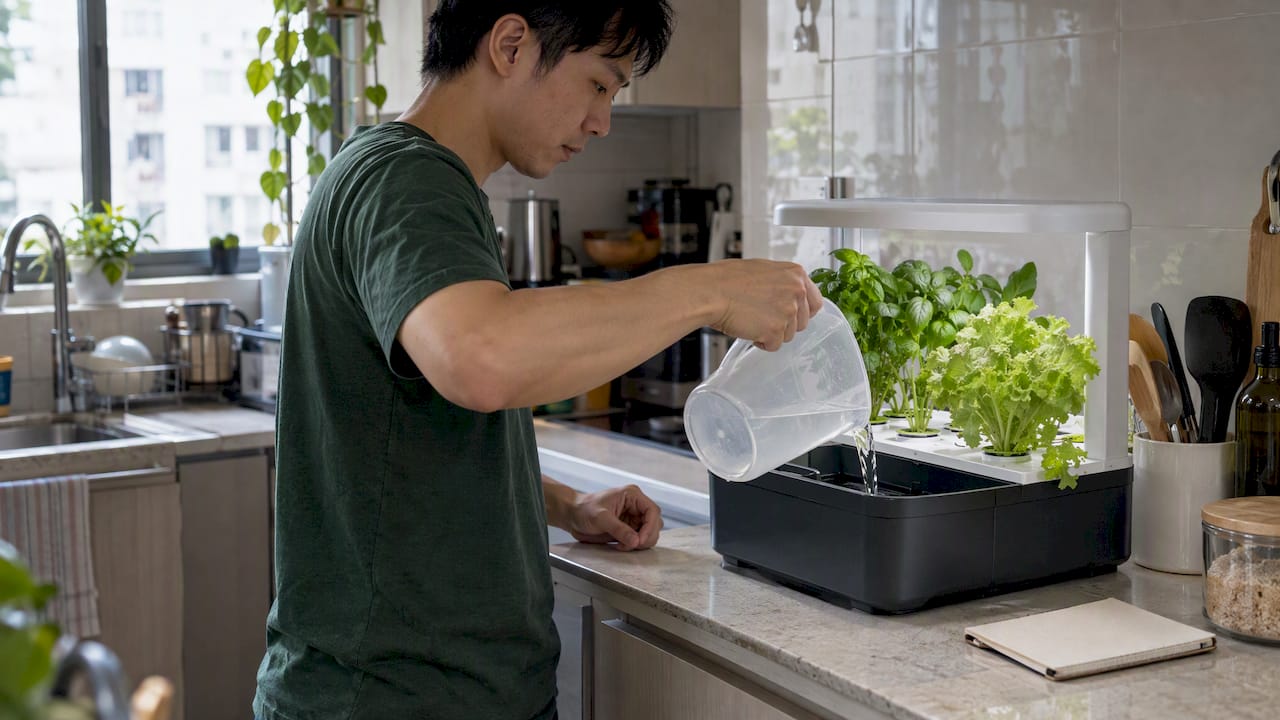
Most home hydroponic systems typically need a full reservoir change every two to three weeks, but the calendar is only a backup plan. The real trigger is cumulative volume: once your top-ups add up to the original reservoir size, treat that as a full replacement, following the reservoir-volume refill rule. pH swings, cloudy water, or stalled growth should override any schedule.
TL;DR:
- Reservoirs with smaller volumes or crops like lettuce and herbs require water changes every one to two weeks, while larger systems can extend to three weeks.
- Indicators such as persistent pH drift, cloudy solution, or root stress signal it is time for a full water change rather than relying solely on a calendar schedule.
- Matching water change frequency to the specific system type matters: DWC needs continuous aeration, NFT requires frequent pH checks, and media-based systems can stretch intervals.
- Once cumulative top-ups equal the original reservoir volume, the solution should be fully replaced to prevent hidden nutrient imbalances.
- Regular monitoring of pH, EC, and dissolved oxygen, combined with thorough system cleaning, is essential to prevent common issues like microbial growth, root rot, and equipment failure.
The 14 to 21 day window shows up across extension guidance because it balances two realities: nutrient solutions drift as plants feed unevenly on different ions, and most home reservoirs are small enough that this drift becomes noticeable within a few weeks. Smaller reservoirs or fast-growing leafy greens pull water and nutrients out faster relative to their volume, which pushes the interval toward the shorter end.
Adjust the baseline using reservoir size and crop:
A simple example: if a 10 liter reservoir loses 1 liter a day to transpiration and evaporation, you are replacing roughly 70% of the original volume through top-ups alone within a week, which is a strong sign a full change is close.
Some signals matter more than any date on your calendar. MU Extension recommends keeping pH between 5.5 and 6.5 for most crops, and when pH keeps drifting out of that band even after you correct it, the buffering capacity of the solution has likely broken down.
Watch for these triggers:
A solution that looks clear can still be chemically unbalanced. MU Extension notes that EC alone cannot tell you whether specific nutrients have been depleted or concentrated, which is why visual clarity is a poor stand-in for a real test.
Deep water culture (DWC), nutrient film technique (NFT), ebb and flow, and media-based systems don’t drift at the same rate, because they differ in reservoir size, circulation, and how much buffering the medium provides. Virginia Tech’s hydroponic management guidance notes that pump and aeration needs are system-specific, and water-change frequency doesn’t dictate how often the pump runs.
Rules of thumb by system:
The reservoir-volume-to-growth ratio matters more than the system label. A small reservoir supporting large, fast-growing plants will always need more frequent attention than a large reservoir with the same crop.
Topping up means adding plain water (or a dilute nutrient mix) to replace what plants and evaporation have removed, without disturbing the existing solution. A full change means draining everything and starting fresh. Topping up alone can mask nutrient drift, because the ratio of ions in solution keeps shifting even while the total volume looks normal.
Utah State University’s nutrient management guidance lays out the operational rule simply: once your cumulative top-ups equal the reservoir’s original volume, you’ve effectively replaced the solution without controlling what went into it, so treat that point as a full change.
This log does more work than it looks like. It turns a vague feeling of “it’s probably time” into a number you can actually check.
A full change is routine maintenance, not an emergency, if you follow a consistent order. Virginia Tech’s management basics lay out the sequence that avoids shocking your plants.
Pro Tip: Pour concentrated nutrient solution into your mixing reservoir, never directly onto roots, and add acid or base pH adjusters to water, not the other way around, to avoid splash-back and uneven mixing.

Testing little and often beats testing never and guessing. IFAS/UF guidance recommends checking pH daily or every other day for sensitive crops like lettuce, with EC checked several times a week so you catch a drift before it becomes a crisis.
A workable routine:
Pro Tip: A five-minute log entry twice a week catches a slow pH creep weeks before it would show up as stunted leaves.
Most hydroponic failures trace back to one of four things: chemistry drift, contamination, oxygen, or mechanical failure.
Calendar-only changes waste water and nutrients on systems that didn’t need a dump yet, while blind faith in a schedule misses the plant that’s already stressed. I’d rather see a grower check pH twice a week and skip a few calendar changes than dump water on autopilot. Customer support conversations with home growers consistently emphasize that a cheap meter and a five-minute log beat guesswork every time, and you don’t need to get it perfect on day one to see the benefit.
— Irwin Lee
Monitoring-first maintenance works best when your system is built for easy access. Sprout Lab’s modular hydroponic systems are designed for compact spaces and simpler reservoir access, which matters when you’re draining and cleaning every few weeks.

A few things that make the routine faster rather than more complicated:
If you’re setting up or upgrading a home system, Sprout Lab’s shop carries the kits, soil mixes, and accessories that make this schedule something you can actually keep up with.
These recommendations are drawn from university extension and horticulture research, with one gardening-routine perspective included for practical water-use comparisons.
Most home systems need a full reservoir change every 14 to 21 days, adjusted by reservoir size and crop, according to extension guidance on recirculating hydroponics. Change sooner if pH keeps drifting, EC won’t correct, or the solution turns cloudy or smells off.
Pump runtime depends on the system rather than the water-change schedule: NFT needs continual circulation, DWC relies on continuous aeration instead of flow, and media-based systems run on timed irrigation cycles, per Virginia Tech’s management guidance. A pump or aeration failure should always be treated as urgent, not scheduled around.
Hydroponic systems depend on electricity and working pumps, require frequent pH and EC monitoring, can develop hidden nutrient imbalances even when the water looks clear, carry root oxygen and temperature risks in submerged systems, and demand ongoing equipment and cleaning costs, according to IFAS/UF greenhouse hydroponic guidance.
There’s no fixed safe outage time for deep water culture, since it depends on water temperature, root mass, and reservoir volume, per Virginia Tech’s hydroponic guidance. Treat any aeration or pump failure as urgent and have a backup air pump ready rather than waiting to see how long roots can tolerate low oxygen.