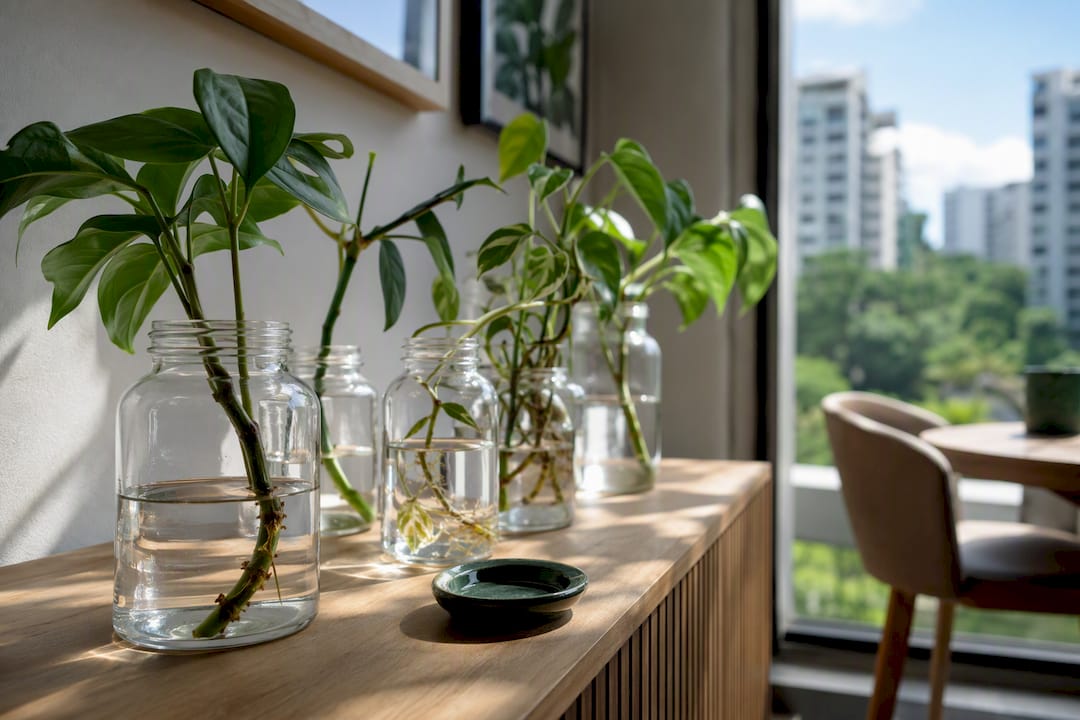
Most common houseplants and kitchen herbs, from pothos and philodendron to coleus and mint, root reliably in plain water. Cut just below a node, keep any remaining leaves out of the water, place the jar in bright indirect light, and swap the water regularly to stop rot before it starts.
TL;DR:
- Most trailing houseplants and kitchen herbs root reliably in water within one to two weeks, especially if they have visible nodes or aerial roots.
- Cuttings should be taken at an angle below a node, with lower leaves removed to prevent rot and clouding water, and changed at least once a week.
- Succulents, woody shrubs, and cacti usually rot in standing water and are better propagated in dry soil or barely moist medium.
- Moving water-rooted cuttings into soil requires waiting until roots are one to two inches long, using well-draining soil, and gradually adjusting watering habits.
- Rooted cuttings can be transitioned to hydroponic systems or soil-based containers, with small space-focused setups like jars or grow lights ideal for apartment growers.
Sprout Lab
Grow More in Less Space
Sprout Lab makes compact hydroponic gardening accessible for Singapore homes, helping beginners cultivate plants where space is limited.
Table of Contents
Best Plants to Propagate in Water by Difficulty Level
Some plants root in days with almost no effort, others need patience, and a few are better started in soil altogether. Grouping candidates by how forgiving they are helps you pick something you’ll actually succeed with on your first try, rather than starting with a stubborn species and assuming you did something wrong.

The plants that root fastest share a trait: visible nodes or aerial roots that are already primed to grow in water. Vining aroids top this list because their nodes often have a small brown bump or root nub before you even cut them. Woody shrubs and most succulents sit at the other end. They tend to rot rather than root, since their tissue isn’t built to sit in standing water.
Very easy (root in one to two weeks):
- Pothos (Epipremnum aureum): cut below a node, roots often appear within about one to two weeks.
- Philodendron (heartleaf and similar trailing types): similar node structure to pothos, roots in 7 to 14 days.
- Tradescantia (wandering dude, wandering jew): roots very quickly in some cases, sometimes within a week.
- Coleus: fast, fibrous roots appear in 7 to 10 days, popular for beginners because failure is rare.
- Chinese evergreen (Aglaonema): stem cuttings with a node root in about two weeks.
- English ivy: roots in about one to two weeks, tolerates lower light than most on this list.
- Spider plant (Chlorophytum comosum): the plantlets already growing on runners often have tiny roots and just need water to extend them.
Good for beginners (root in two to four weeks):
- Monstera deliciosa: needs a node and ideally an aerial root, rooting in 2 to 4 weeks.
- Peace lily (division rather than true cutting): establishes roots in water within 3 weeks.
- Begonia (many rex and cane types): leaf or stem cuttings root in 2 to 3 weeks, though some rex varieties prefer leaf propagation in a moist medium instead.
- Fittonia (nerve plant): roots in about 2 weeks but is prone to wilting if the humidity drops.
- Dracaena (corn plant type): slower, often 3 to 4 weeks, but reliable once roots start.
- African violet (leaf cuttings): roots in a few weeks, best with the leaf stem angled rather than flat against the glass.
- Wax plant (Hoya): roots in several weeks and benefits from a node with a visible aerial root.
- Peperomia: most stem and leaf types root in a few weeks.
Edible herbs (root in one to two weeks, ideal for a kitchen windowsill):
- Mint: among the fastest of all cuttings, often rooting within a week.
- Basil: roots in 7 to 10 days but is sensitive to cold drafts.
- Rosemary and thyme: woodier stems root more slowly, typically 3 to 4 weeks, and benefit from a rooting hormone dip.
- Lemongrass and green onion bases: technically regrowth rather than true propagation, but both extend readily in a shallow glass of water.
Special cases and cautions:
- Succulents and cacti: most rot in standing water and should be propagated in dry air or barely moist soil instead.
- Woody shrubs (roses, hydrangea): water propagation is possible but success rates are lower than with a rooting hormone and soil.
- Snake plant (Sansevieria): roots in water but very slowly, often taking 4 to 8 weeks, and leaf cuttings can lose their variegation.
If you’re building an edible windowsill garden, a beginner’s guide to growing herbs indoors covers which herbs handle low light and small containers best once your cuttings take root.
How to Root a Cutting in Water Step by Step
The mechanics are simple, but small details, where you cut, how much leaf sits below the waterline, and how often you refresh the water, decide whether a cutting roots cleanly or turns to mush.
- Find a node. This is the small joint on the stem where a leaf or aerial root emerges. Roots almost always form here, not along bare stem.
- Cut at an angle, just below the node. Use clean, sharp scissors or pruning shears. A dull blade crushes the stem and invites rot.
- Strip lower leaves. Remove any leaves that would sit underwater. Submerged foliage decomposes and clouds the water within days.
- Choose a clear glass or jar. Clear containers let you watch root development without disturbing the cutting, which matters more than any specialized propagation vessel.
- Fill with room-temperature water. Tap water is fine for most houseplants; if your water is heavily chlorinated, letting it sit out for a few hours before use helps.
- Submerge only the node and stem, not the leaves. The node needs contact with water; the foliage does not.
- Place in bright, indirect light. A spot a few feet from an east or west-facing window works well. Avoid direct sun hitting the glass, since it heats the water and can cook young roots.
- Change the water on a regular schedule. GardeningSG recommends changing propagation water at least once, and ideally twice, a week to prevent rot and reduce mosquito breeding, a detail that matters more in humid, tropical climates than in cooler ones.
- Wait for visible roots before feeding. Once roots are at least an inch long, a very dilute hydroponic nutrient can be added. Full-strength fertilizer at this stage tends to burn young roots rather than help them.
Pro Tip: Keep a spare pothos cutting in the same jar as a harder-to-root plant. Pothos releases natural rooting compounds into the water that can help slower species along, as long as you keep the water clean.
Why Cuttings Rot, Go Limp, or Never Root
Most failed cuttings fall into one of a handful of predictable problems, and nearly all of them trace back to water quality or a leaf that shouldn’t have been submerged.
- Slimy or discolored stem base: this is early rot. Cut above the affected tissue, re-trim at a clean angle, and start over in fresh water.
- Cloudy, smelly water: almost always caused by a decomposing leaf or debris. Rinse the jar, remove any submerged foliage, and refill with clean water.
- Limp or yellowing leaves with no roots: often a light or temperature issue rather than a rooting failure. Move the jar to brighter indirect light and check for cold drafts.
- No root growth after several weeks: some species are simply slow (Hoya and snake plant can take over a month). Confirm the cutting includes a healthy node before giving up on it.
GardeningSG’s guidance on changing water frequently exists for a practical reason beyond preventing rot: standing water is also a mosquito breeding ground in warm, humid conditions. Emptying and refreshing jars twice a week addresses both problems at once.
If a cutting is only partially rotted, a quick salvage attempt is worth trying: trim well above the soft, discolored section, rinse the fresh cut under running water, and place it in a new, clean jar rather than reusing the old water. Always sanitize shears and containers between cuttings, since a single infected jar can spread rot to an otherwise healthy stem.
Moving Water-Rooted Cuttings Into Soil
Roots grown in water are structurally different from soil roots. They’re adapted to constant moisture and oxygen exchange in liquid, which is why a cutting can sometimes struggle, or shed some of its water roots entirely, in the first days after potting.
- Wait until roots are one to two inches long with at least a few branching roots, not just a single thread. More roots mean a better shot at survival once the growing medium changes.
- Pot into an aerated mix, such as a blend heavy in perlite or LECA, rather than dense potting soil. This mimics some of the oxygen access the roots had in water.
- Use a small pot. A container only slightly larger than the root ball keeps the mix from staying soggy, which is the most common cause of transplant failure.
- Tone the cutting gradually. Keep the soil evenly moist for the first 10 to 14 days, tapering watering slowly rather than switching straight to a normal soil-drying schedule. This gradual shift helps the plant grow soil-adapted roots without the shock of sudden dryness.
- Watch for new growth, not just survival. A new leaf or shoot within a few weeks is the clearest sign the plant has adjusted; wilting that doesn’t recover after a few days usually means the mix is too wet or the pot too large.
For readers who want a moisture-management alternative to hand-watering during this toning period, a self-watering system can keep the mix consistently damp without the guesswork.
Making Small Spaces Work for Rooted Cuttings
Getting a cutting to root is only half the job. Turning it into a plant that thrives long-term depends on light, container choice, and a growing medium suited to the space you actually have, which is where a lot of apartment growers hit a wall.
- Reuse what you have first. A jam jar or drinking glass works fine for rooting; there’s no need for specialized equipment at this stage.
- Group jars near a single light source. Clustering cuttings under one grow light or window is more space-efficient than spreading them across a room.
- Watch light levels in low-light apartments. Many rooting failures in dim units come down to insufficient light rather than a bad cutting. A compact grow light extends bright hours for plants that would otherwise stall.
- Match the potting mix to the plant once it’s transplanted. Aroids like pothos and philodendron do best in a chunky, well-draining mix rather than dense garden soil.
For growers who want to skip the trial and error on containers, a jar-based herb garden setup offers a practical structure for keeping multiple cuttings organized and clean while they root.
Why I Still Root a Few Cuttings Every Month
Water propagation earns its popularity because it turns a trimmed stem you’d otherwise compost into a free plant, no soil, no rooting hormone, no guesswork about drainage. I’ve found the best results come from starting with two or three cuttings rather than chopping an entire plant at once, since a smaller batch is easier to monitor and far less discouraging if one fails. It’s a small, low-cost way to experiment before committing more time or space to a plant.
— Irwin Lee
Turning a Rooted Cutting Into a Long-Term Plant
Once a cutting has real roots, the question becomes what to grow it in long-term. Modular hydroponic systems built for compact spaces, along with soil mixes, grow lights, plant care tools, and propagation accessories, are available for urban growers who want a plant to thrive well past the jar stage.
A common flow looks like this: root a pothos or herb cutting in a jar of water, then move it once roots are established into either a small pot with a curated soil mix or a countertop hydroponic tray for continuous, soil-free growth.
- Herb cuttings that have rooted in water can move directly into a countertop hydroponic system for a steady harvest without repotting again.
- Aroids and other houseplants generally prefer a chunky, aerated soil mix suited to their root type.
- Low-light apartments benefit from a compact grow light positioned near the rooting jars or new pots.
| Growing method |
Best suited for |
Space required |
| Water propagation jar |
Rooting the initial cutting |
Windowsill or shelf |
| Potting mix and small pot |
Aroids, herbs, foliage plants |
Small pot footprint |
| Sprout Lab hydroponic system |
Ongoing growth for multiple plants |
Compact modular unit |
Browse the full hydroponics and plant care range to find the setup that fits your space.
FAQ
Which plants can I propagate in water?
Most trailing houseplants root reliably in water, including pothos, philodendron, tradescantia, coleus, and many begonias, along with kitchen herbs like mint, basil, and rosemary. Succulents and most woody shrubs generally do better started in soil, since they tend to rot rather than root in standing water.
How long will plant cuttings last in water?
Fast-rooting plants like pothos or mint typically show roots within one to two weeks, while slower species such as Hoya or snake plant can take a month or more. A cutting can sit in water indefinitely as a houseplant, though most growers move it to soil once roots are an inch or two long for stronger long-term growth.
What are some common mistakes people make when water propagating plants?
The most frequent mistake is leaving leaves submerged, which causes rot and clouds the water within days. A close second is forgetting to change the water regularly. GardeningSG recommends changing it at least once or twice a week to prevent both rot and mosquito breeding.
Is it better to put cuttings in water or soil?
It depends on the plant: aroids, tradescantia, and most soft-stemmed herbs root faster and more visibly in water, which also makes monitoring easy. Woody or succulent plants tend to root more successfully directly in a well-draining soil or perlite mix, since they’re prone to rot in standing water.
Recommended