Free shipping for order over $50

Free shipping for order over $50
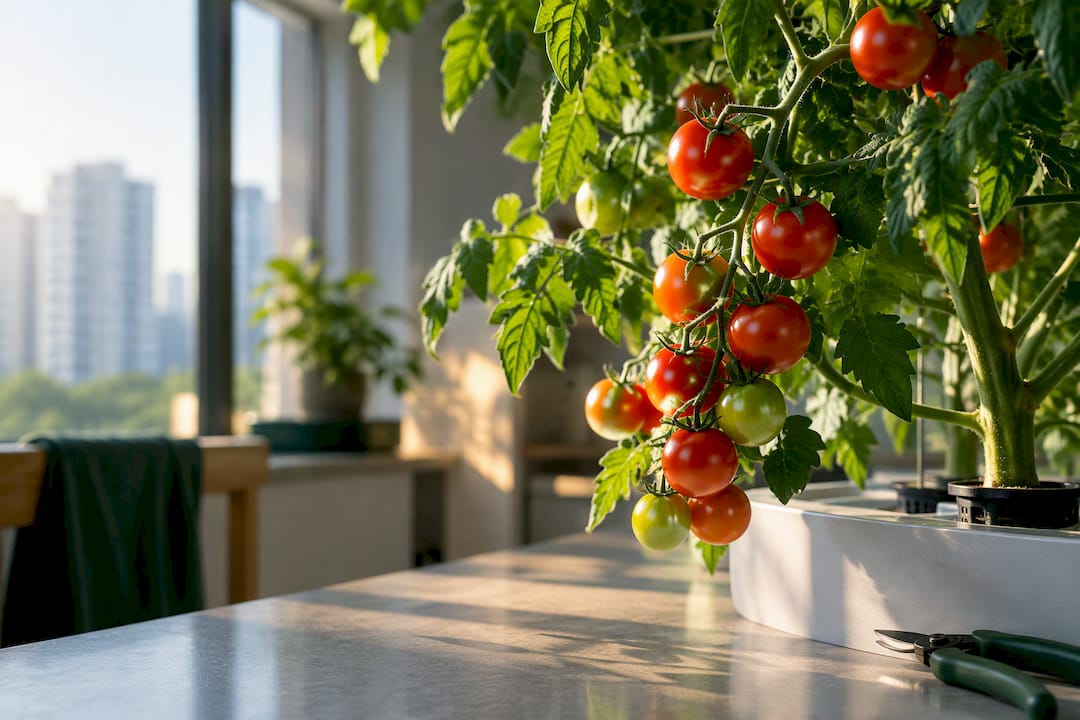
Yes, you can grow fruiting tomatoes hydroponically indoors. The fastest reliable home route is a compact deep water culture (DWC) or small recirculating drip or NFT setup paired with full-spectrum LED lighting, active temperature control, and a stage-appropriate nutrient plan. Three things decide whether you get flowers or just foliage: enough light, a stable microclimate, and nutrient monitoring that goes beyond a single EC reading.
TL;DR:
- Hydroponic tomato growth is most reliable with a compact deep water culture system, full-spectrum LED lighting, and careful nutrient management beyond simple EC monitoring.
- A single bucket DWC system is easiest for small spaces, while recirculating drip setups suit vertical or multi-plant arrangements but require more maintenance.
- Maintaining temperatures of 18°C to 27°C, managing humidity and vapor pressure deficit, and ensuring good airflow are crucial for successful flowering and fruiting indoors.
- Full reservoir changes are more effective than top-offs, and visual plant cues like leaf yellowing often signal deficiencies before EC readings do.
- Successful indoor hydroponic tomato cultivation typically takes six to eight weeks from transplant to flowering, emphasizing stable environmental conditions and pathogen prevention.
For most home growers, DWC is the easiest entry point. A single bucket with an air stone, air pump, and net pot holds the roots suspended in an oxygenated nutrient solution, and tomatoes tolerate the swings in water level between top-ups better than more delicate crops. There is little plumbing to maintain and only one pump to fail.
Recirculating drip systems and small NFT or pipe setups make more sense when you are growing several plants vertically or along a narrow balcony rail, since a single reservoir can feed a row of containers through a manifold. They need a bit more attention: emitters can clog, and the circulation pump needs periodic cleaning.
If you are working with a countertop or a grow box in a closet, DWC keeps setup simple. A balcony table with several plants favors a small drip line. Readers building on a budget can find detailed instructions in a passive hydroponic system setup guide that avoids pumps altogether.
Starting from seed gives you more cultivar choice and lets you time germination to your light and space, but it adds three to four weeks before transplant. Buying a young transplant skips that wait and is often the better choice for a first attempt.
Pro Tip: Label your reservoir with the date of your last full nutrient change so you never lose track of when a complete flush is due.
The first eight to twelve weeks are about establishing roots and vegetative growth before the plant shifts its energy toward flowering, so resist the urge to push nutrient strength too early.
Tomatoes are heavy feeders of light. A full-spectrum LED delivering strong output positioned close enough to maintain even coverage across the canopy, with a photoperiod of 14 to 16 hours during vegetative growth and slightly less once fruiting begins, supports steady flowering.
Growers in consistently warm, humid climates will find more detail on managing this balance in a guide to hydroponics in tropical conditions.
Rootzone pH between 5.5 and 6.5 keeps nutrients available to tomato roots across all growth stages, and a staged nutrient program (lighter for seedlings, stronger through vegetative growth, adjusted again at flowering) tends to track plant demand more closely than a single fixed strength, per an Ohio State extension fact sheet. Closed indoor tomato hydroponic systems often manage EC in a moderate range during early growth, rising through later stages as demand increases.
A single EC reading can hide a real problem. Research tracking ion-level uptake in a closed indoor hydroponic tomato system found that phosphate, iron, manganese, copper, and zinc can drop sharply, in some cases to nearly undetectable levels, even while overall EC stays within target range, because major ions like potassium, calcium, and nitrate dominate the EC signal and mask micronutrient depletion happening underneath it.

That means a grower relying only on an EC pen can watch a plant develop deficiency symptoms, yellowing between leaf veins or stunted new growth, without any warning from the meter. Periodic full nutrient changes rather than only topping up water are the simplest home defense, since topping up alone concentrates whatever remains while doing nothing to replace what has been consumed. When mixing concentrated nutrient salts, add them to water separately and in the order the manufacturer specifies, since combining certain calcium and phosphate or sulfate sources directly can cause precipitation that locks nutrients out of solution. If you notice consistent problems despite correct EC and pH, a lab water analysis is worth the cost before assuming the nutrient formula itself is at fault.
Interestingly, one controlled hydroponic trial found that a constant nutrient concentration held from transplant through the end of the season produced larger average fruit than a growth-stage-based feeding schedule in the tested conditions, suggesting home growers without the equipment to fine-tune multiple feeding stages are not necessarily at a disadvantage.
Indeterminate tomato varieties keep growing and flowering indefinitely, so pruning is how you keep an indoor plant manageable. Removing suckers weekly and training the main stem up a stake or string keeps growth vertical rather than bushy, which matters when floor space is tight.
For tropical or consistently warm and humid conditions, heat- and rain-tolerant cherry varieties are the cultivars most often recommended for home growers, according to Singapore’s National Parks Board gardening resource, and they also tend to suit compact indoor setups better than large beefsteak types.
Pro Tip: Prune lower leaves that touch or approach the nutrient reservoir surface, since damp foliage near standing water invites fungal problems.

Most indoor hydroponic tomato failures trace back to one of four causes, and checking them in order saves time.
Sprout Lab’s modular hydroponic system is built around the same principles covered here: maximizing plant count in a small footprint while keeping root zones oxygenated and monitored, supporting cultivation of up to 56 plants in a compact area. Compared to soil-based growing indoors, the modular design promotes faster germination and healthier root development in the confined conditions many indoor growers face. Customer feedback can help indicate satisfaction and consistent results across a wide range of home setups.
Most advice online treats EC as the whole story: hit the right number and the plant is fed. The ion-level research on closed systems tells a different story, since micronutrients can quietly disappear while the EC meter shows everything is fine. That gap is where home growers lose fruit set without understanding why.
The conventional wisdom also overstates how precisely you need to stage your nutrient strength. Evidence from controlled trials suggests a well-chosen constant concentration can match or even beat a growth-stage program on fruit size, which is good news for anyone without the patience to reformulate their reservoir every few weeks.
If you take one thing from this guide, prioritize full reservoir changes over top-ups and watch your plant’s leaves as closely as any meter. The visual signs of nutrient stress usually show up before a home EC pen catches the problem, and by the time yellowing appears, a full flush and remix is almost always the fastest fix.
— Irwin Lee
Setting up an indoor tomato system from individual parts means sourcing pumps, reservoirs, lighting, and nutrients separately and hoping they work together. Sprout Lab’s modular hydroponic system pairs with full-spectrum LED lighting and a tomato-suited nutrient line so the whole setup arrives ready to configure rather than assembled from a parts list.
Most growers have their station running within a day of unboxing, with first flowers typically following within six to eight weeks. Setup guidance and customer support are available throughout, so questions about your first reservoir change do not go unanswered. Browse the full range at Sprout Lab to build your starter kit.
For further reading on microclimate control, nutrient formulation, and ion-level uptake dynamics, see the tomato microclimate review and closed-system nutrient uptake study cited above. Contact your local extension office for region-specific water analysis and cultivar advice.
Yes, tomatoes can be grown and fruited indoors hydroponically using a system like DWC or small recirculating drip, combined with full-spectrum LED lighting and hand pollination. Success depends on managing light, temperature, and nutrient monitoring together rather than any single factor.
Many cherry tomato varieties begin flowering roughly six to eight weeks after transplant into a hydroponic system, with first ripe fruit following four to six weeks after that. Exact timing varies by cultivar, light intensity, and how consistently temperature and nutrients are managed.
Deep-rooted crops like large root vegetables, sprawling vine crops that need extensive soil anchorage, and certain tall grain crops are generally considered poor fits for home hydroponic systems because of their root structure or space demands. Compact, fruiting plants like cherry tomatoes, leafy greens, and herbs tend to perform far better in home setups.
Yes, tomatoes can be grown indoors in soil or hydroponically as long as they receive adequate light, typically from a full-spectrum LED, and stable temperatures in the range that supports flowering and fruit set. Indoor growers should choose compact or cherry varieties, since large indeterminate beefsteak types need more space and support than most indoor setups allow.