Free shipping for order over $50

Free shipping for order over $50
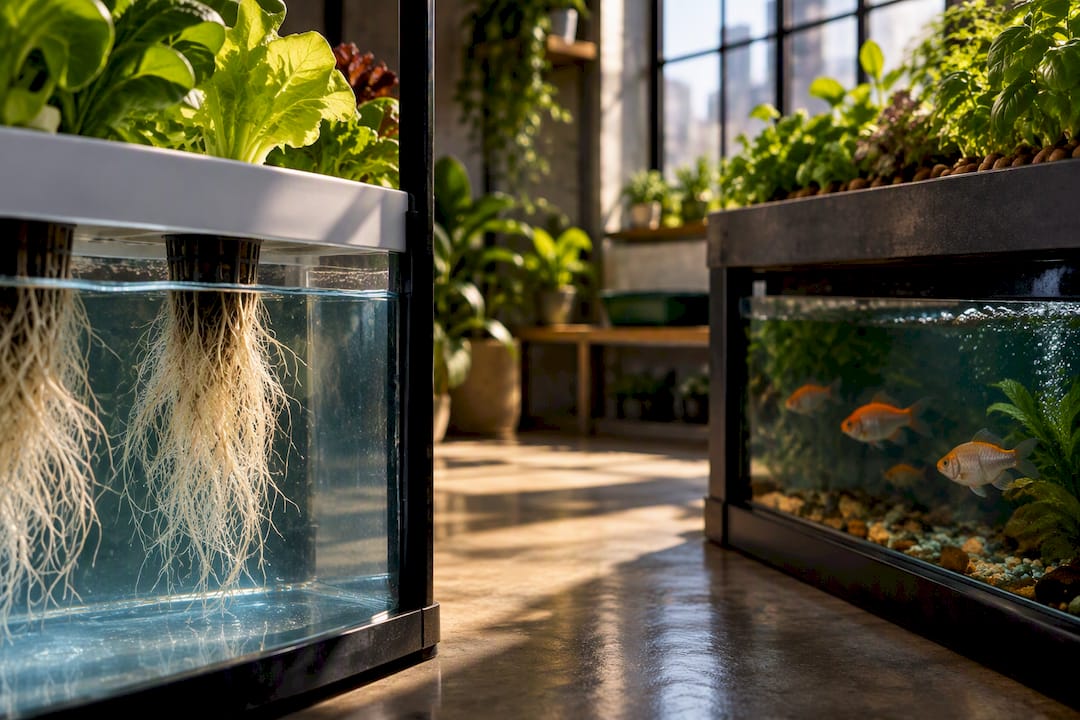
For most home growers who want fast, controllable plant production, hydroponics is the simpler choice. Aquaponics suits growers who want vegetables plus fish and can handle more complexity and cost. Extension research from SARE and a 2026 Nature life-cycle study back up that split: hydroponics wins on speed and control, aquaponics wins on circularity and dual output. Sprout Lab builds for the first group.
TL;DR:
- Hydroponics offers faster setup, lower initial costs, and simpler maintenance, making it ideal for beginners focused on quick, controlled plant production.
- Aquaponics involves higher startup costs and longer cycling times but provides water conservation benefits and edible fish, suited for those interested in a self-sustaining ecosystem.
- The main risk in aquaponics includes sudden fish loss from pump failures, while hydroponics mainly risks root damage from neglecting nutrient and pH monitoring.
- Energy consumption often outweighs water savings in both systems, as continuous aeration and filtration rely on grid power, impacting overall sustainability.
- Beginners should start with small hydroponic setups to learn system management before investing in more complex aquaponic systems involving fish husbandry.
The two systems solve the same problem, feeding plants without soil, in very different ways. Hydroponics dissolves mineral nutrients directly into water. Aquaponics lets fish waste and bacteria generate that nutrition instead. That single distinction drives almost every difference in cost, labor, and risk.
Hydroponics pros:
Aquaponics pros:
Startup costs for a basic hydroponic kit generally run from $100 to $500, while a functional backyard aquaponics setup with tanks, biofilters, and pumps often starts around $500 and climbs quickly with fish stock and filtration needs. Hydroponics best fits anyone who wants quick, clean plant production with minimal daily fuss. Aquaponics best fits anyone who wants a self-sustaining loop and doesn’t mind caring for live animals every day.
Hydroponics grows plants in a nutrient solution instead of soil. A reservoir holds water mixed with a dissolved fertilizer blend, and a pump or wick delivers that solution to plant roots on a schedule. Growers track two numbers constantly: electrical conductivity (EC), which measures nutrient strength, and pH, which determines how well roots absorb what’s in the water. Most home systems run pH between 5.5 and 6.5, adjusted with small doses of pH up or down solution.
A handful of system types cover almost every home use case. Nutrient film technique (NFT) runs a thin stream of solution across roots in a sloped channel, ideal for lettuce and herbs in tight spaces. Deep water culture (DWC) suspends roots directly in an oxygenated reservoir, a favorite for leafy greens because it’s forgiving and cheap to build. Ebb-and-flow systems flood a grow tray on a timer, then drain it back to the reservoir, which works well for larger plants like tomatoes and peppers. Modular systems, including the kind Sprout Lab builds, combine several of these mechanics into stackable units that fit apartments and balconies without demanding a dedicated room.
Hydroponics tends to get growers to harvest faster than soil or aquaponics because nutrient delivery is exact and immediate. There’s no waiting for microbes to break anything down. The tradeoff is that beginners inherit a monitoring job: checking EC and pH a few times a week, topping off the reservoir, and watching for algae or root rot in stagnant water. None of that requires special training. It just requires consistency, and if you’re wondering whether hydroponics gardening tips exist for reducing that workload, automated dosing pumps and timers handle most of it once dialed in.
Aquaponics links a fish tank to a grow bed through a closed water loop, and the biology in between is the whole system. Water flows from the fish tank through mechanical filtration, which strips out solid waste, then into a biofilter where colonies of nitrifying bacteria convert toxic ammonia from fish waste into nitrite, then into nitrate. That nitrate is what plants actually absorb as fertilizer. Clean water cycles back to the fish tank, and the loop repeats continuously.

That bacterial colony doesn’t exist on day one. New systems need a cycling period, commonly 4 to 6 weeks, to build enough nitrifying bacteria to handle a full fish load safely. Add fish too early and ammonia spikes before bacteria can process it, which can kill the entire tank overnight. Some commercial operators shorten that window using nitrifier-enriched starter cultures, an advanced tactic covered in research on microbial inocula in aquaponics, but most home builders just wait out the cycle.
Plant nutrition in aquaponics is a byproduct, not a formula. Growers can’t dial in exact nitrogen, phosphorus, and potassium ratios the way they can with hydroponic fertilizer salts, because the nutrient profile depends entirely on what the fish eat and how much waste they produce. That makes aquaponics better suited to leafy greens and herbs that tolerate variable nutrient levels, and tougher for heavy feeders like fruiting tomatoes, which often need supplemental iron or potassium even in a well-running system. It’s also why extension guidance frequently pitches hydroponics as the more beginner-friendly path when the goal is precise crop nutrition rather than an integrated ecosystem.
The honest answer to which is better, aquaponics or hydroponics, depends on which resource you’re trying to conserve: money and time, or water and waste. Here’s where the two systems actually diverge.
Startup costs. Hydroponic reservoirs, pumps, and grow trays run cheap because there’s no livestock or biofiltration to build around. Aquaponics needs fish tanks, mechanical filters, biofilters, aeration, and a backup power plan, so a functional small setup usually costs several times more than an equivalent hydroponic unit before a single seed goes in.
Operating costs. Hydroponics burns through synthetic nutrient concentrate, which is a predictable, budgetable expense. Aquaponics swaps that for fish feed, which is often cheaper per month, but you’re now also paying for fish replacement, water testing supplies, and the electricity to run aeration around the clock.
Labor. Hydroponics asks for EC and pH checks a few times a week and reservoir top-offs. Aquaponics asks for daily fish feeding, water-quality checks (ammonia, nitrite, nitrate, dissolved oxygen), and vigilance for sick or dead fish, which is a meaningfully bigger time commitment.

Yield and economics. Comparative trials show hydroponic lettuce yields running slightly ahead of aquaponic lettuce grown side by side, but aquaponics frequently posts the higher combined revenue once fish sales are factored in, despite carrying higher operating costs.
Failure risk. This is the sharpest divide. A pump failure in hydroponics dries out roots, and most plants recover if you catch it within a day. A pump or biofilter failure in aquaponics can wipe out an entire fish population in hours, since fish suffocate fast once dissolved oxygen or ammonia levels move outside a safe range.
Pro Tip: If you’re torn between the two, run a small hydroponic tote for one growing cycle before committing to fish. It’s the cheapest way to learn EC, pH, and root health without betting live animals on your learning curve.
Both systems beat soil on water efficiency, but the sustainability picture gets more complicated once you factor in energy. Aquaponics can recycle up to 90% of the water a comparable in-ground garden would use. Hydroponics typically uses around 10% of the water traditional in-ground gardening requires, according to SARE.
The energy trade-off nobody markets: A 2026 life-cycle assessment published in Scientific Reports found that electricity consumption from pumps, filtration, and aeration often dominates the total environmental footprint of intensive aquaponic and hydroponic systems. Water savings mean little if the system runs on a grid powered by fossil fuels around the clock.
That finding matters most for aquaponics, which needs continuous aeration to keep fish alive, running the electric bill higher than a comparable hydroponic setup that can cycle pumps on a timer.
Food safety is the other misconception worth correcting: neither system is automatically cleaner than soil. Researchers at Purdue detected Shiga toxin-producing E. coli in water, fish feces, and roots in both hydroponic and aquaponic systems at harvest. The edible portions of the plants weren’t internalized with bacteria in that study, but the presence of pathogens in the growing water makes handling and sanitation genuinely important, not optional. Practical mitigation is straightforward: use potable, dechlorinated water, sanitize tools and containers between grow cycles, avoid handling roots roughly, and wash produce before eating it regardless of which system grew it.
Matching the system to your actual constraints, not your enthusiasm, prevents most early failures. Answer these before you build anything:
Apartment growers chasing quick, reliable harvests in tight square footage almost always land on hydroponics. Backyard hobbyists with space, patience, and interest in fish husbandry often prefer aquaponics. Small commercial or educational projects sometimes choose aquaponics specifically to teach the nitrogen cycle, accepting the added complexity as part of the value. If you’re unsure, pilot a small hydroponic system first. It’s the lowest-risk way to learn the fundamentals before deciding whether fish are worth the added workload.
A few pieces of equipment prevent most early disasters in either system: a backup air pump or battery backup, a water test kit (EC/pH for hydroponics, ammonia/nitrite/nitrate for aquaponics), and for aquaponics specifically, a quarantine tank for new fish before they join the main system.
The single most common mistake in aquaponics is rushing the cycling period out of impatience. The most common hydroponic mistake is letting EC drift too high, which burns roots and stunts growth.
Pro Tip: Keep a cheap notebook or phone note logging every water test. Patterns in rising ammonia or drifting pH show up days before symptoms do, and that lead time is what saves a harvest.
Modular hydroponic systems designed for compact urban spaces support up to 56 plants in a footprint that fits an apartment balcony or a small room. This piece was written by Irwin Lee, who covers home hydroponic growing methods and system comparisons for readers weighing their first setup. For crop-specific guidance once you’ve picked a direction, Sprout Lab’s plant guides cover which vegetables perform best in small hydroponic systems.
Most people who fail at aquaponics didn’t fail because the biology is hard. They failed because they skipped the cycling period, added fish too soon, or underestimated the daily labor before ever tasting a tomato. Hydroponics forgives impatience far better; a skipped nutrient check costs you a slightly slower week, not a tank of dead fish.
Start small, hydroponic small, if you’ve never grown anything without soil before. Scale into a fish system later, once you’ve proven to yourself you’ll actually show up every day. That’s not caution for its own sake. It’s just where the risk profile changes.
— Irwin Lee
If the comparison above has you leaning toward hydroponics, and for most first-time growers it usually does, the practical path forward doesn’t require fish tanks, biofilters, or a six-week waiting period. Modular hydroponic systems are available designed for the lower-complexity route: compact units that support up to 56 plants, paired with grow lights and curated soil mixes for growers who want to combine methods.
If you already know which crops you want to grow, the hydroponics product line breaks down system options by size and setup complexity. Still deciding what to plant first? The best plants for your hydroponic system guide lists what performs well for beginners. And if fish and full nutrient cycling genuinely appeal to you after reading this, that’s a legitimate path too. It’s just a bigger one, and it’s not what Sprout Lab builds for. For everyone else ready to grow food without the extra biology, start on the Sprout Lab homepage and pick a system sized to your space.
Aquaponics carries higher startup costs, a multi-week cycling period before fish can be added safely, and daily labor for fish care and water testing. Pump or biofilter failures can kill an entire fish population within hours, a risk hydroponics doesn’t share since plants tolerate short outages much better than fish do.
Standard hydroponic systems aren’t designed for fish because they lack biofiltration to convert ammonia into safe nitrate. Adding fish to a hydroponic setup without that biological infrastructure essentially turns it into a basic aquaponic system, which needs the cycling and monitoring aquaponics requires.
Tap water works in most hydroponic and aquaponic systems, but chlorine or chloramines need to be neutralized first since both can harm plant roots and kill beneficial bacteria. Letting water sit uncovered for a day removes chlorine, though chloramines need a dechlorinating treatment or an activated carbon filter.
Hydroponics requires consistent EC and pH monitoring, dependence on purchased nutrient concentrate, and vulnerability to pump failure within a day or two without backup power. It also carries food-safety considerations similar to aquaponics, since Purdue researchers detected E. coli in hydroponic growing water as well, making sanitation and careful handling necessary regardless of system.
For most beginners, yes. Hydroponic systems like Sprout Lab’s modular units cost less to start, skip the biological cycling period aquaponics requires, and let you tailor nutrients precisely to whatever you’re growing. Current pricing and system options are available directly on the Sprout Lab site.