Free shipping for order over $50

Free shipping for order over $50
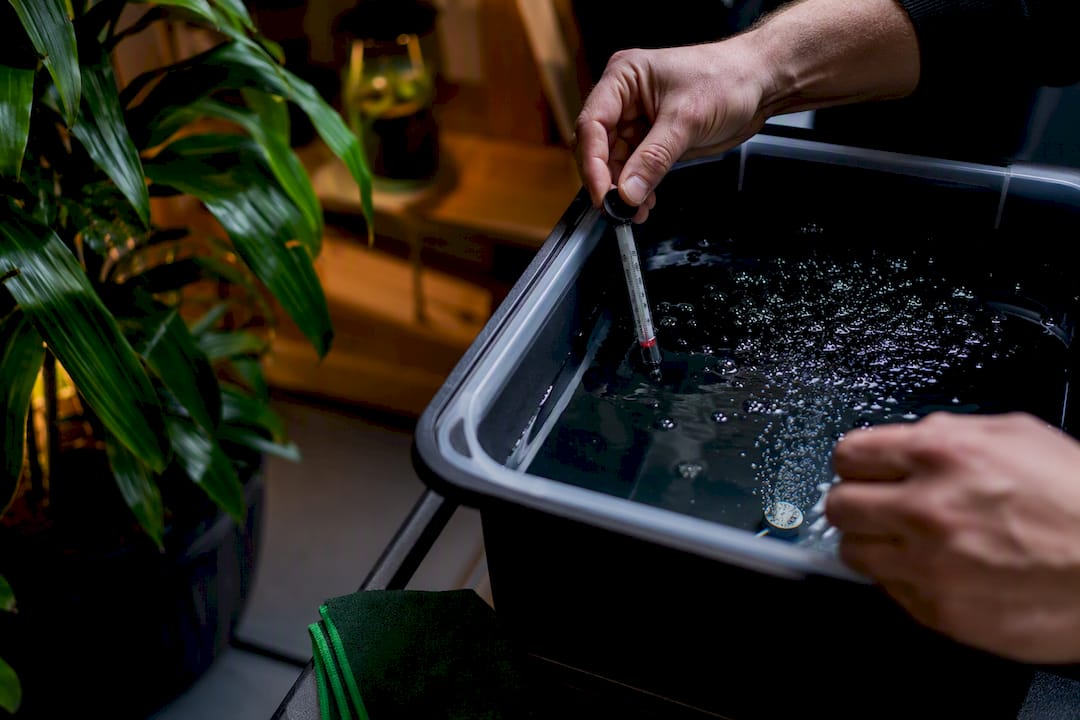
Root rot in hydroponics, usually caused by the water mold Pythium, is preventable, and early infections are often recoverable. If you catch it early, act now: isolate the affected unit, cool the reservoir, boost aeration, prune the rotten roots, and run a targeted flush. Long term, prevention beats treatment every time, and it comes down to keeping the reservoir cool, well oxygenated, dark, and clean.
TL;DR:
- Maintaining reservoir temperature between 18 and 22°C (64 to 72°F) and oxygen levels above 6 mg/L dramatically reduces Pythium proliferation and root rot risk.
- Early root rot signs include roots turning brown, slimy, and easily shedding tissue, with wilting and slow water uptake indicating progressing infection.
- Immediate actions should involve isolating infected plants, pruning affected roots, refilling with fresh solution, lowering water temperature, and increasing aeration.
- Using hydrogen peroxide flushes is a critical emergency treatment for active infections, with careful dosing to avoid damaging healthy roots.
- Prevention relies on consistent sanitation, lightproof reservoirs, proper aeration, and temperature control, making routine monitoring essential for avoiding outbreaks.
Pythium isn’t a fungus in the strict sense. It’s an oomycete, a water mold that behaves like algae’s opportunistic cousin, drifting through nutrient solution looking for stressed root tissue to colonize. It doesn’t need much of an invitation. Warm water, stagnant oxygen, and a film of organic debris on your reservoir walls create ideal conditions for root rot pathogens.
Three conditions drive almost every outbreak:
Pro Tip: Buy an inexpensive aquarium thermometer before you buy anything else. Guessing your reservoir temperature by feel is how most root rot outbreaks get a head start.
The numbers matter more than intuition here. Extension guidance from Colorado State’s PlantTalk program recommends keeping reservoir temperature between 18 and 22°C (64 to 72°F) and targeting dissolved oxygen above roughly 6 to 9 mg/L depending on the crop for suppression. Once you cross into warm, low oxygen territory, Pythium doesn’t creep. It sprints. Under those stress conditions, research on hydroponic root rot shows it can destroy a large portion of a plant’s functional root mass in just 48 to 72 hours. Keeping the reservoir water temperature inside that range is the single highest leverage thing you can do for root health.
By the time you smell rot, you’re already behind. The odor, a sulfurous or swampy stink, is a late signal, and healthy roots that have already started sliming over might not smell like anything yet. Growers who catch outbreaks early are looking, not sniffing.
Here’s what to check, in order:
One detail worth remembering: slowed drawdown and a slight sliminess on the roots typically show up seven to ten days before you’d notice a smell or obvious browning. That gap is your window.
Treatment depends entirely on how far the infection has gone, and the single biggest mistake growers make is trying to nurse a plant along for another week before acting. Speed matters more than perfection here.
Step one: contain it. If you’re running a multi-bucket DWC setup or a shared NFT channel, isolate the infected plant immediately. Move it to its own container if you can. Shared reservoirs and connected channels let Pythium spores travel to healthy roots in hours, not days, so containment is not optional once you’ve confirmed an infection.
Step two: mild to moderate cases. For plants where less than half the root mass looks affected, prune away every brown or slimy root segment with clean scissors, dumping the trimmings, not the reservoir. Dump the entire reservoir and refill with fresh nutrient solution. Drop the temperature immediately, either by relocating the reservoir out of direct heat or adding ice packs in a sealed bag. Crank aeration to maximum. These four moves, done together and done fast, save more plants than any single fix on its own.
Step three: the emergency chemical option. For active, spreading infections, a controlled hydrogen peroxide flush is the standard emergency protocol. One documented DWC emergency approach involves draining the infected reservoir, pruning damaged roots, then running a diluted peroxide oxidation cycle for 48 to 72 hours before refilling with clean solution. Peroxide is nonselective, meaning it kills beneficial microbes right alongside Pythium, so dosing and timing matter: too weak and it does nothing, too strong or too frequent and it damages the roots you’re trying to save.
Step four: reintroduce beneficials, later. Once the peroxide cycle finishes and you’ve refilled with fresh solution, that’s the moment to inoculate with a Bacillus or Trichoderma-based product to rebuild a protective microbial layer on the roots. Never mix peroxide and beneficial bacteria in the same cycle. The peroxide will kill the bacteria you just added, wasting the product and the effort.
Every grower who’s dealt with a bad outbreak says the same thing afterward: prevention took less effort than the recovery did. The routine below covers the four levers that matter most.
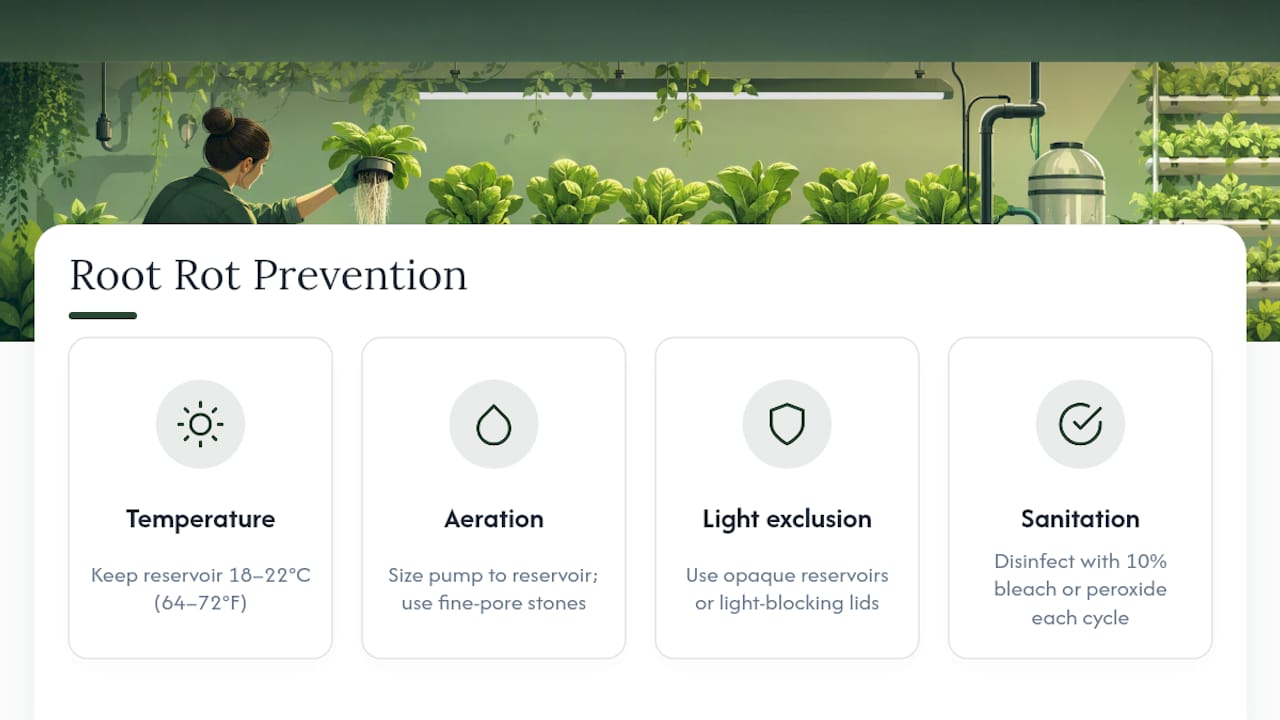
Temperature control. Keep your reservoir between 18 and 22°C (64 to 72°F). In warmer climates or during summer heat waves, insulate the reservoir with foam board, paint opaque containers a light color to reflect heat, or add a small aquarium chiller if you’re running a larger system. Even something as simple as relocating the reservoir away from a sunny window or a hot grow light ballast can shave several degrees off water temperature.
Aeration. Undersized air pumps are one of the most common, and most fixable, causes of chronic low DO. Size your pump to your reservoir volume, not the other way around, and use multiple fine-pore air stones rather than one large coarse stone. Fine pores create smaller bubbles, and smaller bubbles mean more surface area for oxygen to actually dissolve into the water. Run a backup pump on larger setups. If your primary pump fails overnight, that’s exactly the low-oxygen window Pythium needs.
Light exclusion. Light hitting your nutrient solution feeds algae, and algae blooms create exactly the organic load and oxygen swings that invite root rot. Use opaque reservoirs, light-blocking lids, or simple foil wraps around clear containers. This single fix also reduces the workload of your filtration, since algae growth in hydroponics is one of the biggest hidden drivers of reservoir organic buildup, and keeping DO above 6 ppm alongside a weekly light peroxide dose is one of the more effective combination habits home growers use.
Sanitation schedule. Disinfect reservoirs, net pots, and tubing with a 10% bleach solution or a peroxide-based cleaner between every grow cycle, never just when something looks wrong. Reusable media needs the same treatment, not a quick rinse. Extension research on hydroponic root disease management treats sanitation and environmental control as the two pillars of long-term prevention, ranking above any chemical or biological rescue treatment.
For anyone setting up a new system, checking your reservoir design and maintenance routine before your first grow cycle is far easier than retrofitting sanitation habits onto a system already carrying six months of biofilm.
Not every hydroponic setup carries the same exposure, and knowing your system’s weak point changes how you prioritize prevention.
Under warm, low-oxygen conditions, Pythium moves fast enough to catch experienced growers off guard, destroying up to 80% of functional root mass within 48 to 72 hours once conditions favor it. That timeline is why “wait and see” is the wrong instinct.
A simple decision rule helps cut through the panic:
Modular hydroponic systems can be designed to help home growers maintain temperature and oxygen levels within optimal ranges without constant babysitting. A workable daily and weekly routine looks like this: check reservoir temperature and top-off level daily, inspect roots and airstones weekly, and do a full reservoir clean and refill every two to three weeks depending on crop and system size.
Different product categories solve different pieces of this puzzle. A well-insulated reservoir and properly sized aeration accessories address temperature and dissolved oxygen directly. The right grow light placement reduces ambient heat reaching the reservoir, and a quality growing mix reduces the organic debris that feeds outbreaks in media-based setups. None of this replaces basic vigilance, but the right equipment makes vigilance a lot less demanding.
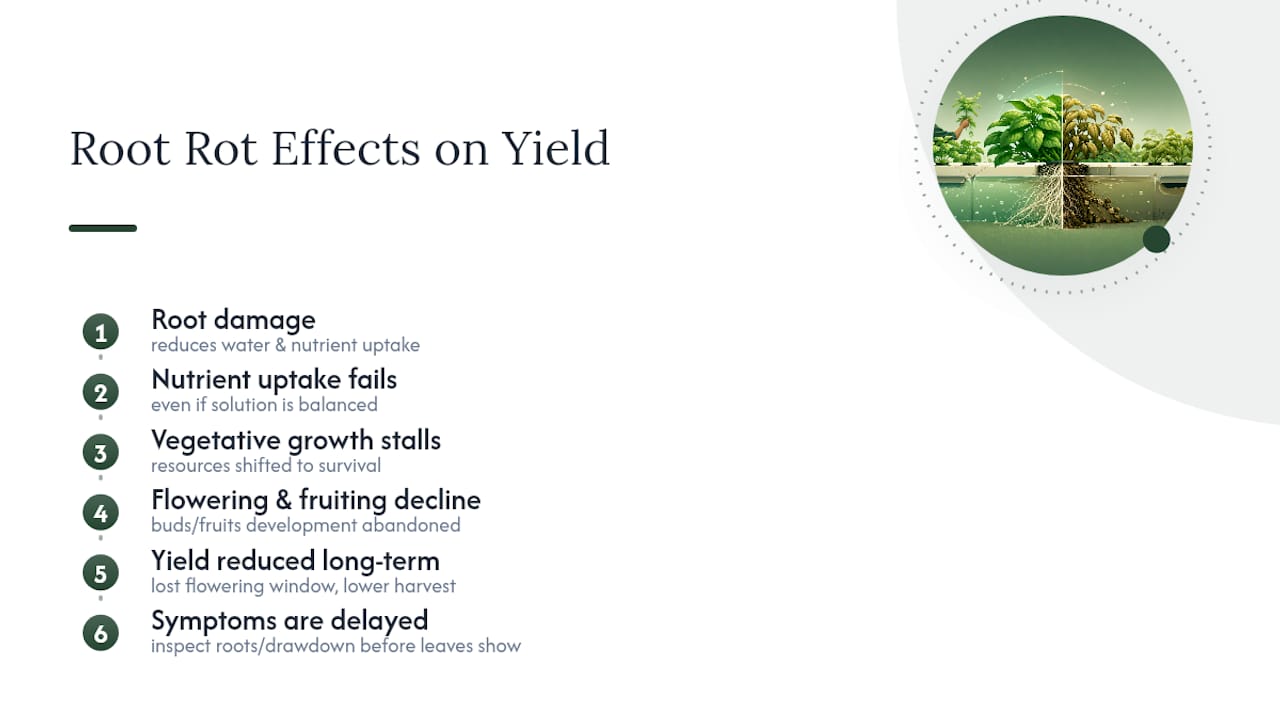
Roots are the only way a plant absorbs water and nutrients, so root damage shows up everywhere else, often before you’d expect it to. A plant losing root mass to Pythium can’t take up nitrogen, potassium, or calcium efficiently even when your nutrient solution is perfectly balanced, which is why root rot so often gets mistaken for a nutrient deficiency by growers checking the wrong end of the plant first.
Yield impact tends to follow a predictable pattern. Vegetative growth stalls first, since the plant redirects whatever resources it has left toward survival rather than new leaf production. Flowering and fruiting crops suffer the worst losses, because bud or fruit development is usually the first thing a stressed plant abandons. A tomato or pepper plant that survives a moderate root rot episode often produces a fraction of its expected harvest, even after the roots recover, simply because the growth window it needed for flowering already passed.
The damage isn’t always visible right away. A plant can look outwardly fine for several days while root function quietly deteriorates underneath, which is exactly why reservoir drawdown and root inspections matter more than watching leaves for stress signals. By the time leaves droop or yellow, the plant has usually already lost a meaningful percentage of its root system, and whatever yield reduction is coming has already been set in motion.
Damaged roots can’t absorb nutrients at the same rate healthy roots can, so running your normal feeding schedule during an active infection often does more harm than good. A common mistake is bumping up nutrient concentration when a plant looks stressed, assuming it needs more food, when the real problem is that it can’t process what’s already there.
During active treatment, dilute your nutrient solution to roughly half strength. Weakened roots handle a lighter feed better, and a lower EC reduces osmotic stress on tissue that’s already compromised. Hold off on nutrient boosters, bloom stimulants, or anything marketed as a root growth accelerator until you’ve confirmed the infection is under control. Layering additional inputs onto stressed roots usually just adds more for the plant to struggle with.
After treatment, ramp feeding back up gradually over 7 to 10 days rather than jumping straight back to full strength. Watch leaf color and new root growth as your guide. Pale new growth or slow root regeneration means you’re pushing the recovery too fast. Keeping a stable, balanced nutrient solution during this window, rather than experimenting with concentration or additives, gives recovering roots the most predictable environment to rebuild in.
Temperature and dissolved oxygen get most of the attention, but humidity and pH shape root rot risk too, often in ways growers overlook.
High ambient humidity, especially above 70%, slows evaporation from exposed reservoir surfaces and grow media, keeping conditions damp and stagnant in ways that favor Pythium alongside other mold and mildew problems. Improving airflow around your grow area with a small fan does double duty: it helps regulate humidity and keeps the reservoir surface from turning into stagnant, warm air pocket.
pH swings matter for a less obvious reason. Nutrient solution pH drifting outside the 5.5 to 6.5 range that most hydroponic crops prefer stresses roots directly, and stressed roots are more susceptible to Pythium colonization even when temperature and oxygen are otherwise fine. A pH crash or spike essentially opens the door that a healthy, unstressed root system would normally keep shut. Checking pH alongside temperature during your daily reservoir check catches this risk factor before it compounds with anything else going wrong in the system.
You don’t need a lab setup to catch root rot early, but a few inexpensive tools shrink the detection window considerably. A basic aquarium thermometer, kept permanently in the reservoir rather than checked occasionally with a handheld probe, gives you a constant read on the single most important number in this entire process.
A simple dissolved oxygen meter, while not strictly necessary for casual growers, removes the guesswork around whether your aeration setup is actually keeping pace with your reservoir volume. Combined pH and EC pens, which most growers already own for nutrient management, double as early warning tools since pH drift often precedes visible root stress.
For growers running larger or multiple systems, some hobbyists have started experimenting with continuous monitoring sensors that log temperature and pH over time rather than requiring manual spot checks, flagging drift before it becomes a crisis rather than after. Even without automated sensors, a simple daily log of reservoir temperature, drawdown volume, and a quick visual root check through a clear net pot or access point catches the vast majority of outbreaks while they’re still in the recoverable stage.
The mistake I see most often isn’t ignorance. It’s hesitation. Growers notice something off, a slightly slower drawdown, a faint smell, and give it another day before acting, and that’s the day Pythium needed. Undersized air pumps and light leaks into reservoirs cause more outbreaks than bad nutrients ever do.
Build a two-minute daily reservoir check into your routine: temperature, water level, a quick look at the roots. That habit alone prevents more losses than any emergency treatment ever will.
— Irwin Lee
Modular hydroponic systems can be designed to maintain stable reservoir temperature, strong aeration, and lightproof housing to minimize algae and organic buildup, reducing troubleshooting time and increasing harvesting time.
If you’re setting up a new system or replacing one that’s had a rough season, the Sprout Lab hydroponics category covers the systems and accessories built to hold the temperature and oxygen ranges this guide walks through. Growers dealing with recurring algae or organic buildup in their reservoirs might also find the algae prevention guide useful alongside their equipment upgrade. For hands-on guidance on managing reservoir temperature and oxygen in smaller propagation setups, the clone care resource from Minnesota Cannabis College covers similar fundamentals worth reviewing. This practical, prevention-first approach is often reflected in high customer satisfaction ratings from many users. Browse the full Sprout Lab lineup to find the system and accessories that match your setup, or explore why hydroponics outperforms soil for indoor growing if you’re still deciding whether to make the switch.
The temperature, oxygen, and treatment numbers in this guide come from a small set of trusted references: Colorado State’s PlantTalk program for reservoir temperature and sanitation standards, e-GRO’s root disease management alert for dissolved oxygen targets and staged treatment steps, Atlas Scientific’s hydroponic root rot breakdown for infection speed data, and Current Culture’s DWC emergency protocol for the peroxide flush sequence. Each one is worth reading directly if you want the full technical detail behind these numbers.
Isolate the affected plant, prune away brown or slimy roots, do a full reservoir change, and either run a controlled hydrogen peroxide flush for active infections or reintroduce beneficial bacteria after a milder case. Lower the reservoir temperature and boost aeration at the same time, since treatment fails if the underlying warm, low-oxygen conditions aren’t fixed too.
Rarely, and it depends entirely on severity. Mild cases with under 50% root damage sometimes stabilize if temperature and oxygen conditions improve naturally, but moderate to severe infections need active intervention, since Pythium keeps spreading as long as warm, low-oxygen conditions persist.
Not directly. Root rot comes from the Pythium pathogen thriving in warm, oxygen-poor water, and overwatering in soil-grown plants creates those same low-oxygen conditions around the roots, which is why the two get confused. In hydroponics, the risk factor isn’t water volume, it’s water temperature and dissolved oxygen.
Yes, if you catch it early and act fast. Plants with less than half their root mass affected and green, turgid top growth generally respond well to pruning, a reservoir change, cooling, and aggressive aeration, while plants with majority root loss or crown infection usually need a full system restart instead.
Sprout Lab’s hydroponic systems and aeration accessories are built to hold the temperature and oxygen ranges this guide recommends. Current pricing and product details are available directly on the Sprout Lab site.