Free shipping for order over $50

Free shipping for order over $50
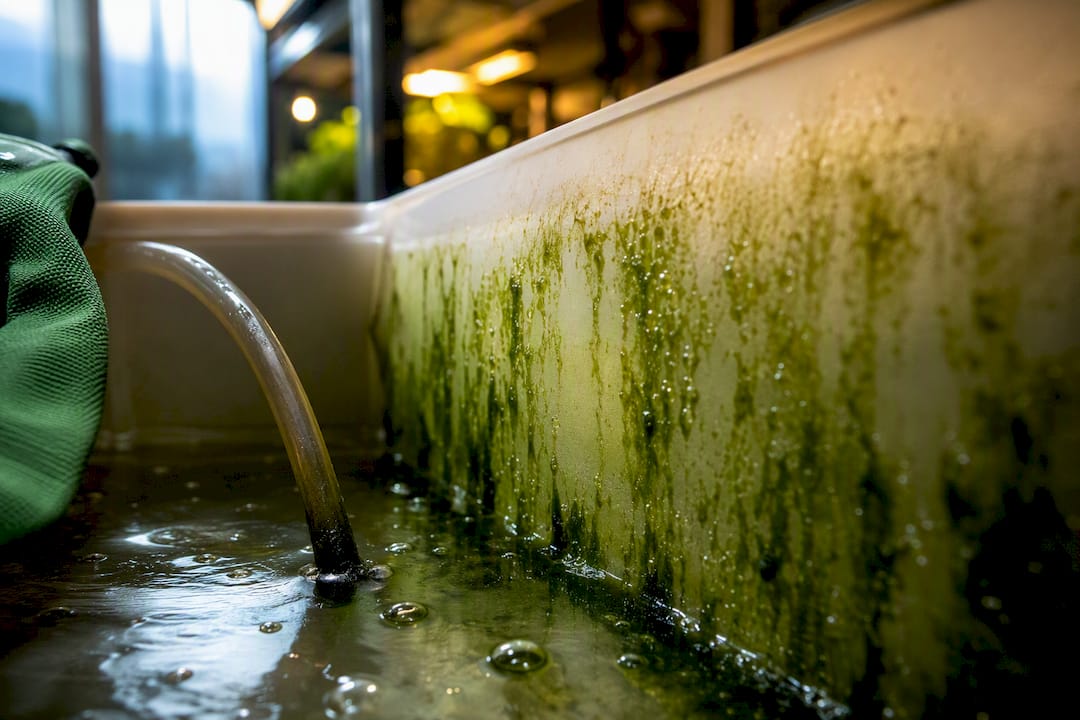
Drain the reservoir, scrub every surface, and sanitize before you refill. That single cleaning pass, paired with blocking light from every net-pot gap and tubing joint, prevents most algae comebacks. If a bloom is already established, a measured hydrogen peroxide treatment clears it without harming plants, but only at the right dose and frequency. Everything else is maintenance to keep it that way.
TL;DR:
- Blocking light at net-pot collars and sealing reservoir leaks are the most effective ways to prevent algae from establishing in hydroponic systems.
- Maintaining water temperature below 77°F and increasing oxygen levels help slow algae growth and protect plant roots from oxygen competition.
- If algae already takes over, a full drain, mechanical scrubbing, and careful chemical sanitization with dilute bleach or peroxide is necessary before refilling and replanting.
- Weekly small doses of hydrogen peroxide at controlled rates are more effective and safer than infrequent large doses for algae control.
- Automated systems with opaque reservoirs, sealed fittings, and integrated aeration significantly reduce recurring algae issues by eliminating key entry points.
Algae in hydroponics shows up in three main forms: a thin green slime on reservoir walls and tubing, thick floating mats in slow-moving water, and a green or brown tint in the nutrient solution itself. Deep water culture and ebb-and-flow systems tend to grow the worst mats because they hold standing water for days. NFT channels and Kratky jars get the slime version, usually right where light sneaks past a net-pot collar.
The conditions that grow your lettuce also grow algae. Both need light, water, and dissolved nutrients, and a nutrient-rich reservoir sitting under a grow light is close to ideal algae habitat. That overlap is why algae control in hydroponic systems is really about denying it one of those three inputs rather than fighting the organism directly.
Algae rarely kills a crop outright, but it does real damage indirectly:
None of that shows up overnight. It builds over a week or two of warm, sunlit reservoir water, which is exactly the window prevention is meant to close.
Blocking light matters more than any other single step. Extension research on algae management consistently ranks light exclusion and better aeration as the primary defense, ahead of chemical treatments. Growers who trace recurring blooms back to one spot almost always find it at the net-pot collar, where daylight leaks straight into the reservoir.
Pro Tip: Buy or 3D-print net-pot collars sized to fully seal the gap around your net pots. That one $10 fix has stopped more recurring algae problems for home growers than any bottle of treatment ever will.
If algae has already taken over, environmental tweaks alone won’t touch it. You need a full mechanical and chemical reset before you replant.
Before you start:
The cleaning sequence:
A reservoir hydroponic system built with cleaning access in mind makes this whole process faster, since you’re not fighting tight corners or sealed compartments to reach the mat buildup.
Hydrogen peroxide is the most tested rescue option for active blooms, but the dose window is narrow. A greenhouse experiment from ASHS compared 35 mL and 70 mL rates of a horticultural H2O2 product applied either weekly or biweekly.
The finding that matters most: weekly applications at appropriately controlled rates managed algae and improved growth in pepper and tomato, but higher biweekly doses caused some damage to crops. More frequent, lower-dose treatment beat less frequent, higher-dose treatment.
That’s the opposite of what most growers assume. The instinct is to hit a bad bloom hard and infrequently; the research says a small weekly dose is safer and more effective than a large occasional one.
Beyond hydrogen peroxide, a few other tools matter, each with tradeoffs:
Algae rarely returns without a measurable cause behind it. Checking a handful of numbers tells you which fix to make instead of guessing.
Persistent cloudiness that keeps coming back despite regular cleaning is usually a biofilm problem, not a fresh bloom, and it needs the full drain-scrub-sanitize sequence again rather than a quick fix.
Algae control works best as a habit, not a crisis response. This is the schedule that keeps most home systems clear without heavy intervention.
Growers running a balanced nutrient mix with stable EC tend to spend less time on this list overall, since nutrient swings that stress plants also create the murky, inconsistent water conditions where algae gets a foothold.
Most algae advice treats it like a chemistry problem. It’s mostly a design problem. Every recurring bloom I’ve looked into traces back to the same three culprits: a clear reservoir, a gap around a net pot, or warm stagnant water sitting under a grow light for too long. Fix the light and temperature, and the chemistry mostly takes care of itself.
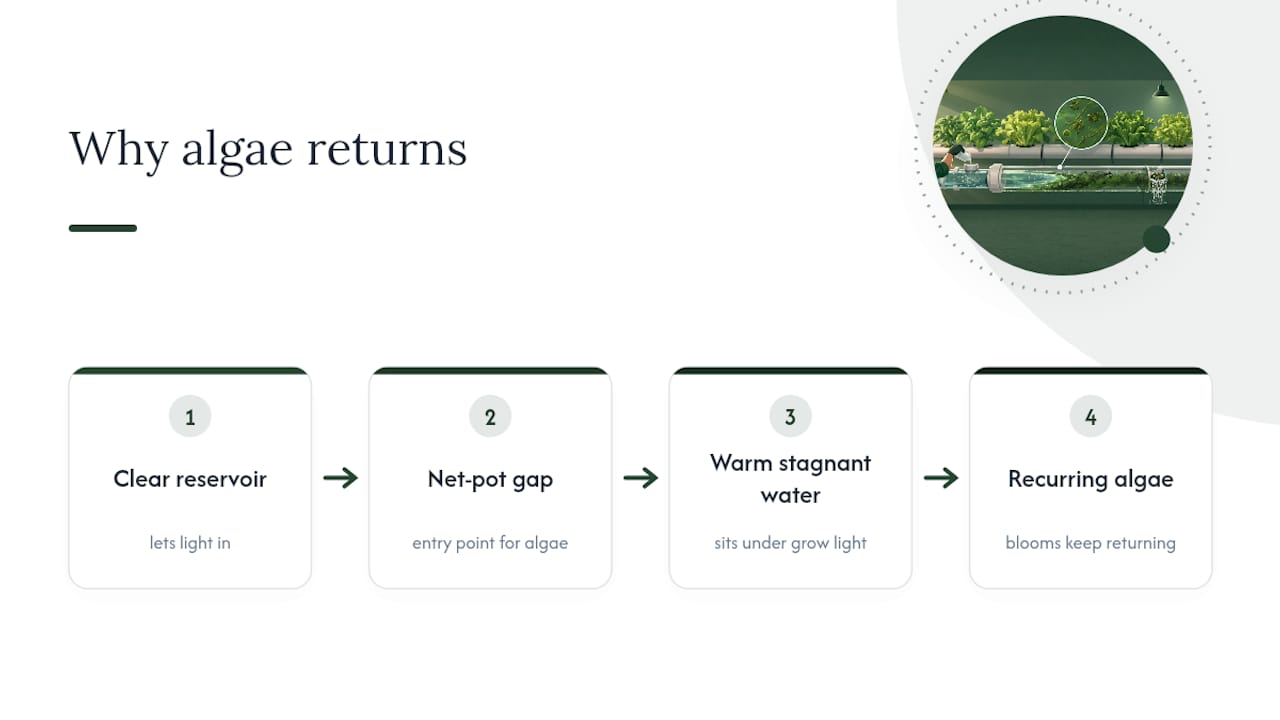
Certain hydroponic systems build around that principle rather than fighting it after the fact. Opaque reservoir housing, sealed collar fittings, and built-in aeration all exist specifically to close the gaps that let algae start in the first place, rather than relying on the grower to remember a treatment schedule.
If there’s one thing home growers underestimate, it’s how much automation and hands-on checking need to coexist. A sealed, aerated system removes the biggest failure points, but nobody should skip glancing at the water weekly. Set the system up right, then check it like you mean it.
— Luna
All the scrubbing, dosing, and light sealing above works, but it’s still work you have to remember to do. Sprout-lab builds that prevention into the hardware instead of leaving it to your memory. The automated hydroponic systems use opaque reservoir housing, sealed net-pot collars, and integrated aeration, closing off the exact entry points this article just walked through.
That means fewer light leaks to check for, more consistent dissolved oxygen without a separate air pump to manage, and a reservoir designed from the start to resist the warm, sunlit conditions algae needs. For growers juggling a full plant setup in a small apartment, that’s less time spent scrubbing tubing and more time actually harvesting. Browse the full system lineup to find the setup that fits your space, and see which configuration handles algae prevention for you before it ever becomes a Saturday cleaning project.
For dosing specifics and disinfection thresholds, the ASHS hydrogen peroxide experiment, Missouri Extension’s nutrient solution guidance, and Oklahoma State’s greenhouse algae fact sheet cover the technical details in full. Growers researching seed-stage hygiene practices may also find this cannabis seed collection guide useful for general sanitation habits.
Drain the reservoir, mechanically scrub every surface, sanitize with diluted bleach or hydrogen peroxide, then rinse thoroughly before refilling. Skipping the rinse step is the most common reason growers see plant damage right after a cleanup.
Not directly, but algae usually signals conditions that also stress plants: warm water, low dissolved oxygen, or light reaching the reservoir. It’s a symptom worth investigating rather than a water-quality verdict on its own.
Hydrogen peroxide applied weekly at measured, product-labeled rates controlled algae effectively in greenhouse testing without harming crops, while high biweekly doses caused leaf damage. Pond algicides and copper-based products are not safe substitutes for food crops.
Block any light reaching the reservoir with opaque tape or a wrap, keep the water reasonably cool, and wipe down the reservoir and lid gaps weekly before slime gets established. Small countertop units have less water volume, so a light bloom shows up faster and spreads faster too.
Algae rarely attacks plant tissue itself, but it competes for dissolved oxygen, clogs pumps and emitters, and creates biofilm that shelters root pathogens like Pythium. The damage is almost always indirect, through starved roots or clogged equipment rather than the algae itself.