Free shipping for order over $50

Free shipping for order over $50
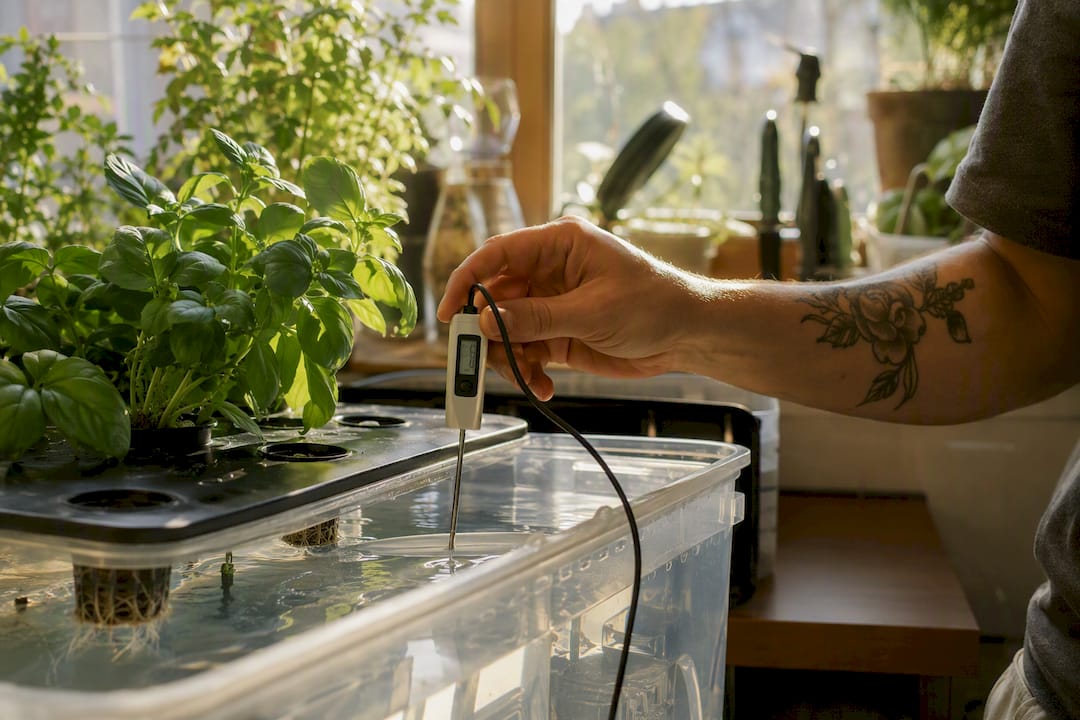
Aim for 65 to 72°F (18 to 22°C), with a tighter sweet spot of 68 to 72°F (20 to 22°C) for most crops in a reservoir or DWC system. Cooler water holds more dissolved oxygen, which roots need to breathe; warmer water speeds up plant metabolism but bleeds oxygen out of the solution and opens the door to root pathogens. If you take one key point from this article, it is to maintain your reservoir at a steady temperature conducive to root health and oxygen availability.
Stable water temperature in the 68 to 72°F (20 to 22°C) sweet spot protects dissolved oxygen, keeps nutrient uptake steady, and cuts root rot risk far more reliably than any single piece of equipment.
| Point | Details |
|---|---|
| Target the sweet spot | Hold reservoir water at 68 to 72°F (20 to 22°C) for most crops, ranging 65 to 72°F overall. |
| Insulate before you cool | Passive insulation and burying the reservoir can drop temperature by up to 10°F at no ongoing cost. |
| Watch the danger zone | Root rot risk climbs sharply once water passes 72 to 75°F and becomes severe above 82°F. |
| Place probes correctly | Position sensors away from heaters and air stones, opposite the heat source, for accurate averages. |
| Compensate pH and EC readings | Temperature drift skews pH and EC meters, so accurate dosing depends on stable water temperature first. |
Oxygen dissolves better in cold water than warm water, a basic chemistry fact known as Henry’s Law. In practice, that means your reservoir’s temperature is doing double duty: it sets how hard your roots have to work to breathe and how fast the plant burns through nutrients.
Water at 82°F (28°C) holds about 25% less dissolved oxygen than water at 64°F (18°C), according to Atlas Scientific. That gap is the difference between roots that stay white and firm and roots that start to brown at the tips.
Warmer water also revs up plant metabolism, a temperature sensitivity biologists call the Q10 effect, so a 10 degree rise in solution temperature can noticeably speed nutrient uptake and respiration. Faster metabolism sounds good until oxygen supply cannot keep pace.
Different crops tolerate different bands, and seedlings need special handling because their roots are underdeveloped and more vulnerable to both cold stress and oxygen starvation.
| Crop group | Recommended range |
|---|---|
| Leafy greens (lettuce, spinach) | 65 to 70°F (18 to 21°C) |
| Herbs (basil, mint, cilantro) | 68 to 72°F (20 to 22°C) |
| Fruiting crops (tomatoes, peppers) | 68 to 75°F (20 to 24°C) |
| Strawberries | 65 to 70°F (18 to 21°C) |
| Seedlings and germination | 70 to 75°F (21 to 24°C) |
Seedlings actually prefer the warmer end of the range early on, since heat speeds germination, but growers should shift them cooler once true leaves appear and root mass increases. Fruiting crops like tomatoes tolerate slightly warmer water than leafy greens, largely because their root systems are more developed and better at scavenging oxygen. If you run leafy greens with easy hydroponic vegetables and herbs in the same reservoir, size your setpoint to the more sensitive crop rather than splitting the difference. Extension guidance from Greenhouse Management puts the broader nutrient solution optimum at roughly 60 to 75°F (15 to 24°C), which lines up with this table but leaves room for crop-specific tuning.
Once reservoir water climbs past 72 to 75°F (22 to 24°C), root rot risk shifts from low to high fairly quickly. Anything above 82°F (28°C) counts as a serious emergency, not a minor drift.
Atlas Scientific’s guidance confirms that root rot risk transitions from manageable to severe once water sits above roughly 72°F for extended periods. Watch for slimy, brown, or foul-smelling roots on the hot end, and yellowing lower leaves with sluggish growth on the cold end. Cold stress rarely kills a crop outright, but it quietly costs you weeks of yield.
A single misplaced probe can throw off every downstream decision you make.
Pro Tip: Check your pH meter’s manual for automatic temperature compensation (ATC). If it lacks ATC, take readings at the same time each day when reservoir temperature is most stable, usually early morning.
Understanding pH in hydroponics starts with knowing that a stable temperature is what makes your pH and EC numbers trustworthy in the first place.
Passive fixes beat active ones for most home growers, both on cost and on how little can go wrong.
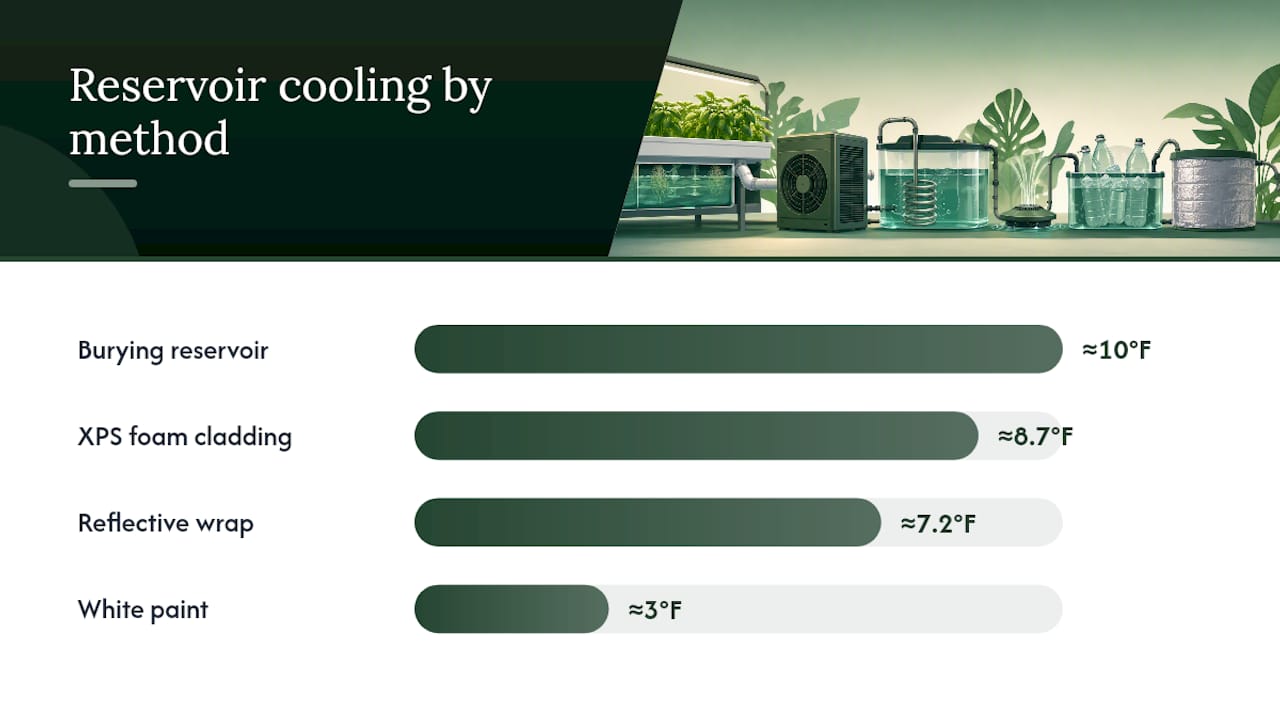
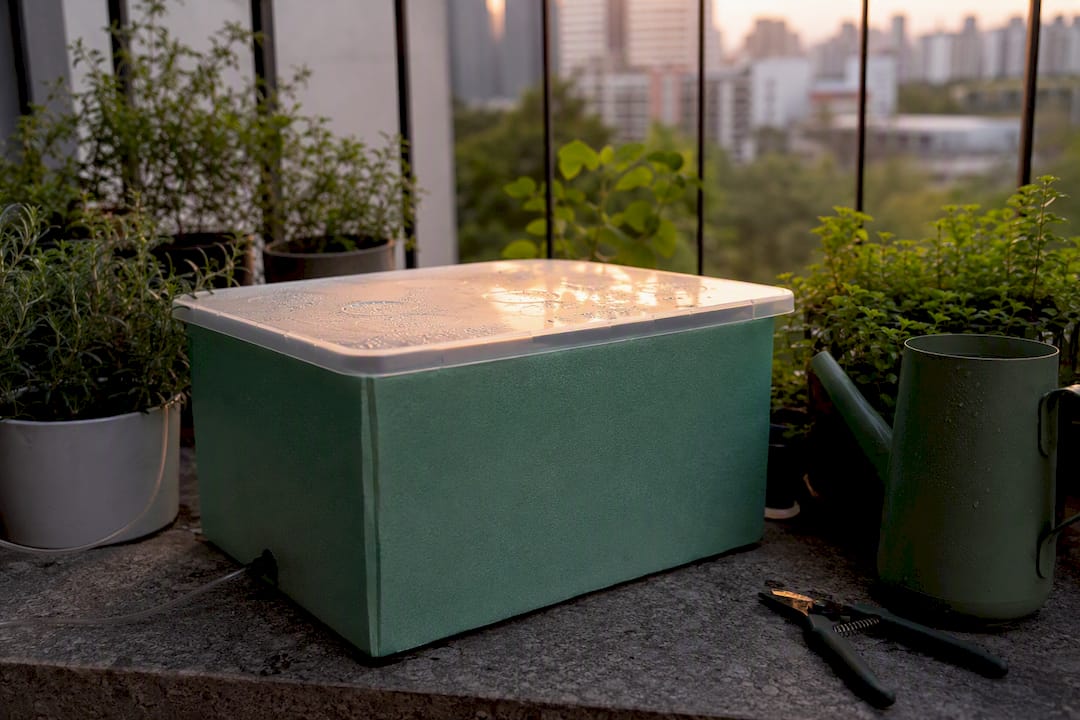
Passive methods come first. Full insulation, meaning walls, lid, and floor, is the baseline. An experiment testing several passive approaches found that XPS foam cladding lowered reservoir temperature by about 8.7°F, while burying the reservoir in the ground dropped it by roughly 10°F. Reflective wrap knocked off about 7.2°F, and painting the reservoir white shaved off around 3°F. Insulating the floor matters as much as the sides. A reservoir sitting directly on cold concrete loses that heat advantage fast, and it’s a step most growers skip.
Active options step in when passive measures aren’t enough. Water chillers pull heat out mechanically and work well for hot climates or grow tents running warm lights, though they draw meaningful power. Aquarium heaters with external thermostats handle the opposite problem. The safer approach is slow, uniform heating: size the heater to your reservoir volume, place it near an air stone to circulate the warm plume, and keep the thermostat probe on the opposite side, according to SmartHydroLab’s cold-weather guidance. Larger commercial operations sometimes tap geothermal or groundwater loops as a heat exchanger, which cuts running costs significantly at scale.
Avoid ice bottles as a routine fix. Dropping ice straight into a reservoir causes a rapid temperature swing that can shock the plant. One test documented wilting that took over a week to recover from after a sudden ice-driven drop. Good circulation and aeration help stabilize whatever setpoint you land on, regardless of method.
| Method | Typical effect | Best for |
|---|---|---|
| Full insulation (walls, lid, floor) | Stabilizes existing temperature | All growers, first step |
| XPS foam cladding | About 8.7°F drop | Hot climates, DWC |
| Burying reservoir | About 10°F drop | Outdoor or garage setups |
| Reflective wrap | About 7.2°F drop | Budget cooling |
| Water chiller | Precise, adjustable cooling | Commercial, hot regions |
| Aquarium heater + thermostat | Precise, adjustable warming | Cold climates, winter |
Pro Tip: Insulate before you buy a chiller. Growers who skip insulation often end up running a chiller nonstop just to fight heat that better insulation would have blocked for free.
Act on the numbers, not on a hunch, and move fast once you’re outside 65 to 72°F.
Sprout-lab treats insulation and continuous monitoring as the two highest-return changes a home grower can make, ahead of any mechanical chiller purchase.
Explore Sprout-lab’s hydroponic equipment for reservoir setups built with insulation and sensor placement already considered.
Getting reservoir temperature right is mostly a setup problem, not an ongoing chore, once insulation and a reliable probe are in place. Sprout-lab’s automated hydroponic setups are built for growers who want the 68 to 72°F sweet spot without babysitting a thermometer every few hours. If you’re starting from a bare reservoir, the beginner’s guide to reservoir hydroponic systems walks through probe placement and insulation in the order that gives you the most benefit for the least effort.
Most advice on hydroponic water temperature obsesses over chillers and controllers, and that’s backward for the average grower. The experiment data on passive cooling tells a plainer story: insulation and reservoir placement solve most of the problem before you spend a dollar on active equipment. A chiller matters once you’re fighting a hot grow tent or a commercial-scale system, but for a home DWC bucket in a spare room, foam board and a lid do most of the work.
The overlooked piece is monitoring, not intervention. Growers chase the perfect setpoint number while running a probe jammed against the heater, producing readings that lie to them daily. Fix the measurement first. A stable, correctly measured 70°F beats a chased, badly measured 68°F every time, because your pH and EC numbers only mean something once temperature stops drifting under them.
If I had to rank the fixes, insulation and proper probe placement come before any purchase decision. Everything else, chillers, heaters, fuzzy logic controllers, is fine tuning on top of a foundation most guides skip entirely.
— Luna
Yes, though the mechanism differs from soil. Overly frequent flooding or a reservoir that never drains oxygen properly can suffocate roots, especially in warm water where dissolved oxygen is already low.
No, 70°F (21°C) sits inside the ideal 65 to 72°F range for most hydroponic crops and is close to the 68 to 72°F sweet spot. It only becomes a problem if the reservoir keeps climbing past 72 to 75°F.
Plants need light to photosynthesize, but it doesn’t have to be sunlight. Many indoor hydroponic setups run entirely on grow lights, which also helps growers control heat load on the reservoir more precisely than sunlight allows.
The main drawbacks are upfront equipment cost, dependence on stable power for pumps and temperature control, a steeper learning curve around water chemistry, faster spread of root diseases if temperature or sanitation slips, and less forgiveness for equipment failures compared with soil.
Check at least twice daily, and more often during heat waves or cold snaps, since reservoir temperature can shift several degrees within hours depending on ambient conditions and equipment load.