Free shipping for order over $50

Free shipping for order over $50
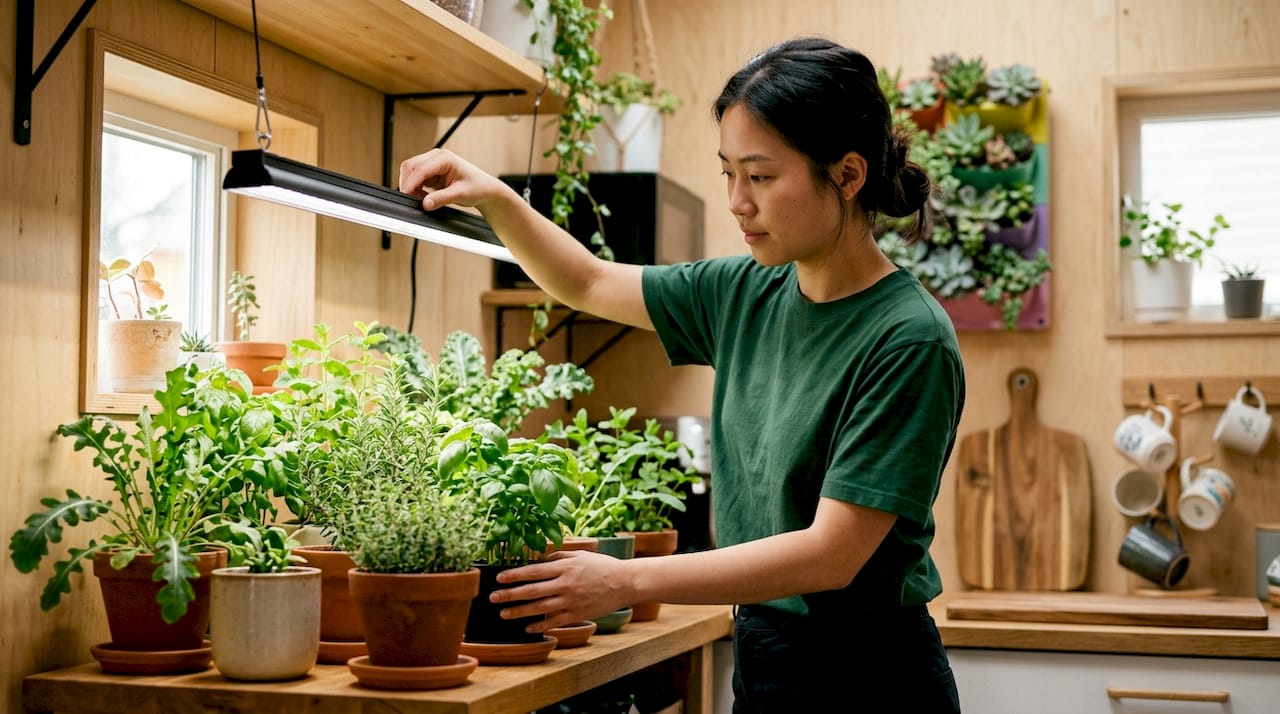
Grow lights are defined as artificial light sources engineered to supply plants with photosynthetically active radiation (PAR), the specific light spectrum that drives photosynthesis. The role of grow lights indoors is to replace or supplement natural sunlight when windows, seasons, or building layouts leave plants starved for light. Modern full-spectrum LED grow lights now deliver the blue and red wavelengths plants need while running efficiently enough for apartment living. Whether you grow herbs on a kitchen shelf or tropical aroids in a windowless room, understanding how artificial lighting works is the foundation of every successful indoor plant lighting setup.
Plants convert light into energy through photosynthesis, and not all light does the job equally well. Plants absorb blue light in the 400–500nm range for compact, leafy vegetative growth, and red light in the 600–700nm range to trigger flowering and fruiting. Full-spectrum lights combine these with green and far-red wavelengths for balanced growth across the entire plant life cycle. Standard household LED bulbs lack the intensity and spectrum range for sustained growth, which is why dedicated grow lights produce noticeably better results.
Light intensity matters as much as spectrum. The industry measures usable intensity in PPFD (photosynthetic photon flux density), which tells you how many light particles hit a square meter of leaf surface per second. For most houseplants, a 20–40 watt LED grow light positioned 12–24 inches above the plant delivers sufficient growth energy. High-light species like succulents and fruiting herbs need the light source moved to 8–12 inches to reach adequate PPFD.
Photoperiod, the daily balance of light and dark, controls flowering, dormancy, and overall plant health. Experts recommend 10–18 hours of light per day for most plants, with a mandatory dark period every night. Running grow lights continuously for 24 hours causes stress and actively inhibits flowering in many species. That dark window is when plants respire, process nutrients, and prepare for the next growth cycle.
Key lighting variables to track:
Pro Tip: Set a mechanical or digital timer the day you install your grow light. A timer costs as little as $6–$10 and removes the single biggest cause of plant stress: inconsistent light cycles.
Three technologies dominate the indoor grow light market: LED, fluorescent (T5 and T12 tubes), and HID (high-intensity discharge) lamps. Each suits a different use case, budget, and plant type.
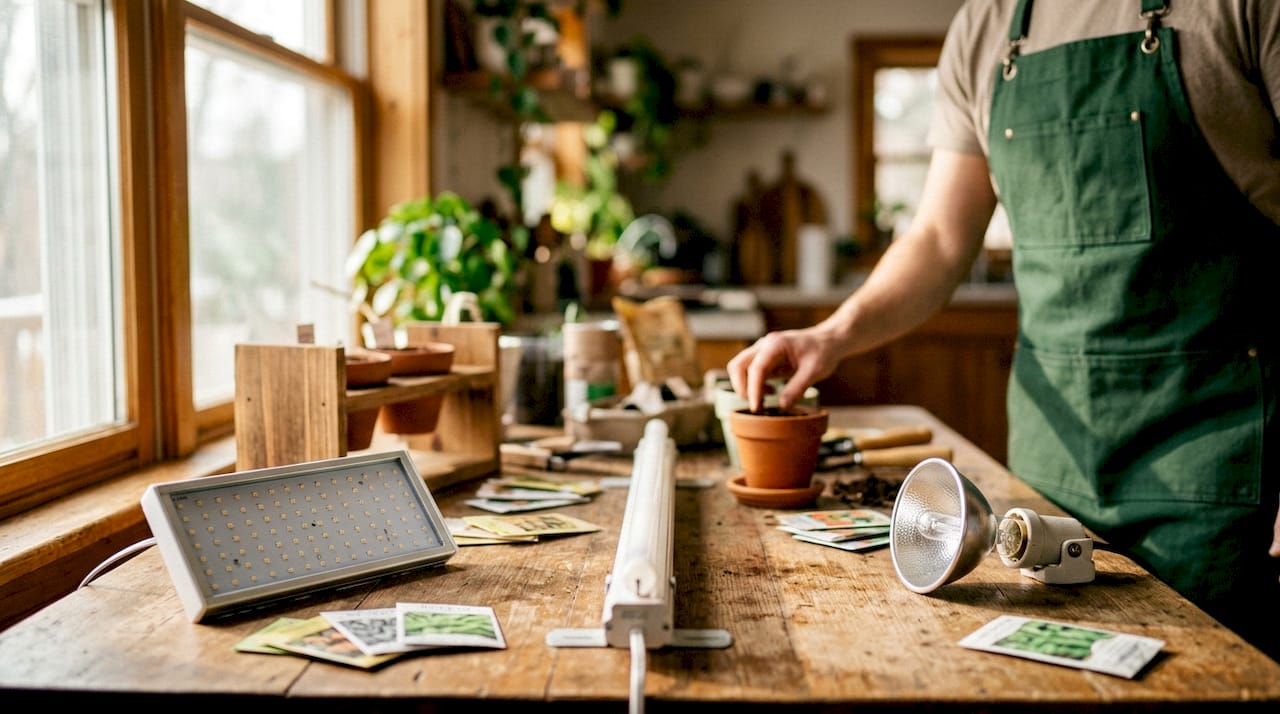
| Light type | Best use | Energy use | Lifespan | Heat output |
|---|---|---|---|---|
| Full-spectrum LED | All plant types, living spaces | Low | 50,000+ hours | Very low |
| T5 fluorescent | Seedlings, low-light herbs | Medium | 20,000 hours | Low |
| T12 fluorescent | Budget seed starting | Medium-high | 10,000 hours | Low-medium |
| HID (MH/HPS) | Large grow rooms, high-light crops | High | 10,000–24,000 hours | High |
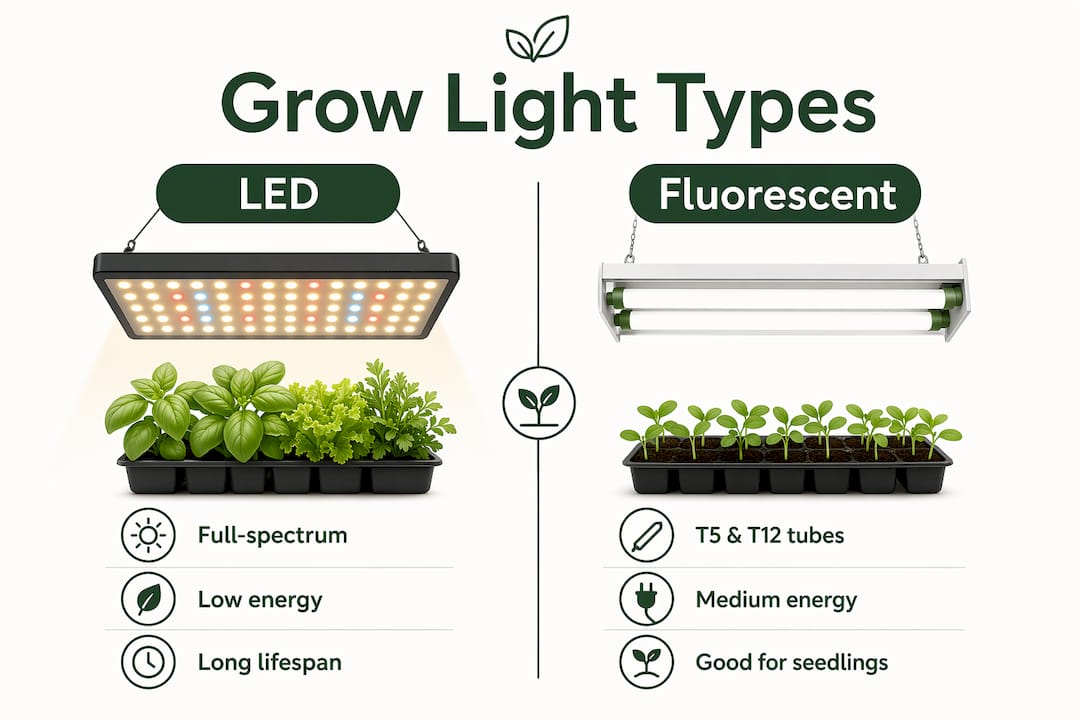
Modern LED grow lights last more than 50,000 hours and consume far less electricity than older technologies. That lifespan translates to roughly 13 years of daily 10-hour use before replacement. For urban gardeners in apartments, that efficiency matters both for electricity bills and for heat management in small rooms.
The biggest misconception in home grow lighting is that purple “blurple” lights are necessary or superior. Full-spectrum white LED grow lights deliver the same blue and red wavelengths plants need while producing a pleasant, natural-looking light that does not turn your living room into a nightclub. Aesthetics are a real consideration when your grow light sits in a shared living space, and full-spectrum white LEDs solve that problem without sacrificing plant performance.
Fluorescent T5 tubes remain a solid choice for seed starting and low-light herbs because they spread light evenly across a wide area. HID lights produce intense output suited to large dedicated grow rooms but generate significant heat and draw too much power for most apartments. For the majority of urban indoor gardeners, a quality full-spectrum LED panel is the right starting point.
Pro Tip: Check the light’s color rendering index (CRI) before buying. A CRI above 90 means the light looks natural to human eyes, which matters when the fixture lives in your kitchen or living room.
Light intensity drops off sharply with distance. The inverse-square law means that doubling the distance between your light and your plant reduces intensity to one quarter of its original value. Small adjustments in height produce large changes in how much usable light your plant actually receives.
Practical placement by plant category:
Timers are non-negotiable for consistent results. A timer is the most impactful accessory after the grow light itself, replicating the natural photoperiod that plants evolved to follow. Without one, missed or extended light periods accumulate into real stress over weeks.
Reading your plant tells you more than any meter. Leggy, stretched stems reaching toward the light signal the source is too far away or too dim. Yellowing or bleached leaves near the top indicate the light is too close or too intense. Healthy plants under correct lighting show compact growth, deep color, and steady new leaf production.
Integrating grow lights into tight urban spaces takes creativity. Clip-on LED panels attach to shelving units and angle toward plants without taking up floor space. Pendant-style grow lights hang from ceiling hooks and double as room lighting. For indoor gardening in small spaces, vertical shelving with one grow light per level lets you grow 10 to 20 plants in the footprint of a single bookcase.
Pro Tip: Raise your grow light as your plant grows taller. A fixed-height setup that works for a seedling will burn the canopy of a mature plant three months later.
Not every plant needs a grow light, and buying one for the wrong species wastes money. Low-light plants like Pothos and Snake Plants thrive in dim conditions and do not require supplemental lighting, though they will grow faster and produce more vibrant foliage under a grow light.
Plants that see the biggest gains from artificial lighting:
Grow lights also prevent winter dormancy in plants that would otherwise slow or stop growing during short-day months. A consistent 14-hour photoperiod in december or january keeps tropical plants in active growth, which matters if you are growing food in an apartment year-round.
Incorrect lighting causes its own problems. Too much intensity bleaches leaves and causes tip burn. Too little produces etiolation, where stems stretch thin and weak toward any available light source. Flowering plants kept under continuous light fail to bloom because many species require a dark period to trigger the hormonal shift that initiates flower production.
Energy cost is a real factor. A 40-watt LED running 14 hours a day uses roughly 0.56 kilowatt-hours daily. At average US electricity rates, that amounts to a modest monthly cost that most urban gardeners find worthwhile for year-round harvests. Scaling to multiple lights requires a quick calculation before you commit to a setup.
Grow lights are the single most effective tool for enabling healthy plant growth in low-light urban spaces, provided you match spectrum, intensity, and photoperiod to your plant’s actual needs.
| Point | Details |
|---|---|
| Spectrum drives growth | Blue light builds foliage; red light triggers flowering. Full-spectrum LEDs deliver both. |
| Distance is critical | Light intensity drops by 75% when you double the distance. Keep most plants 12–24 inches from the source. |
| Timers prevent stress | Running lights 10–18 hours with a mandatory dark period replicates natural photoperiods and protects plant health. |
| LEDs are the best choice | Full-spectrum white LEDs last 50,000+ hours, run cool, and look natural in living spaces. |
| Match light to plant | Low-light species like Pothos need no grow light. High-light tropicals and fruiting plants gain the most from supplemental lighting. |
The most common mistake I see urban gardeners make is buying a grow light and then placing it too high. They read “12–24 inches” and default to 24 inches for every plant in the room. Then they wonder why their basil is leggy and their Monstera refuses to push new leaves. Distance is not a suggestion. It is the variable that determines whether your light is actually working.
The second thing I’ve learned is that full-spectrum white LEDs changed everything for apartment growers. The old purple blurple lights worked, but they made every room look like a grow operation. Guests noticed. Landlords noticed. White full-spectrum panels look like normal lighting and grow plants just as well. That shift made it socially acceptable to have a grow light in a living room, which opened up a lot of space options that were previously awkward.
Timers are the most underrated piece of equipment in any indoor garden. I spent two years manually switching lights on and off before I bought a $9 mechanical timer. The difference in plant consistency was immediate. Consistent photoperiods produce consistent growth. That is not a theory. It is what you see when you compare a timed setup to a manual one over three months.
The Royal Horticultural Society recommends using plant condition rather than technical metrics to judge lighting success. That advice is correct. Watch your plants. Compact growth, deep color, and steady new leaves mean your setup is working. Stretched stems and pale color mean something needs to change. The plant always tells you the truth.
— Luna
Grow lights solve the light problem. Sprout-lab solves the rest of the growing equation for urban gardeners who want results without complexity.
Sprout-lab’s modular hydroponic systems are built for exactly the kind of compact, light-optimized setups this article describes. Their systems fit in apartments, work alongside full-spectrum LED panels, and let you grow up to 56 plants in a small footprint. With a 4.9/5 star rating from over 25,000 completed orders, Sprout-lab has a proven track record with urban growers who need reliable results in limited space. If you are ready to pair effective lighting with a growing system designed for your environment, Sprout-lab is the logical next step.
Grow lights supply plants with photosynthetically active radiation (PAR) when natural sunlight is insufficient. They replicate the blue and red wavelengths that drive photosynthesis, vegetative growth, and flowering.
Most plants need 10–18 hours of light per day with a mandatory dark period. Running lights for 24 hours causes stress and prevents flowering in many species.
No. Low-light species like Pothos and Snake Plants thrive without supplemental lighting. Grow lights deliver the biggest benefits to high-light plants like fruiting vegetables, herbs, and tropical aroids in dim spaces.
Full-spectrum white LED grow lights are the best choice for most apartment gardeners. They last 50,000+ hours, run cool, consume little electricity, and produce natural-looking light that suits shared living spaces.
Position most houseplants 12–24 inches below the light source. High-light species like succulents need the light moved to 8–12 inches. Light intensity drops sharply with distance, so small adjustments produce large changes in plant growth.