Free shipping for order over $50

Free shipping for order over $50
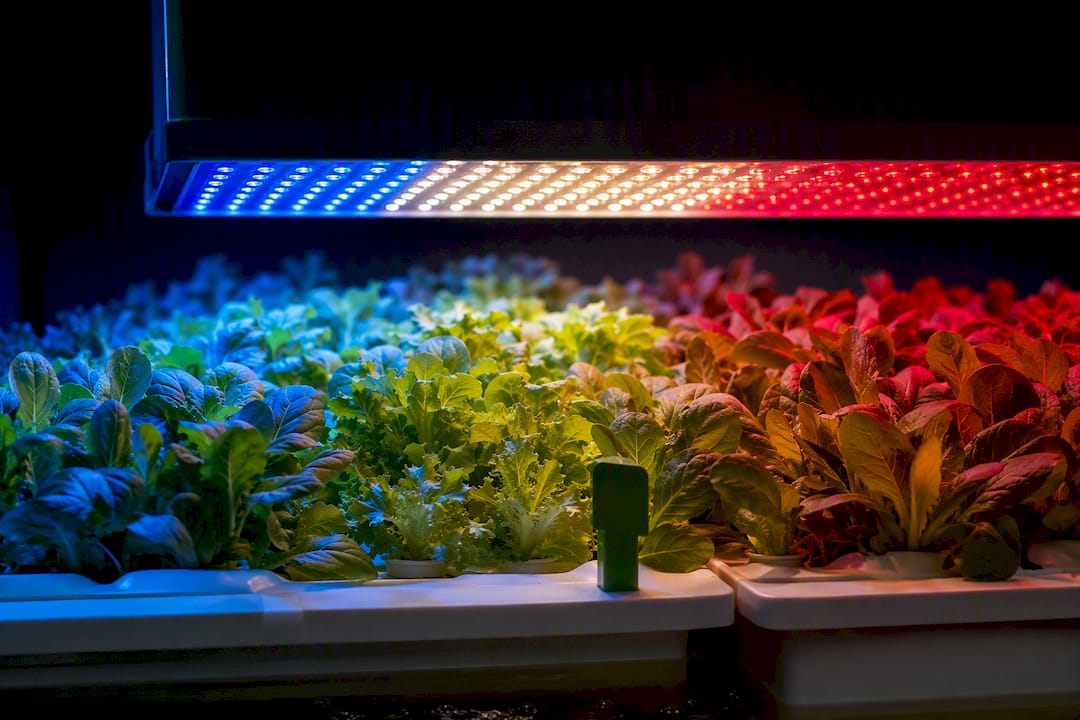
For most sole-source indoor setups, use a full-spectrum white LED panel with a 660 nm red boost, and add far-red only when you want to trigger flowering or the Emerson Effect. PAR (photosynthetically active radiation, 400 to 700 nm) is the light plants actually use for photosynthesis. This baseline is backed by a peer-reviewed spectrum review in HortScience, extension guidance from UGA, and what Sprout-lab builds into its own hydroponic lighting.
TL;DR:
- Narrow-band red and blue LEDs offer higher efficiency but lack coverage for canopy penetration and morphology, making full-spectrum white LEDs better for most indoor setups.
- The optimal spectral composition shifts with plant stages: blue for seedlings, full spectrum with some red and far-red for flowering, and specific red boosts for fruiting crops.
- Measurements like PPFD and PPE are crucial for assessing fixture performance, with continuous spectral coverage and realistic hang-height data indicating better quality grow lights.
- Using a full-spectrum panel with a 660 nm red boost simplifies setup and ensures coverage across growth phases without dependence on narrow-band blurple lights.
- Small-scale, integrated hydroponic systems often feature spectrum-matched lighting, reducing complexity and helping growers avoid the pitfalls of mismatched spectra and insufficient PPFD.
Plants don’t see light the way you do. They respond to specific wavelength bands through distinct pigments and photoreceptors, and each band produces a different physical or biochemical outcome.
Blue light (400 to 500 nm) drives strong chlorophyll absorption and controls stomatal opening, the pores that regulate gas exchange. It also keeps growth compact by suppressing excessive stem stretch, which is why blue-heavy setups are common for seedling trays.
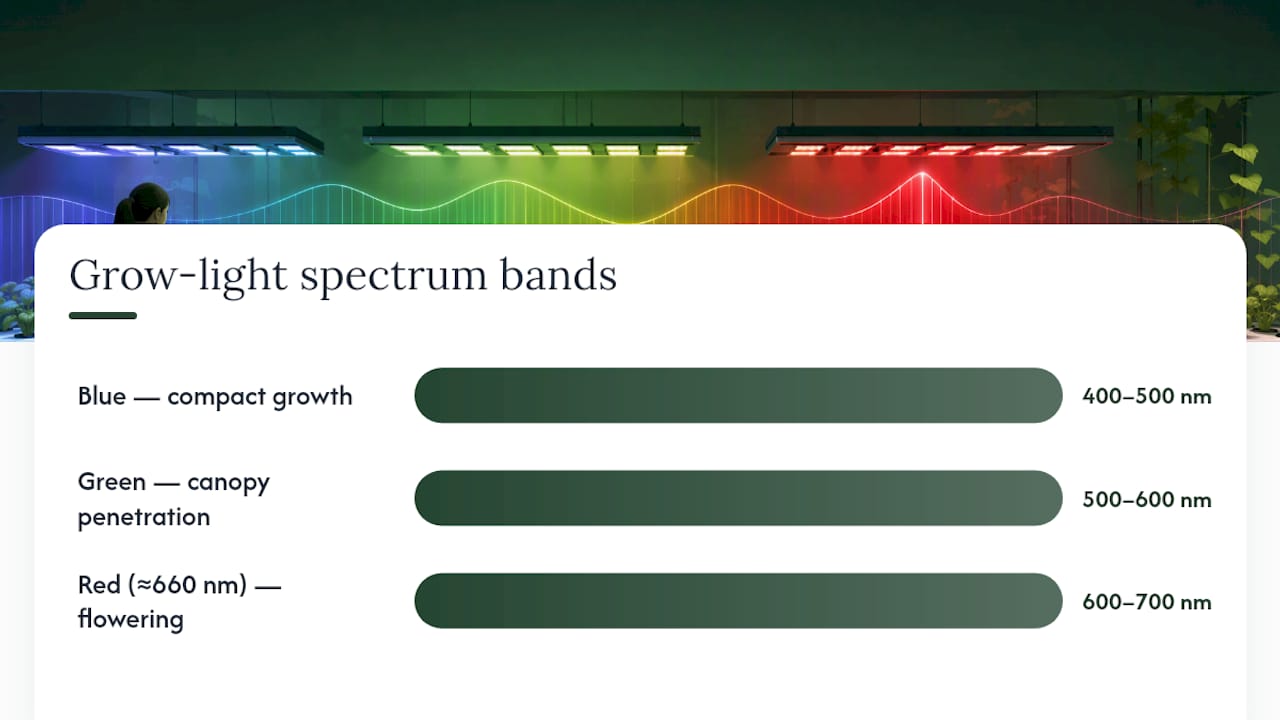
Green light (500 to 600 nm) gets dismissed too often. It penetrates deeper into a leaf canopy than blue or red, reaching lower mesophyll layers and contributing meaningfully to whole-canopy photosynthesis in denser plantings.
Red light (600 to 700 nm) is the workhorse. Red and blue are the primary wavelengths plants use for photosynthesis, with red driving efficient carbon fixation and playing an outsized role in flowering and fruiting. Deep red around 660 nm is the specific wavelength most fixtures target for this boost.
Far-red light (700 to 750+ nm) sits just outside classic PAR, but it matters enormously. It works through phytochrome, the pigment that tells a plant whether it’s shaded by neighbors, triggering shade-avoidance responses like stem elongation. Combined with red light, far-red can actually increase gross photosynthesis beyond what red alone achieves. Researchers call this the Emerson Enhancement Effect.
UV light (below 400 nm) triggers secondary metabolite production, things like flavonoids and anthocyanins tied to flavor, pigmentation, and stress defense. Use it sparingly and briefly. Most home growers don’t need dedicated UV diodes at all.
One caution worth flagging early: university trials have documented “red light syndrome,” a set of negative morphological outcomes when plants grow under narrow-band red or blue alone. Broad-spectrum white light corrects it.
Lumens measure brightness to the human eye. They tell you almost nothing about how much usable light a plant receives, which is why growers rely on photon-based metrics instead.
When you read a spectral chart (an SPD, or spectral power distribution), look for continuous coverage across the curve rather than isolated spikes. A PPFD map paired with a hang height tells you what a fixture actually delivers at your canopy, not just what it claims at the diode.
Blurple lights, the narrow-band red and blue combination that gave early LED grow lights their purple glow, were built around a simple efficiency argument: red and blue are the wavelengths chlorophyll absorbs most strongly, so why waste electricity on anything else? The logic holds up in a lab. It falls apart in a grow room.
There’s a human factor too, and it rarely makes it into spec sheets. Working under blurple light for hours is genuinely unpleasant, and it makes spotting nutrient deficiencies or pest damage almost impossible since the light itself distorts leaf color. Full-spectrum white light lets you actually see your plants.
Pro Tip: If you’re torn between the two, default to full spectrum for anything you’re growing indoors as the sole light source. Save red/blue setups for greenhouse supplementation or single-crop leafy green production where budget is the deciding factor.
Spectrum needs shift as a plant moves through its life cycle, and matching the recipe to the stage prevents two of the most common indoor growing mistakes: leggy seedlings and weak flowering.
If you’re setting up a compact hydroponic system indoors, matching spectrum to stage matters more in tight spaces, where you can’t simply move plants closer to a window for extra red on cloudy days.
A lot of “full spectrum” marketing copy describes a light that’s really just blurple with a thin white coating. Here’s what separates a genuinely usable fixture from a label:
If a product page won’t show you the SPD, assume the spectrum isn’t something the manufacturer wants you scrutinizing.
Hydroponic systems are designed for small footprint cultivation, often paired with soil mixes and lighting matched to plant needs.
Start with a neutral 4000 to 5000 K full-spectrum panel plus a 660 nm red boost. That combination covers seedling through flowering stages without constant swapping. Test it on a small group of plants before committing your whole setup, and track PPFD alongside spectrum, since even the right spectrum underperforms at the wrong intensity. Spectrum is one lever. Photoperiod, nutrient balance, and airflow still decide whether that light gets used well.
— Luna
Piecing together spectrum charts, PPFD maps, and diode ratios yourself takes real effort, and most standalone grow lights leave you guessing whether the fixture you bought actually matches your plants’ stage. Some compact hydroponic systems have built-in lighting matched to seedling, vegetative, and flowering needs, reducing guesswork.
Units often pair full-spectrum coverage with a red-diode boost, integrated into systems designed to handle nutrients and space constraints for multiple plants. You get the light recipe without sourcing panels, diode specs, or hang-height charts separately. Interested readers can explore automated hydroponic setups built for urban growers and evaluate which configuration fits their space.
For general indoor gardening habits that pair well with any lighting setup, these urban gardening tips cover the basics worth knowing before you scale up.
A full-spectrum white LED with a 660 nm red boost works best for most sole-source indoor setups, since it covers photosynthesis, morphology, and canopy penetration in one fixture.
Narrow-band light with no blue or red balance causes the poorest outcomes; growing under red or blue alone has been linked to abnormal leaf and stem development known as red light syndrome.
Neither is strictly better; 4000 to 5000 K gives a balanced, neutral white that works across growth stages, while higher color temperatures skew bluer and suit seedling or vegetative phases more than flowering.
Red light around 660 nm drives the most efficient photosynthesis and flowering response, but it performs best paired with blue for morphology and green for canopy-level light penetration rather than used alone.